
Lifetime Risk of Maternal Death 2009
Lifetime risk of maternal death indicates the probability a woman will die from maternal causes. High values signal poor maternal health.
Newer data is available: Lifetime Risk of Maternal Death by country 2023 →
Where does your country rank? Pick it to see its position.
Related Health statistics
More ↓Interactive Map
Complete Data Rankings
Rank | Actions | ||
|---|---|---|---|
1 |  Chad | 8.497 % | |
2 |  Somalia | 6.807 % | |
3 |  Nigeria | 5.959 % | |
4 |  Afghanistan | 5.663 % | |
5 |  Sierra Leone | 5.359 % | |
6 |  Central African Republic | 5.351 % | |
7 |  Niger | 4.812 % | |
8 |  South Sudan | 4.22 % | |
9 |  Lesotho | 4.167 % | |
10 |  Guinea | 4.01 % | |
11 |  Mali | 3.738 % | |
12 |  Guinea-Bissau | 3.672 % | |
13 |  Congo, Democratic Republic of the | 3.66 % | |
14 |  Burundi | 3.653 % | |
15 |  Liberia | 3.444 % | |
16 |  Ethiopia | 3.332 % | |
17 |  Gambia | 3.216 % | |
18 |  Benin | 3.143 % | |
19 |  Côte d'Ivoire | 3.044 % | |
20 |  Cameroon | 3.04 % | |
21 |  Malawi | 2.81 % | |
22 |  Eswatini | 2.731 % | |
23 |  Mauritania | 2.627 % | |
24 |  Tanzania | 2.614 % | |
25 |  Madagascar | 2.546 % | |
26 |  Burkina Faso | 2.422 % | |
27 |  Eritrea | 2.286 % | |
28 |  Togo | 2.221 % | |
29 |  Senegal | 2.178 % | |
30 |  Timor-Leste | 2.176 % | |
31 |  Zambia | 2.158 % | |
32 |  Zimbabwe | 2.148 % | |
33 |  Angola | 2.08 % | |
34 |  Uganda | 1.946 % | |
35 |  Congo | 1.94 % | |
36 |  Mozambique | 1.916 % | |
37 |  Sudan | 1.91 % | |
38 |  Rwanda | 1.881 % | |
39 |  Namibia | 1.824 % | |
40 |  Ghana | 1.468 % | |
41 |  Comoros | 1.446 % | |
42 |  Equatorial Guinea | 1.365 % | |
43 |  Haiti | 1.358 % | |
44 |  Papua New Guinea | 1.159 % | |
45 |  Nauru | 1.156 % | |
46 |  Laos | 1.148 % | |
47 |  Pakistan | 1.102 % | |
48 |  Kenya | 0.97 % | |
49 |  Marshall Islands | 0.912 % | |
50 |  Nepal | 0.859 % | |
51 |  Sao Tome and Principe | 0.848 % | |
52 |  Djibouti | 0.839 % | |
53 |  Bangladesh | 0.798 % | |
54 |  Yemen | 0.75 % | |
55 |  Cambodia | 0.734 % | |
56 |  Solomon Islands | 0.683 % | |
57 |  Bolivia | 0.675 % | |
58 |  Gabon | 0.662 % | |
59 |  Botswana | 0.657 % | |
60 |  Myanmar | 0.598 % | |
61 |  Tuvalu | 0.592 % | |
62 |  Micronesia (Fed. States of) | 0.581 % | |
63 |  Indonesia | 0.574 % | |
64 |  India | 0.561 % | |
65 |  South Africa | 0.544 % | |
66 |  Vanuatu | 0.478 % | |
67 |  Guatemala | 0.477 % | |
68 |  Iraq | 0.474 % | |
69 |  Paraguay | 0.428 % | |
70 |  Philippines | 0.405 % | |
71 |  Samoa | 0.385 % | |
72 |  Guyana | 0.382 % | |
73 |  Suriname | 0.377 % | |
74 |  Morocco | 0.376 % | |
75 |  Kiribati | 0.364 % | |
76 |  Tonga | 0.343 % | |
77 |  Bhutan | 0.301 % | |
78 |  Nicaragua | 0.292 % | |
79 |  Venezuela | 0.265 % | |
80 |  Dominican Republic | 0.252 % | |
81 |  Honduras | 0.242 % | |
82 |  Algeria | 0.229 % | |
83 |  Ecuador | 0.223 % | |
84 |  Peru | 0.221 % | |
85 |  State of Palestine | 0.218 % | |
86 |  Kyrgyzstan | 0.207 % | |
87 |  Mongolia | 0.197 % | |
88 |  Libya | 0.184 % | |
89 |  Jordan | 0.182 % | |
90 |  Jamaica | 0.17 % | |
91 |  Saint Kitts and Nevis | 0.157 % | |
92 |  Colombia | 0.156 % | |
93 |  Bahamas | 0.15 % | |
94 |  Palau | 0.15 % | |
95 |  Cabo Verde | 0.148 % | |
96 |  Argentina | 0.143 % | |
97 |  Panama | 0.141 % | |
98 |  Maldives | 0.135 % | |
99 |  Belize | 0.125 % | |
100 |  Brazil | 0.121 % | |
101 |  Vietnam | 0.121 % | |
102 |  Mexico | 0.12 % | |
103 |  North Korea | 0.12 % | |
104 |  Saint Vincent and the Grenadines | 0.118 % | |
105 |  Egypt | 0.116 % | |
106 |  Fiji | 0.112 % | |
107 |  Seychelles | 0.109 % | |
108 |  Tajikistan | 0.104 % | |
109 |  Georgia | 0.1 % | |
110 |  Uzbekistan | 0.091 % | |
111 |  Dominica | 0.088 % | |
112 |  Saint Lucia | 0.085 % | |
113 |  Tunisia | 0.085 % | |
114 |  Trinidad and Tobago | 0.083 % | |
115 |  Grenada | 0.082 % | |
116 |  El Salvador | 0.08 % | |
117 |  Brunei Darussalam | 0.073 % | |
118 |  Syrian Arab Republic | 0.07 % | |
119 |  Mauritius | 0.069 % | |
120 |  Barbados | 0.061 % | |
121 |  Malaysia | 0.061 % | |
122 |  Cuba | 0.061 % | |
123 |  Kazakhstan | 0.061 % | |
124 |  Sri Lanka | 0.058 % | |
125 |  Antigua and Barbuda | 0.057 % | |
126 |  Costa Rica | 0.055 % | |
127 |  Iran | 0.053 % | |
128 |  China | 0.052 % | |
129 |  Oman | 0.052 % | |
130 |  Azerbaijan | 0.051 % | |
131 |  Thailand | 0.05 % | |
132 |  Turkey | 0.049 % | |
133 |  Armenia | 0.045 % | |
134 |  Chile | 0.04 % | |
135 |  Bahrain | 0.039 % | |
136 |  Saudi Arabia | 0.036 % | |
137 |  Romania | 0.036 % | |
138 |  Republic of Moldova | 0.036 % | |
139 |  Russia | 0.033 % | |
140 |  Uruguay | 0.032 % | |
141 |  Lebanon | 0.031 % | |
142 |  Ukraine | 0.031 % | |
143 |  Latvia | 0.031 % | |
144 |  Turkmenistan | 0.027 % | |
145 |  Puerto Rico | 0.025 % | |
146 |  United States | 0.024 % | |
147 |  Kuwait | 0.021 % | |
148 |  Luxembourg | 0.021 % | |
149 |  Qatar | 0.019 % | |
150 |  Monaco | 0.018 % | |
151 |  New Zealand | 0.018 % | |
152 |  United Kingdom | 0.017 % | |
153 |  Canada | 0.017 % | |
154 |  France | 0.016 % | |
155 |  Hungary | 0.016 % | |
156 |  Serbia | 0.015 % | |
157 |  Estonia | 0.015 % | |
158 |  Albania | 0.014 % | |
159 |  Andorra | 0.014 % | |
160 |  Montenegro | 0.013 % | |
161 |  Cyprus | 0.013 % | |
162 |  Malta | 0.013 % | |
163 |  Lithuania | 0.013 % | |
164 |  Bulgaria | 0.013 % | |
165 |  Ireland | 0.012 % | |
166 |  Finland | 0.012 % | |
167 |  Portugal | 0.011 % | |
168 |  Denmark | 0.011 % | |
169 |  Netherlands | 0.01 % | |
170 |  Israel | 0.01 % | |
171 |  Singapore | 0.01 % | |
172 |  Italy | 0.01 % | |
173 |  San Marino | 0.01 % | |
174 |  Belgium | 0.009 % | |
175 |  Iceland | 0.009 % | |
176 |  Australia | 0.009 % | |
177 |  Bosnia and Herzegovina | 0.009 % | |
178 |  Slovenia | 0.009 % | |
179 |  South Korea | 0.009 % | |
180 |  Switzerland | 0.009 % | |
181 |  North Macedonia | 0.008 % | |
182 |  Sweden | 0.008 % | |
183 |  Croatia | 0.008 % | |
184 |  Japan | 0.007 % | |
185 |  Norway | 0.007 % | |
186 |  Slovakia | 0.007 % | |
187 |  Austria | 0.007 % | |
188 |  Czech Republic | 0.006 % | |
189 |  United Arab Emirates | 0.006 % | |
190 |  Germany | 0.006 % | |
191 |  Spain | 0.006 % | |
192 |  Belarus | 0.005 % | |
193 |  Greece | 0.004 % | |
194 |  Poland | 0.004 % |
- #1Chad
- #2Somalia
- #3Nigeria
- #4Afghanistan
- #5Sierra Leone
- #6Central African Republic
- #7Niger
- #8South Sudan
- #9Lesotho
- #10Guinea
Analysis: These countries represent the highest values in this dataset, showcasing significant scale and impact on global statistics.
- #194Poland
- #193Greece
- #192Belarus
- #191Spain
- #190Germany
- #189United Arab Emirates
- #188Czech Republic
- #187Austria
- #186Slovakia
- #185Norway
Context: These countries or territories have the lowest values, often due to geographic size, administrative status, or specific characteristics.
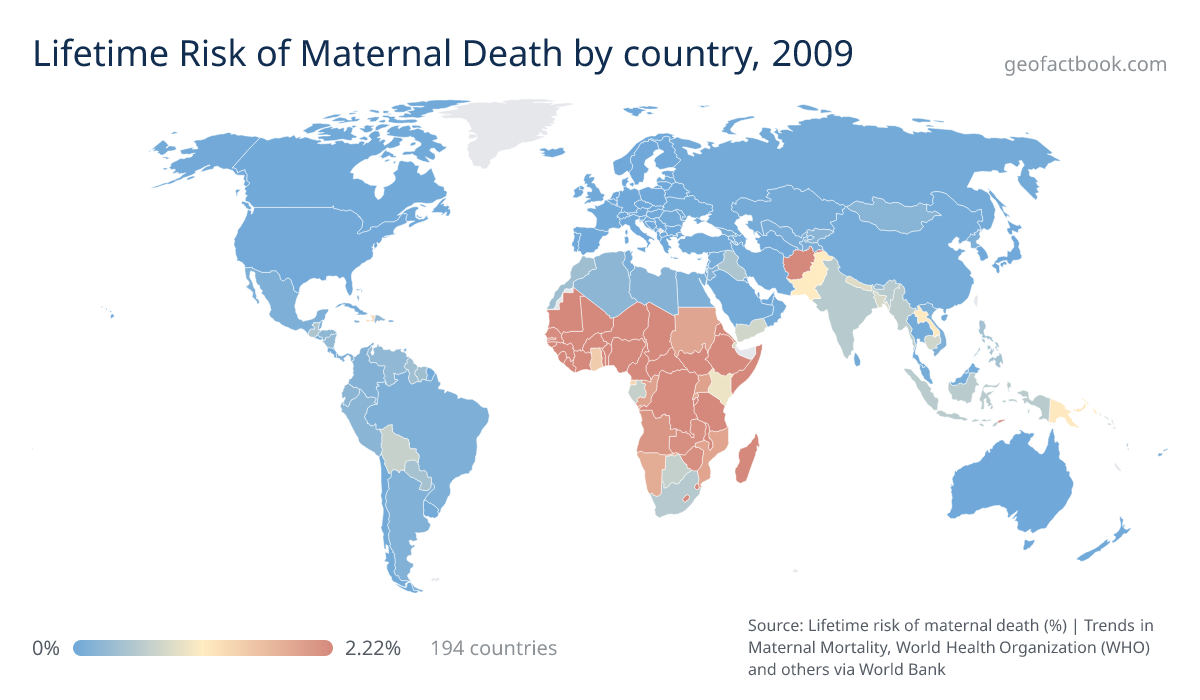
Lifetime Risk of Maternal Death by country, 2009: map image
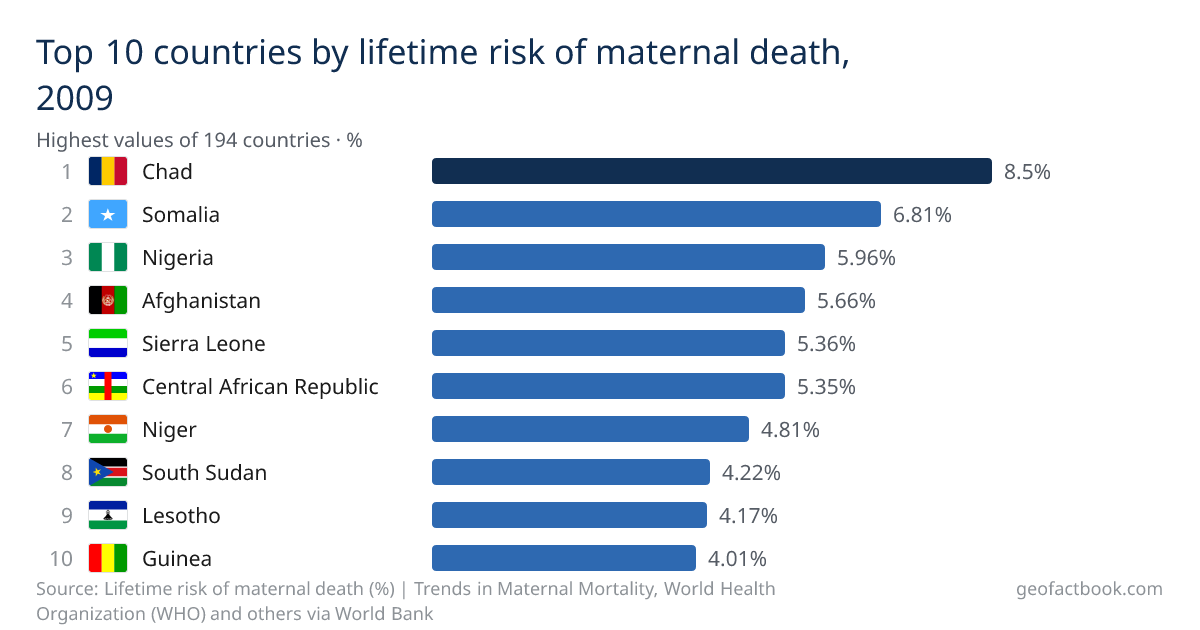
Top 10 countries by lifetime risk of maternal death, 2009: chart
Insights by country
Malaysia
In 2009, Malaysia had a Lifetime Risk of Maternal Death of 0.0609676842860439 %, ranking #121 out of 194 countries. This figure is notably lower than the global average, indicating relatively better maternal health outcomes compared to nations with higher risks. Key factors contributing to this statistic include Malaysia's robust healthcare system, which has seen significant investments in maternal health services, and its relatively high literacy rates, which improve access to health information and services.
Timor-Leste
In 2009, Timor-Leste had a Lifetime Risk of Maternal Death of 2.17565650927724 %, ranking #30 out of 194 countries. This figure is notably higher than the global average, reflecting challenges in maternal healthcare access compared to more developed nations. Key drivers of this statistic include limited healthcare infrastructure and ongoing socioeconomic challenges following years of conflict, which have hindered improvements in maternal health services.
Mexico
In 2009, Mexico had a Lifetime Risk of Maternal Death of 0.120294352943781 %, ranking #102 out of 194 countries. This rate is higher than the global average, indicating significant challenges in maternal health compared to countries with lower risks, such as those in Northern Europe. Contributing factors include disparities in access to quality healthcare, socioeconomic inequalities, and regional variations in health services, which impact maternal care across the country.
Namibia
In 2009, Namibia had a Lifetime Risk of Maternal Death of 1.82421679500785 %, ranking #39 out of 194 countries. This figure is notably higher than the global average, reflecting significant health challenges faced by the country. Contributing factors include limited access to quality healthcare services, especially in rural areas, and socio-economic disparities that affect women's health outcomes.
Venezuela
In 2009, Venezuela had a lifetime risk of maternal death of 0.265194203444075 %, ranking #79 out of 194 countries. This figure is notably higher than that of neighboring Colombia, which has made significant improvements in maternal health care. Contributing factors to this statistic include Venezuela's ongoing economic crisis, which has severely impacted healthcare access and quality, alongside political instability that has hindered effective health policy implementation.
Guinea-Bissau
In 2009, Guinea-Bissau had a Lifetime Risk of Maternal Death of 3.67187031673988 %, ranking #12 out of 194 countries. This figure is significantly higher than the global average, indicating serious maternal health challenges. Contributing factors include limited access to quality healthcare services, high rates of poverty, and political instability, which hinder effective health policy implementation.
Slovakia
In 2009, Slovakia had a Lifetime Risk of Maternal Death of 0.00735836082628482 %, ranking #186 out of 194 countries. This figure is notably higher than many European nations, reflecting challenges in maternal healthcare access compared to regional averages. Contributing factors include Slovakia's healthcare system, which, despite improvements, still faces issues related to rural access and disparities in healthcare quality.
Andorra
In 2009, Andorra had a Lifetime Risk of Maternal Death of 0.0135330718383146 %, ranking #159 out of 194 countries. This figure is significantly lower than that of many countries with higher maternal mortality rates, reflecting Andorra's robust healthcare system. The country's high standard of living, coupled with its comprehensive healthcare policies, contributes to the low risk associated with maternal death.
Romania
In 2009, Romania had a Lifetime Risk of Maternal Death of 0.0355346630537428 %, ranking #137 out of 194 countries. This figure is notably higher than many Western European nations, reflecting disparities in healthcare access and maternal health services. Contributing factors include economic challenges, a legacy of underfunded healthcare systems, and regional disparities in healthcare quality.
Qatar
In 2009, Qatar had a Lifetime Risk of Maternal Death of 0.0190756856697857 %, ranking #149 out of 194 countries. This figure is notably lower than that of many developing countries, reflecting Qatar's advanced healthcare system. The country's wealth, driven by its significant natural gas reserves, enables substantial investment in healthcare infrastructure and maternal health services.
Analysis & Context
In 2009, Chad had the highest Lifetime Risk of Maternal Death at 8.50%, while the global range spanned from 0.00% to 8.50%. The global average for this risk was 0.86%, providing a stark contrast to the highest risk countries.
Understanding the Extremes: High-Risk Countries
The countries with the highest Lifetime Risk of Maternal Death in 2009 were predominantly in Africa, with Chad, Somalia, and Nigeria leading. Chad's risk of 8.50% was the highest recorded, followed by Somalia at 6.81% and Nigeria at 5.96%. These high figures are often linked to inadequate healthcare infrastructure, limited access to maternal health services, and socio-economic challenges. For instance, Nigeria—despite being Africa's largest economy—faces significant disparities in healthcare access, particularly in rural areas.
The common thread among these high-risk countries is a combination of poverty, conflict, and insufficient healthcare systems. In Afghanistan, with a risk of 5.66%, ongoing conflict has severely disrupted healthcare services, impacting maternal health outcomes. Similarly, in Sierra Leone and the Central African Republic, risk levels were above 5%, highlighting the critical need for international support and investment in health systems.
Low-Risk Countries: The Role of Healthcare Systems
At the other end of the spectrum, countries with the lowest lifetime risk values, such as Poland (0.0037%) and Greece (0.0045%), benefit from robust healthcare systems and comprehensive maternal care policies. These nations have established prenatal and postnatal care programs that significantly reduce maternal mortality.
European countries like Spain and Germany also report low risks, at 0.0056% and 0.0059% respectively. The commonality here is the emphasis on universal healthcare coverage and proactive maternal health initiatives, which ensure that women receive necessary medical attention throughout pregnancy and childbirth.
Year-over-Year Changes: Significant Movers
Analyzing year-over-year changes reveals notable trends. Lesotho experienced the most significant increase in risk, rising by 0.52% to 4.17%, a 14.2% increase. This could be attributed to economic instability and limited healthcare resources. Conversely, the Central African Republic saw a significant decrease of 1.17% in its risk, down to 5.35%, which might reflect improved health interventions or external aid efforts.
Other countries like Somalia and Sierra Leone also showed decreases in risk of 4.4% and 5.5% respectively. These reductions suggest positive impacts from international health programs aimed at improving maternal health services.
Economic and Social Drivers of Maternal Mortality
Economic and social factors play a crucial role in determining the Lifetime Risk of Maternal Death. Countries with higher economic stability and investments in public health tend to have lower risks. For example, nations with low risk such as Austria and Norway (0.0067% and 0.0074% respectively) benefit from strong economic frameworks that support comprehensive healthcare systems.
In contrast, high-risk countries like Niger and South Sudan face economic challenges that limit healthcare access and quality. The lack of infrastructure and healthcare funding exacerbates maternal mortality rates, highlighting the need for targeted economic policies and health sector investments.
Addressing maternal mortality requires a multifaceted approach, integrating economic development, healthcare improvements, and policy reforms. The 2009 data underscores the disparities between countries and the critical need for global efforts to ensure maternal health is prioritized worldwide.
Frequently Asked Questions About Lifetime Risk of Maternal Death in 2009
Which country had the highest lifetime risk of maternal death in 2009?
Chad had the highest lifetime risk of maternal death in 2009, with a probability of 8.5%.
What was the average lifetime risk of maternal death across all countries in 2009?
The average lifetime risk of maternal death across all countries in 2009 was 0.86%.
Which country had the lowest lifetime risk of maternal death in 2009?
Poland had the lowest lifetime risk of maternal death in 2009, with a probability of 0%.
What was the median lifetime risk of maternal death in 2009?
The median lifetime risk of maternal death in 2009 was 0.14%.
Can you list the top three countries with the highest lifetime risk of maternal death in 2009?
The top three countries with the highest lifetime risk of maternal death in 2009 were Chad (8.5%), Somalia (6.81%), and Nigeria (5.96%).
What is the range of lifetime risk of maternal death values in 2009?
The range of lifetime risk of maternal death values in 2009 spans from 0% in Poland to 8.5% in Chad.
Data Source
Lifetime risk of maternal death (%) | Trends in Maternal Mortality, World Health Organization (WHO) and others via World Bank
Data produced by Trends in Maternal Mortality, World Health Organization (WHO); UN Children's Fund (UNICEF), note: Trends in Maternal Mortality; UN Population Fund (UNFPA), note: Trends in Maternal Mortality; World Bank Group (WBG), note: Trends in Maternal Mortality, compiled and published by World Bank as "Lifetime risk of maternal death (%)".
Visit Data SourceCite this page
Geo Factbook. (n.d.). Lifetime Risk of Maternal Death by Country, 2009. Retrieved November 29, 2026, from https://geofactbook.com/fact/lifetime-risk-of-maternal-death/2009
The figures on this page come from Lifetime risk of maternal death (%) | Trends in Maternal Mortality, World Health Organization (WHO) and others via World Bank. For academic work, cite the original source as well.
›Embed this ranking on your site
Free to embed with attribution. Shows the top 10 countries and links back to the full ranking.
Historical Data by Year
Explore Lifetime Risk of Maternal Death data across different years. Compare trends and see how statistics have changed over time.
More Health Facts
See all Health facts →Mean Age at First Birth
Mean age at first birth indicates maternal age trends. Compare countries, explore rankings, and see historical shifts with interactive maps.
Highest: Andorra32.8Nurses and Midwives Density
Nurses and midwives density measures healthcare accessibility. Learn about countries with the highest and lowest density per 1,000 people.
Highest: Norway16.51 per 1,000 peopleAccess to Safe Drinking Water
Access to safe drinking water measures the percentage of a population with reliable, clean water sources.
 Highest: Bonaire, Sint Eustatius and Saba100%
You might also like
Currently married (Percent)
FeaturedThe percentage of currently married individuals by country highlights societal trends in family structure and relationships. Understanding these statistics can provide insights into cultural norms and demographic shifts, influencing policies and social programs.
Highest: Bangladesh81.95%Total population
FeaturedDiscover the latest total population statistics for every country and region worldwide. Explore accurate, up-to-date data on global population growth, density, and demographic trends — sourced from trusted international databases like the UN and World Bank. Perfect for researchers, students, and data enthusiasts looking to understand how the world’s population is changing.
Highest: India1.48B personsGross Domestic Product (GDP) by Country in Current US Dollars
FeaturedDiscover the Gross Domestic Product (GDP) by country in current US dollars, a key indicator of economic performance. This statistic reveals the financial health and growth potential of nations, making it essential for investors and policymakers.
Highest: United States32.95T $