
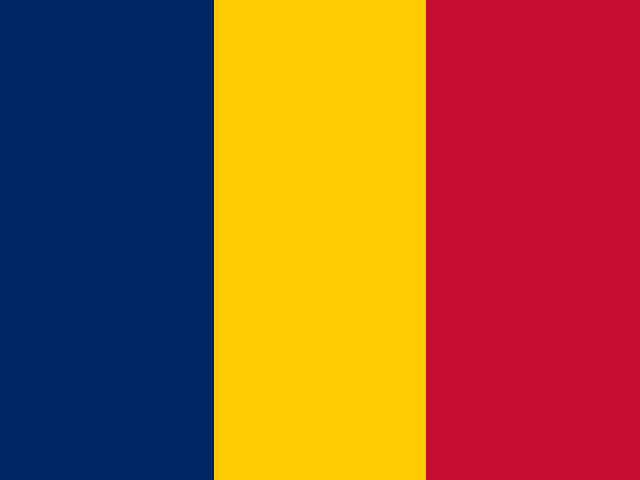
Location
Chad is in Central Africa, south of Libya. It shares land borders with Central African Republic (1,556 km), Sudan (1,403 km), Niger (1,196 km), Cameroon (1,116 km), Libya (1,050 km) and Nigeria (85 km) and is landlocked. The capital is N'Djamena.
Chad population 2026: 21.71 Million — growth, rank & history →Key Statistics for 2026
Total population
Population Change
Median age of population
Population density
Life expectancy at birth
Agricultural land
Average Female Breast Size by Country: Worldwide Data & Rankings
Female population of reproductive age
Health Care Spending per Capita
Learning-adjusted years of school
Length of paid parental leave for mother
History
The history of Chad is rich and complex, tracing back to ancient times when it was inhabited by various ethnic groups and civilizations. The region was home to some of the earliest human settlements, with evidence of habitation dating back to the Paleolithic era. By the first millennium BCE, the area saw the emergence of the Kanem Empire, one of the prominent early states in the region. This empire, established around the 9th century CE, was significant for its trade networks that connected the Sahara to the central African kingdoms, facilitating the exchange of goods such as salt, leather, and slaves.
During the medieval period, Chad experienced a series of transformations influenced by the rise and fall of various empires. The arrival of Islam in the 11th century marked a pivotal change, as the religion spread throughout the region, particularly in the Kanem and later the Bornu Empire, which dominated the northern parts of Chad. The 15th century saw the decline of the Kanem Empire, leading to increased fragmentation and the emergence of smaller chiefdoms. Notably, the Toubou and Sara peoples became prominent during this era, influencing the cultural and political landscape of Chad. The region remained largely autonomous until the arrival of European powers in the late 19th century.
The modern history of Chad began with its colonization by France in the late 1800s, culminating in the establishment of French Equatorial Africa. Chad became a French territory in 1910, leading to significant economic and social changes. The struggle for independence intensified after World War II, and Chad finally achieved independence from France on August 11, 1960. However, the post-independence era was marked by internal conflict and political instability, with a series of coups and civil wars that plagued the nation throughout the 1960s and 1970s.
In recent decades, Chad has faced numerous challenges, including regional conflicts, humanitarian crises, and economic difficulties. The Darfur conflict in neighboring Sudan had spillover effects, leading to an influx of refugees and increased tensions within Chad. The government under President Idriss Déby, who came to power in 1990, navigated these turbulent waters until his death in April 2021, which sparked a transitional period in the country's leadership. Chad’s historical significance lies not only in its rich cultural tapestry but also in its strategic importance in Central Africa, affecting regional stability and international relations. The country's ongoing struggles continue to shape its identity and future prospects.
Geography
Chad is a landlocked country located in north-central Africa, bordered by Libya to the north, Sudan to the east, the Central African Republic to the south, Cameroon and Nigeria to the southwest, and Niger to the west. This strategic location positions Chad at the crossroads of sub-Saharan Africa and the Sahara Desert, making it a significant area for both cultural exchange and geopolitical interests. The country's diverse borders encompass a variety of landscapes, from arid regions in the north to more fertile areas in the south, highlighting the geographical contrasts that define Chad.
The physical features of Chad are marked by a combination of vast plains, mountainous regions, and notable bodies of water. The Adamawa Plateau in the southwestern part of the country features hills and mountains, including the Mount Toubkal, which is the highest peak in Chad. The Chad Basin is characterized by its low-lying terrain, and the country is home to the Chad River, a vital waterway that flows into Lake Chad, one of the largest lakes in Africa. This lake is not only crucial for local ecosystems but also serves as a resource for fishing and agriculture, although it has been shrinking due to climate change and overuse.
Chad experiences a predominantly arid climate, with distinct wet and dry seasons. The northern regions are dominated by the Sahara Desert, characterized by extreme temperatures and minimal rainfall, while the southern regions have a more temperate climate with a rainy season typically occurring from May to October. Average temperatures can reach up to 40 degrees Celsius (104 degrees Fahrenheit) in the summer months, while cooler temperatures prevail during the winter. The variability in climate across different regions contributes to diverse ecological zones, from desert to savannah and forest.
Natural resources in Chad include oil, gold, and various minerals, which play a significant role in the country's economy. The oil industry, in particular, has attracted foreign investment and has the potential to generate substantial revenue. However, environmental challenges persist, including deforestation, soil degradation, and water scarcity exacerbated by climate change. The country's rich biodiversity, which includes species adapted to both desert and savannah environments, is at risk due to these environmental pressures. Efforts to balance economic development with environmental sustainability are crucial for the future of Chad and its natural landscapes.
Government
Chad is a landlocked country located in Central Africa, functioning as a presidential republic. The political system of Chad is characterized by a strong executive branch, where the President serves as both the head of state and the head of government. The current political landscape has been shaped by decades of conflict and instability, influencing the governance structure and the functionality of its institutions. The President of Chad, elected for a five-year term with the possibility of re-election, holds significant powers, including the ability to appoint the Prime Minister and members of the Cabinet.
The structure of government in Chad comprises three branches: the executive, legislative, and judicial. The executive branch is led by the President, who is supported by the Prime Minister and a Council of Ministers. The legislative branch is bicameral, consisting of the National Assembly and the Senate. Members of the National Assembly are elected through a direct electoral process, while Senators are appointed by regional councils. The judicial branch is intended to operate independently, with the Supreme Court serving as the highest court in the land, although its independence has been questioned in the context of political influence and pressure.
Key institutions in Chad include the National Assembly, the Senate, and the Constitutional Council, which oversees the adherence to the constitution and electoral processes. The political landscape is dominated by the ruling party, the Patriotic Salvation Movement (MPS), which has been in power since the 1990s. Opposition parties exist but often face significant challenges, including restrictions on freedom of assembly and expression, which limit their effectiveness in the political arena. This has led to a limited political pluralism, where the ruling party maintains a strong grip on power despite periodic elections.
The electoral system in Chad has been marked by controversies, with allegations of fraud and irregularities during elections. The most recent presidential election was held in April 2021, in which President Idriss Déby was declared the winner, receiving over 79% of the votes. However, this election was boycotted by several opposition parties, reflecting ongoing tensions within the country. The political landscape remains complex, with issues of governance, human rights, and the rule of law continuing to be significant challenges for Chad as it navigates its path toward stability and democratic development.
Economy
The economy of Chad is characterized as a mixed economy, with a significant reliance on agriculture and natural resources. As of 2023, Chad's Gross Domestic Product (GDP) is estimated to be around $12 billion, reflecting a modest growth rate driven largely by its oil sector. The country's economic system is heavily influenced by its historical reliance on subsistence farming and livestock herding, which employ a majority of the population. Despite recent efforts to diversify, oil extraction remains the dominant force in Chad's economy, accounting for over 80% of total export revenues and a large share of government revenue.
Chad's major industries include agriculture, livestock, and oil production. The agricultural sector, which consists mainly of subsistence farming, employs approximately 70% of the workforce and is vital for food security. The oil industry, concentrated in the southern regions, has attracted foreign investment, particularly from China and the United States, leading to increased production levels. Additionally, the mining sector, primarily focused on gold and other minerals, is emerging as a potential growth area, although it remains underdeveloped compared to oil.
In terms of trade relationships, Chad has established partnerships with several countries, primarily for its oil exports. The nation exports crude oil mainly to refineries in the United States, Europe, and Asia, while imports largely consist of machinery, food, and consumer goods from countries like France, Nigeria, and China. As a landlocked country, Chad faces significant logistical challenges, which affect its trade capabilities and increase transportation costs. The government has been working to improve infrastructure, including roads and rail systems, to facilitate trade and enhance economic connections with neighboring countries.
Chad's economy faces several challenges, including political instability, inadequate infrastructure, and vulnerability to climatic changes, which can affect agricultural outputs. Additionally, the country grapples with high levels of poverty and unemployment, with over 40% of the population living below the poverty line. However, opportunities exist in the diversification of its economy, particularly through investment in renewable energy and development of the agricultural sector. By enhancing food production and exploring sustainable practices, Chad has the potential to reduce its reliance on oil and create a more resilient economic framework for future growth.
Culture
The culture of Chad is a vibrant tapestry woven from its diverse ethnic groups, languages, and religions. The country is home to over 200 different ethnic groups, with the largest being the Sara, Arab, and Kanem-Bornu. The official languages of Chad are French and Arabic, reflecting the nation's colonial history and its Islamic heritage. Additionally, numerous indigenous languages are spoken, including Sara and Chadian Arabic. Religion plays a significant role in shaping Chadian society, with approximately 55% of the population identifying as Muslim, primarily Sunni, while around 35% practice Christianity, mainly Roman Catholicism and Protestantism. The coexistence of these religions fosters a rich cultural dialogue and intermingling of traditions.
Chadian customs and traditions are deeply rooted in the daily lives of its people. Traditional ceremonies, such as weddings and initiations, are often elaborate occasions that showcase the unique customs of different ethnic groups. For example, among the Sara people, weddings can last several days and involve vibrant attire, music, and dances that highlight their cultural heritage. In rural areas, communal gatherings and festivals are vital for social interaction, where storytelling, poetry recitation, and traditional games strengthen community bonds. The use of traditional crafts, such as weaving and pottery, is also prevalent, with artisans passing their skills down through generations.
The arts in Chad encompass a rich musical landscape, influenced by both traditional and contemporary styles. Music plays an essential role in cultural expression, with genres like Chadian folk music and modern pop gaining popularity. Instruments such as the *ngoni* (a stringed instrument) and the *djembe* (a drum) are integral to performances, often accompanied by traditional dances that narrate historical events or daily life. Literature, while less represented, has been gaining prominence, with authors like Aminata Sow Fall and others contributing to the narrative of Chadian identity. Oral traditions remain a cornerstone of Chadian literature, with storytelling serving as a means of preserving history and imparting moral lessons.
Chadian cuisine is as diverse as its culture, with staple foods varying by region. Common ingredients include millet, sorghum, and rice, often accompanied by sauces made from vegetables, fish, or meat. A traditional dish, *boko har* (a type of bean cake), is widely enjoyed across the country, reflecting the local agricultural practices and available resources. Daily life in Chad is characterized by a strong sense of community, where families gather to share meals and participate in communal activities. Markets are bustling centers of social life, where people engage in trade and exchange stories, further highlighting the interconnectedness of Chadian society.
About This Data
This page displays comprehensive statistical data for Chad for the year 2026. All data points are sourced from authoritative international organizations and are regularly updated to ensure accuracy and reliability.
Click on any statistic to explore more detailed information, see how Chad compares with other countries, and view historical trends.
Primary Data Sources
CIA World Factbook
Comprehensive country profiles and demographic statistics from the Central Intelligence Agency
Learn moreUnited Nations Statistics
Global demographic data and population projections from UN agencies and research divisions
Learn moreWorld Bank Open Data
Development indicators and comprehensive population metrics from the World Bank database
Learn moreCompare Chad with other countries
Side-by-side comparisons across population, GDP, geography, and more.
Frequently Asked Questions About Chad
Which continent is Chad in?▾
Chad is in Africa, in the Middle Africa subregion according to the UN geoscheme.
What is the population of Chad in 2026?▾
The population of Chad in 2026 is 21,708,287 persons.
What is the total area of Chad?▾
Chad covers approximately 1.28 million square kilometers, making it one of the larger countries in Central Africa.
What is the GDP of Chad in 2026?▾
The Gross Domestic Product (GDP) of Chad in 2026 is 21,754,535,426.28 US dollars.
What is the life expectancy in Chad?▾
The life expectancy at birth in Chad is 58.27 years.
What is the official language of Chad?▾
The official languages of Chad are French and Arabic.
What is the capital of Chad?▾
The capital of Chad is N'Djamena.