
Lifetime Risk of Maternal Death 2017
Lifetime risk of maternal death indicates the probability a woman will die from maternal causes. High values signal poor maternal health.
Newer data is available: Lifetime Risk of Maternal Death by country 2023 →
Where does your country rank? Pick it to see its position.
Related Health statistics
More ↓Interactive Map
Complete Data Rankings
Rank | Actions | ||
|---|---|---|---|
1 |  South Sudan | 6.68 % | |
2 |  Chad | 6.565 % | |
3 |  Central African Republic | 6.318 % | |
4 |  Nigeria | 5.374 % | |
5 |  Somalia | 4.572 % | |
6 |  Afghanistan | 3.47 % | |
7 |  Congo, Democratic Republic of the | 3.07 % | |
8 |  Liberia | 3.062 % | |
9 |  Niger | 2.929 % | |
10 |  Benin | 2.928 % | |
11 |  Mali | 2.817 % | |
12 |  Guinea | 2.757 % | |
13 |  Burundi | 2.59 % | |
14 |  Guinea-Bissau | 2.506 % | |
15 |  Sierra Leone | 2.481 % | |
16 |  Mauritania | 2.227 % | |
17 |  Côte d'Ivoire | 2.215 % | |
18 |  Gambia | 2.046 % | |
19 |  Madagascar | 2.033 % | |
20 |  Togo | 1.901 % | |
21 |  Cameroon | 1.824 % | |
22 |  Tanzania | 1.742 % | |
23 |  Burkina Faso | 1.506 % | |
24 |  Zimbabwe | 1.486 % | |
25 |  Eritrea | 1.485 % | |
26 |  Lesotho | 1.466 % | |
27 |  Ethiopia | 1.418 % | |
28 |  Senegal | 1.417 % | |
29 |  Uganda | 1.277 % | |
30 |  Sudan | 1.255 % | |
31 |  Malawi | 1.252 % | |
32 |  Angola | 1.224 % | |
33 |  Congo | 1.142 % | |
34 |  Rwanda | 1.099 % | |
35 |  Haiti | 1.023 % | |
36 |  Ghana | 1.018 % | |
37 |  Nauru | 1.004 % | |
38 |  Mozambique | 0.984 % | |
39 |  Equatorial Guinea | 0.975 % | |
40 |  Comoros | 0.894 % | |
41 |  Timor-Leste | 0.892 % | |
42 |  Namibia | 0.734 % | |
43 |  Gabon | 0.73 % | |
44 |  Pakistan | 0.73 % | |
45 |  Papua New Guinea | 0.692 % | |
46 |  Kenya | 0.684 % | |
47 |  Yemen | 0.674 % | |
48 |  Zambia | 0.657 % | |
49 |  Solomon Islands | 0.553 % | |
50 |  Tuvalu | 0.547 % | |
51 |  Marshall Islands | 0.54 % | |
52 |  Djibouti | 0.523 % | |
53 |  Nepal | 0.482 % | |
54 |  Micronesia (Fed. States of) | 0.481 % | |
55 |  Eswatini | 0.459 % | |
56 |  Vanuatu | 0.45 % | |
57 |  Sao Tome and Principe | 0.448 % | |
58 |  Bolivia | 0.445 % | |
59 |  Laos | 0.439 % | |
60 |  Myanmar | 0.436 % | |
61 |  Samoa | 0.436 % | |
62 |  Cambodia | 0.43 % | |
63 |  Venezuela | 0.418 % | |
64 |  Bangladesh | 0.408 % | |
65 |  Indonesia | 0.354 % | |
66 |  Guatemala | 0.329 % | |
67 |  Iraq | 0.296 % | |
68 |  Kiribati | 0.295 % | |
69 |  South Africa | 0.292 % | |
70 |  Guyana | 0.281 % | |
71 |  Dominican Republic | 0.248 % | |
72 |  India | 0.246 % | |
73 |  Tonga | 0.242 % | |
74 |  Algeria | 0.238 % | |
75 |  Suriname | 0.234 % | |
76 |  Philippines | 0.214 % | |
77 |  Morocco | 0.2 % | |
78 |  Nicaragua | 0.183 % | |
79 |  Libya | 0.168 % | |
80 |  Paraguay | 0.156 % | |
81 |  Honduras | 0.149 % | |
82 |  Kyrgyzstan | 0.147 % | |
83 |  Jamaica | 0.146 % | |
84 |  Botswana | 0.14 % | |
85 |  Peru | 0.138 % | |
86 |  Belize | 0.138 % | |
87 |  Ecuador | 0.13 % | |
88 |  Palau | 0.13 % | |
89 |  Mongolia | 0.129 % | |
90 |  Jordan | 0.113 % | |
91 |  Colombia | 0.111 % | |
92 |  Saint Kitts and Nevis | 0.11 % | |
93 |  North Korea | 0.11 % | |
94 |  Panama | 0.108 % | |
95 |  Vietnam | 0.105 % | |
96 |  Saint Vincent and the Grenadines | 0.103 % | |
97 |  Bahamas | 0.1 % | |
98 |  Bhutan | 0.098 % | |
99 |  Brazil | 0.098 % | |
100 |  Seychelles | 0.096 % | |
101 |  Cabo Verde | 0.087 % | |
102 |  Mexico | 0.086 % | |
103 |  State of Palestine | 0.084 % | |
104 |  El Salvador | 0.084 % | |
105 |  Uzbekistan | 0.082 % | |
106 |  Fiji | 0.082 % | |
107 |  Mauritius | 0.081 % | |
108 |  Maldives | 0.081 % | |
109 |  Tunisia | 0.081 % | |
110 |  Argentina | 0.079 % | |
111 |  Trinidad and Tobago | 0.074 % | |
112 |  Egypt | 0.071 % | |
113 |  Brunei Darussalam | 0.07 % | |
114 |  Grenada | 0.064 % | |
115 |  Dominica | 0.061 % | |
116 |  Tajikistan | 0.061 % | |
117 |  Syrian Arab Republic | 0.06 % | |
118 |  Saint Lucia | 0.058 % | |
119 |  Malaysia | 0.055 % | |
120 |  Barbados | 0.052 % | |
121 |  Georgia | 0.051 % | |
122 |  Cuba | 0.048 % | |
123 |  Oman | 0.048 % | |
124 |  Costa Rica | 0.044 % | |
125 |  Iran | 0.042 % | |
126 |  Azerbaijan | 0.041 % | |
127 |  Antigua and Barbuda | 0.04 % | |
128 |  Sri Lanka | 0.04 % | |
129 |  Thailand | 0.038 % | |
130 |  China | 0.037 % | |
131 |  Armenia | 0.036 % | |
132 |  Turkey | 0.036 % | |
133 |  Republic of Moldova | 0.034 % | |
134 |  Latvia | 0.034 % | |
135 |  Bahrain | 0.034 % | |
136 |  Lebanon | 0.034 % | |
137 |  Kazakhstan | 0.031 % | |
138 |  United States | 0.028 % | |
139 |  Uruguay | 0.027 % | |
140 |  Romania | 0.024 % | |
141 |  Saudi Arabia | 0.024 % | |
142 |  Luxembourg | 0.019 % | |
143 |  Russia | 0.018 % | |
144 |  Ukraine | 0.018 % | |
145 |  Hungary | 0.017 % | |
146 |  Chile | 0.017 % | |
147 |  Canada | 0.017 % | |
148 |  Turkmenistan | 0.016 % | |
149 |  Serbia | 0.016 % | |
150 |  Puerto Rico | 0.016 % | |
151 |  Cyprus | 0.016 % | |
152 |  Portugal | 0.015 % | |
153 |  Kuwait | 0.015 % | |
154 |  United Kingdom | 0.014 % | |
155 |  Lithuania | 0.013 % | |
156 |  France | 0.013 % | |
157 |  New Zealand | 0.012 % | |
158 |  Montenegro | 0.012 % | |
159 |  Albania | 0.011 % | |
160 |  Qatar | 0.01 % | |
161 |  Andorra | 0.01 % | |
162 |  Finland | 0.01 % | |
163 |  Monaco | 0.01 % | |
164 |  Australia | 0.009 % | |
165 |  Malta | 0.009 % | |
166 |  Israel | 0.009 % | |
167 |  Bulgaria | 0.008 % | |
168 |  Switzerland | 0.008 % | |
169 |  Austria | 0.008 % | |
170 |  Italy | 0.008 % | |
171 |  Estonia | 0.008 % | |
172 |  Bosnia and Herzegovina | 0.008 % | |
173 |  Singapore | 0.007 % | |
174 |  Sweden | 0.007 % | |
175 |  Ireland | 0.007 % | |
176 |  Belgium | 0.007 % | |
177 |  Denmark | 0.007 % | |
178 |  Netherlands | 0.007 % | |
179 |  Slovenia | 0.007 % | |
180 |  Slovakia | 0.006 % | |
181 |  Greece | 0.006 % | |
182 |  San Marino | 0.006 % | |
183 |  Germany | 0.006 % | |
184 |  North Macedonia | 0.005 % | |
185 |  Japan | 0.005 % | |
186 |  South Korea | 0.005 % | |
187 |  Iceland | 0.005 % | |
188 |  United Arab Emirates | 0.005 % | |
189 |  Croatia | 0.004 % | |
190 |  Czech Republic | 0.004 % | |
191 |  Spain | 0.004 % | |
192 |  Norway | 0.003 % | |
193 |  Poland | 0.003 % | |
194 |  Belarus | 0.002 % |
- #1South Sudan
- #2Chad
- #3Central African Republic
- #4Nigeria
- #5Somalia
- #6Afghanistan
- #7Congo, Democratic Republic of the
- #8Liberia
- #9Niger
- #10Benin
Analysis: These countries represent the highest values in this dataset, showcasing significant scale and impact on global statistics.
- #194Belarus
- #193Poland
- #192Norway
- #191Spain
- #190Czech Republic
- #189Croatia
- #188United Arab Emirates
- #187Iceland
- #186South Korea
- #185Japan
Context: These countries or territories have the lowest values, often due to geographic size, administrative status, or specific characteristics.
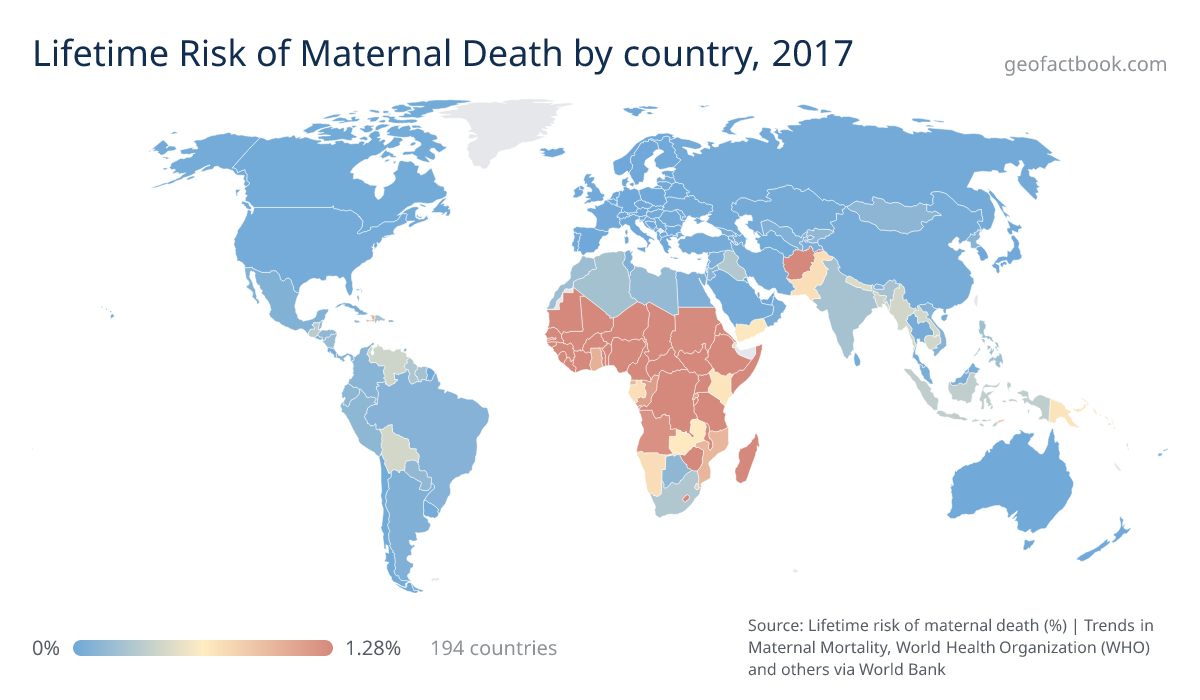
Lifetime Risk of Maternal Death by country, 2017: map image
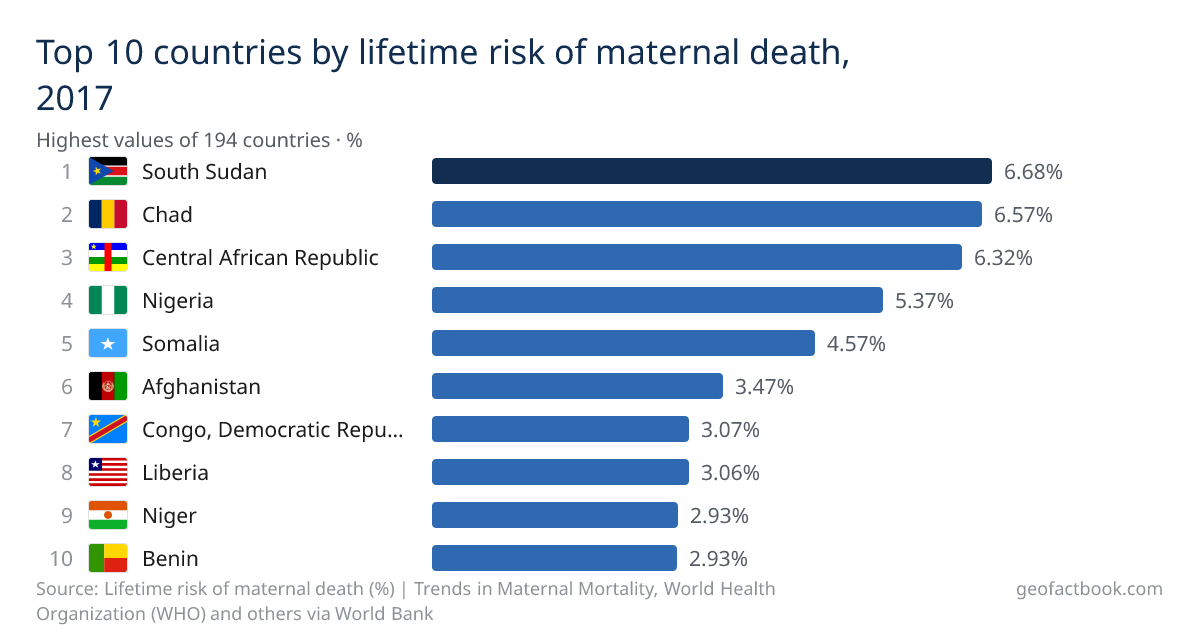
Top 10 countries by lifetime risk of maternal death, 2017: chart
Insights by country
Australia
In 2017, Australia had a Lifetime Risk of Maternal Death of 0.00899329332295266 %, ranking #164 out of 194 countries. This rate is significantly lower than that of many developing nations, highlighting Australia's advanced healthcare system. Key factors contributing to this low risk include Australia's comprehensive maternal health policies, access to quality prenatal care, and a high standard of living which supports overall health outcomes.
South Korea
In 2017, South Korea had a Lifetime Risk of Maternal Death of 0.00477276590871297 %, ranking #186 out of 194 countries. This figure is significantly lower than that of many developing nations, reflecting the country's advanced healthcare system and strong maternal health policies. South Korea benefits from high levels of medical technology and access to healthcare services, which contribute to lower maternal mortality rates compared to its regional peers in East Asia.
Côte d'Ivoire
Côte d'Ivoire had a Lifetime Risk of Maternal Death of 2.21519522214145 % in 2017, ranking #17 out of 194 countries. This figure is notably higher than many countries in the region, reflecting persistent challenges in maternal healthcare access and quality. Contributing factors include limited healthcare infrastructure, economic constraints, and regional disparities in health service delivery, which disproportionately affect rural populations.
Tanzania
Tanzania's Lifetime Risk of Maternal Death in 2017 was 1.74195548283015 %, ranking it #22 out of 194 countries. This figure is significantly higher than the global average, reflecting persistent challenges in maternal healthcare access compared to countries with lower risks. Contributing factors include inadequate healthcare infrastructure, high rates of poverty, and limited access to skilled birth attendants, particularly in rural areas.
Venezuela
In 2017, Venezuela had a Lifetime Risk of Maternal Death of 0.418250012791954 %, ranking #63 out of 194 countries. This figure is notably higher than many of its neighbors in South America, reflecting broader regional health challenges. Contributing factors include Venezuela's ongoing economic crisis, which has severely impacted healthcare access and quality, alongside political instability that has disrupted essential maternal health services.
Norway
In 2017, Norway had a Lifetime Risk of Maternal Death of 0.00263629794731578 %, ranking #192 out of 194 countries. This figure is significantly higher than many of its Nordic neighbors, reflecting challenges in maternal health despite Norway's robust healthcare system. Contributing factors include geographical disparities in access to healthcare services in rural areas and the need for ongoing public health initiatives to address maternal health comprehensively.
Republic of Moldova
In 2017, the Republic of Moldova had a Lifetime Risk of Maternal Death of 0.0342474099588887 %, ranking #133 out of 194 countries. This figure is notably higher than that of neighboring Romania, which benefits from better healthcare infrastructure and maternal health policies. Contributing factors to Moldova's maternal health challenges include economic constraints, limited access to quality healthcare services, and a lack of comprehensive maternal health education.
Afghanistan
In 2017, Afghanistan had a Lifetime Risk of Maternal Death of 3.46973936527902 %, ranking #6 out of 194 countries. This figure is significantly higher than the global average, reflecting the severe health challenges faced by women in the region. Contributing factors include ongoing conflict, limited access to healthcare services, and high rates of poverty, which severely impact maternal health outcomes.
Serbia
In 2017, Serbia had a Lifetime Risk of Maternal Death of 0.016193333053134 %, ranking #149 out of 194 countries. This figure is higher than the global average, reflecting challenges in maternal healthcare access compared to neighboring countries like Hungary, which has a significantly lower risk. Contributing factors include Serbia's healthcare system, which, while improving, still faces issues such as resource allocation and regional disparities in medical services.
Sudan
In 2017, Sudan had a Lifetime Risk of Maternal Death of 1.25485015772888 %, ranking #30 out of 194 countries. This figure is significantly higher than many neighboring countries, reflecting ongoing challenges in maternal health care. Contributing factors include limited access to quality health services, high rates of poverty, and ongoing conflict that disrupts healthcare delivery systems.
Analysis & Context
In 2017, the country with the highest Lifetime Risk of Maternal Death was South Sudan, with a staggering rate of 6.68%. The global range of this risk spanned from 0.00% to 6.68%. The average lifetime risk across the 194 countries with available data was 0.60%, while the median stood at 0.10%. This context highlights significant disparities in maternal health outcomes worldwide.
Global Disparities in Maternal Health
The Lifetime Risk of Maternal Death varies drastically across the globe, with the highest rates predominantly observed in sub-Saharan Africa. South Sudan, Chad (6.57%), and the Central African Republic (6.32%) lead the list, indicating severe challenges in maternal healthcare. Economic instability, inadequate healthcare infrastructure, and ongoing conflicts contribute significantly to these elevated risks. In contrast, countries like Belarus (0.0017%), Poland (0.0026%), and Norway (0.0026%) report the lowest risks, reflecting strong healthcare systems and high standards of living.
Economic and Demographic Influences
Economic factors play a crucial role in the disparities observed in maternal death risks. Nations such as Nigeria (5.37%) and Somalia (4.57%) face challenges not only from economic constraints but also from demographic pressures, including high fertility rates and young populations. These factors strain healthcare systems, making it difficult to provide adequate maternal care. Conversely, countries with robust economies and lower fertility rates, such as Japan (0.0053%) and South Korea (0.0048%), benefit from better healthcare access and outcomes.
Policy and Healthcare System Impacts
Effective policies and healthcare infrastructures are pivotal in reducing maternal mortality risks. Countries like the United Arab Emirates (0.0045%) and Iceland (0.0048%) demonstrate how comprehensive healthcare policies and investments in maternal health can significantly mitigate risks. In contrast, countries embroiled in conflict or lacking stable governance, such as Afghanistan (3.47%) and the Democratic Republic of the Congo (3.07%), struggle to implement effective healthcare strategies, resulting in higher maternal mortality risks.
Year-over-Year Trends and Changes
Analyzing year-over-year changes in the Lifetime Risk of Maternal Death reveals both progress and setbacks. The average global risk decreased by 5.0%, yet some countries experienced increases. The Central African Republic saw the most significant rise at 13.0%, indicative of deteriorating healthcare conditions. Conversely, countries like Chad (-5.5%) and Somalia (-6.8%) recorded notable decreases, suggesting improvements in healthcare access and maternal health initiatives. Such trends underscore the dynamic nature of maternal health risks and the impact of targeted interventions.
Understanding the Lifetime Risk of Maternal Death requires a nuanced examination of economic, demographic, and policy factors. While global averages provide a snapshot, the wide range of risks highlights persistent inequalities. Addressing these disparities demands sustained international cooperation, investment in healthcare infrastructure, and policies tailored to the specific needs of high-risk regions.
Frequently Asked Questions About Lifetime Risk of Maternal Death in 2017
Which country had the highest lifetime risk of maternal death in 2017?
South Sudan had the highest lifetime risk of maternal death in 2017, with a risk of 6.68%.
Which country had the lowest lifetime risk of maternal death in 2017?
Belarus had the lowest lifetime risk of maternal death in 2017, with a risk of 0%.
What was the average lifetime risk of maternal death across all countries in 2017?
The average lifetime risk of maternal death across all countries in 2017 was 0.6%.
What was the median lifetime risk of maternal death in 2017?
The median lifetime risk of maternal death in 2017 was 0.1%.
Which countries were in the top 3 for lifetime risk of maternal death in 2017?
The top 3 countries for lifetime risk of maternal death in 2017 were South Sudan (6.68%), Chad (6.57%), and the Central African Republic (6.32%).
How many countries had a lifetime risk of maternal death of 0% in 2017?
In 2017, there were 9 countries with a lifetime risk of maternal death of 0%.
Data Source
Lifetime risk of maternal death (%) | Trends in Maternal Mortality, World Health Organization (WHO) and others via World Bank
Data produced by Trends in Maternal Mortality, World Health Organization (WHO); UN Children's Fund (UNICEF), note: Trends in Maternal Mortality; UN Population Fund (UNFPA), note: Trends in Maternal Mortality; World Bank Group (WBG), note: Trends in Maternal Mortality, compiled and published by World Bank as "Lifetime risk of maternal death (%)".
Visit Data SourceCite this page
Geo Factbook. (n.d.). Lifetime Risk of Maternal Death by Country, 2017. Retrieved November 29, 2026, from https://geofactbook.com/fact/lifetime-risk-of-maternal-death/2017
The figures on this page come from Lifetime risk of maternal death (%) | Trends in Maternal Mortality, World Health Organization (WHO) and others via World Bank. For academic work, cite the original source as well.
›Embed this ranking on your site
Free to embed with attribution. Shows the top 10 countries and links back to the full ranking.
Historical Data by Year
Explore Lifetime Risk of Maternal Death data across different years. Compare trends and see how statistics have changed over time.
More Health Facts
See all Health facts →Mean Age at First Birth
Mean age at first birth indicates maternal age trends. Compare countries, explore rankings, and see historical shifts with interactive maps.
Highest: Andorra32.8Nurses and Midwives Density
Nurses and midwives density measures healthcare accessibility. Learn about countries with the highest and lowest density per 1,000 people.
Highest: Norway16.51 per 1,000 peopleAccess to Safe Drinking Water
Access to safe drinking water measures the percentage of a population with reliable, clean water sources.
 Highest: Bonaire, Sint Eustatius and Saba100%
You might also like
Currently married (Percent)
FeaturedThe percentage of currently married individuals by country highlights societal trends in family structure and relationships. Understanding these statistics can provide insights into cultural norms and demographic shifts, influencing policies and social programs.
Highest: Bangladesh81.95%Total population
FeaturedDiscover the latest total population statistics for every country and region worldwide. Explore accurate, up-to-date data on global population growth, density, and demographic trends — sourced from trusted international databases like the UN and World Bank. Perfect for researchers, students, and data enthusiasts looking to understand how the world’s population is changing.
Highest: India1.48B personsGross Domestic Product (GDP) by Country in Current US Dollars
FeaturedDiscover the Gross Domestic Product (GDP) by country in current US dollars, a key indicator of economic performance. This statistic reveals the financial health and growth potential of nations, making it essential for investors and policymakers.
Highest: United States32.95T $