
Education Share of Government Spending 2001
Education share of government spending reveals priorities; measures the percentage of national budgets allocated to education.
Newer data is available: Education Share of Government Spending by country 2025 →
Where does your country rank? Pick it to see its position.
Related Government statistics
More ↓Interactive Map
Complete Data Rankings
Rank | Actions | ||
|---|---|---|---|
1 |  Vanuatu | 40.078 % | |
2 |  Yemen | 30.321 % | |
3 |  Barbados | 26.889 % | |
4 |  Djibouti | 26.28 % | |
5 |  Saint Lucia | 25.855 % | |
6 |  Togo | 25.731 % | |
7 |  Rwanda | 25.313 % | |
8 |  Tunisia | 24.648 % | |
9 |  Iran | 24.424 % | |
10 |  Malaysia | 24.349 % | |
11 |  Thailand | 24.241 % | |
12 |  Côte d'Ivoire | 23.202 % | |
13 |  Lesotho | 22.966 % | |
14 |  Kenya | 22.962 % | |
15 |  Namibia | 22.776 % | |
16 |  China, Hong Kong SAR | 22.419 % | |
17 |  Tonga | 22.109 % | |
18 |  Kuwait | 22.01 % | |
19 |  Nepal | 21.656 % | |
20 |  Singapore | 21.557 % | |
21 |  Aruba | 21.323 % | |
22 |  Saudi Arabia | 20.896 % | |
23 |  Azerbaijan | 20.878 % | |
24 |  Mexico | 20.624 % | |
25 |  South Africa | 20.472 % | |
26 |  Jamaica | 19.991 % | |
27 |  Paraguay | 19.879 % | |
28 |  Eswatini | 19.656 % | |
29 |  Fiji | 19.639 % | |
30 |  Costa Rica | 19.153 % | |
31 |  Bangladesh | 18.585 % | |
32 |  Belize | 18.305 % | |
33 |  Sierra Leone | 17.97 % | |
34 |  Madagascar | 17.682 % | |
35 |  Niger | 16.65 % | |
36 |  Panama | 16.639 % | |
37 |  Guyana | 16.556 % | |
38 |  Republic of Moldova | 16.425 % | |
39 |  Argentina | 16.356 % | |
40 |  Lithuania | 15.995 % | |
41 |  Latvia | 15.878 % | |
42 |  Norway | 15.784 % | |
43 |  Ghana | 15.741 % | |
44 |  Cameroon | 15.733 % | |
45 |  Senegal | 15.73 % | |
46 |  Syrian Arab Republic | 15.662 % | |
47 |  Denmark | 15.493 % | |
48 |  Benin | 15.311 % | |
49 |  Palau | 15.308 % | |
50 |  Switzerland | 15.255 % | |
51 |  Estonia | 14.826 % | |
52 |  Peru | 14.796 % | |
53 |  Mali | 14.493 % | |
54 |  Ethiopia | 14.462 % | |
55 |  Cyprus | 14.322 % | |
56 |  Saint Kitts and Nevis | 14.319 % | |
57 |  Iceland | 14.142 % | |
58 |  Tajikistan | 14.007 % | |
59 |  Philippines | 13.916 % | |
60 |  Chad | 13.787 % | |
61 |  Kyrgyzstan | 13.721 % | |
62 |  Israel | 13.405 % | |
63 |  Mauritius | 13.239 % | |
64 |  Bhutan | 13.226 % | |
65 |  Dominican Republic | 13.214 % | |
66 |  Ukraine | 12.811 % | |
67 |  Sweden | 12.786 % | |
68 |  Samoa | 12.77 % | |
69 |  Ireland | 12.705 % | |
70 |  Finland | 12.634 % | |
71 |  Georgia | 12.362 % | |
72 |  Canada | 12.212 % | |
73 |  Trinidad and Tobago | 12.165 % | |
74 |  Portugal | 12.097 % | |
75 |  United Kingdom | 12.082 % | |
76 |  Poland | 11.866 % | |
77 |  Slovenia | 11.828 % | |
78 |  Indonesia | 11.594 % | |
79 |  Kiribati | 11.516 % | |
80 |  Burundi | 11.433 % | |
81 |  Cambodia | 11.381 % | |
82 |  China, Macao SAR | 11.092 % | |
83 |  Austria | 10.817 % | |
84 |  Spain | 10.703 % | |
85 |  Netherlands | 10.639 % | |
86 |  Oman | 10.584 % | |
87 |  Albania | 10.582 % | |
88 |  Qatar | 10.551 % | |
89 |  Hungary | 10.435 % | |
90 |  Guinea | 10.37 % | |
91 |  Laos | 9.947 % | |
92 |  Romania | 9.849 % | |
93 |  Italy | 9.832 % | |
94 |  Brazil | 9.659 % | |
95 |  Luxembourg | 9.281 % | |
96 |  Bulgaria | 9.278 % | |
97 |  Uruguay | 9.23 % | |
98 |  Russia | 9.213 % | |
99 |  Eritrea | 8.785 % | |
100 |  Czech Republic | 8.619 % | |
101 |  Slovakia | 8.526 % | |
102 |  Gambia | 8.205 % | |
103 |  Lebanon | 7.421 % | |
104 |  Greece | 7.317 % |
Analysis: These countries represent the highest values in this dataset, showcasing significant scale and impact on global statistics.
- #104Greece
- #103Lebanon
- #102Gambia
- #101Slovakia
- #100Czech Republic
- #99Eritrea
- #98Russia
- #97Uruguay
- #96Bulgaria
- #95Luxembourg
Context: These countries or territories have the lowest values, often due to geographic size, administrative status, or specific characteristics.
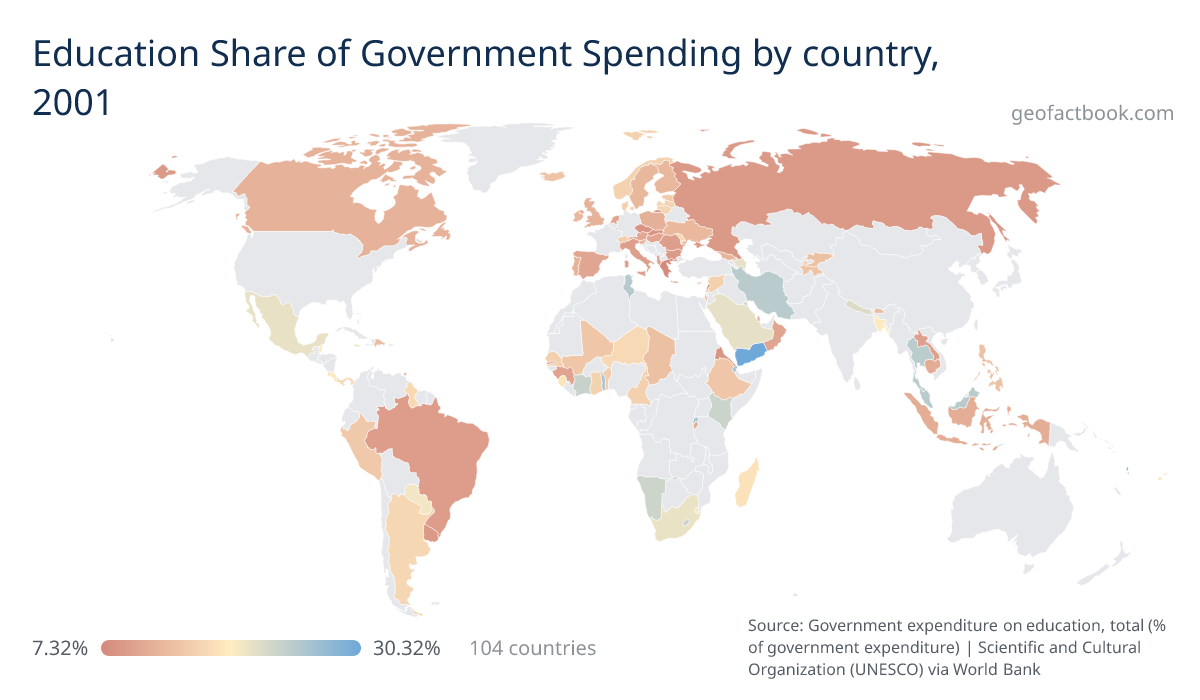
Education Share of Government Spending by country, 2001: map image
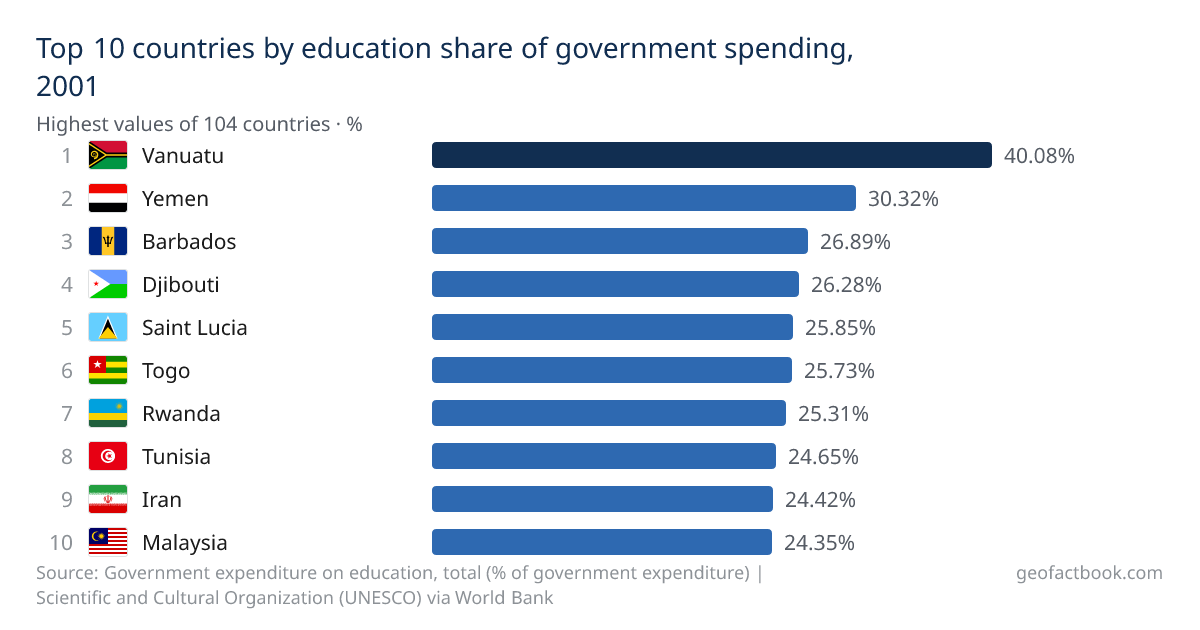
Top 10 countries by education share of government spending, 2001: chart
Insights by country
Saint Kitts and Nevis
In 2001, Saint Kitts and Nevis ranked #56 globally with an Education Share of Government Spending of 14.319109916687 %. This figure is higher than the global average, indicating a commitment to education relative to many other nations. The country's investment in education is driven by its small population and the need to develop a skilled workforce to support its tourism-dependent economy.
Republic of Moldova
In 2001, the Republic of Moldova ranked #38 globally with an Education Share of Government Spending of 16.4247608184814 %. This figure is notably higher than that of some neighboring countries, reflecting a commitment to education amid economic challenges. The emphasis on education spending can be attributed to the country's efforts to improve human capital and align with European educational standards following its independence from the Soviet Union.
Yemen
In 2001, Yemen achieved a remarkable global rank of #2 with an Education Share of Government Spending of 30.3212795257568%. This figure significantly surpassed the global average, reflecting Yemen's prioritization of education amidst its developmental challenges. The high share of spending can be attributed to a commitment to improve literacy rates and educational access in a country grappling with economic instability and a young, growing population.
Mexico
In 2001, Mexico ranked #24 globally with an Education Share of Government Spending of 20.6242809295654 %. This figure is notably above the average for Latin America, reflecting the country's commitment to education despite economic challenges. Key drivers include Mexico's demographic profile, with a large youth population, and ongoing reforms aimed at improving educational access and quality.
Cambodia
In 2001, Cambodia ranked #81 globally in Education Share of Government Spending, allocating 11.3807897567749 % of its budget to education. This figure is notably lower than many neighboring countries, reflecting a broader regional trend of underinvestment in education. Contributing factors include Cambodia's recovery from decades of conflict, which has strained public resources, and a focus on immediate economic development over long-term educational reforms.
Sierra Leone
Sierra Leone ranked #33 globally with an Education Share of Government Spending of 17.9699993133545% in 2001. This figure is notably higher than many of its regional peers, reflecting a commitment to rebuilding the education sector after years of civil conflict. The prioritization of education spending can be attributed to international support and a national policy focus on improving literacy and access to education in a country with a young population.
Portugal
In 2001, Portugal ranked #74 globally in Education Share of Government Spending, allocating 12.0966300964356 % of its budget to education. This percentage is below the average for European Union countries, indicating a relatively lower prioritization of educational funding compared to its neighbors. Contributing factors include Portugal's economic challenges during the early 2000s and ongoing efforts to reform its educational system to improve quality and accessibility.
Oman
In 2001, Oman ranked #86 globally in Education Share of Government Spending, allocating 10.5839900970459 % of its budget to education. This figure is lower than the global average, reflecting challenges in prioritizing educational investment compared to top-ranking countries. The Omani government has historically focused on economic diversification and infrastructure development, which may have diverted funds away from educational initiatives.
Argentina
In 2001, Argentina ranked #39 globally in Education Share of Government Spending, allocating 16.3559608459473 % of its government budget to education. This figure is notably higher than the global average, reflecting Argentina's commitment to education as a priority in public policy. Economic challenges, including inflation and debt, have historically influenced budget allocations, yet education remained a focal point for fostering long-term development and social equity.
Malaysia
In 2001, Malaysia ranked #10 globally with an Education Share of Government Spending of 24.3485202789307 %. This figure is significantly higher than the global average, reflecting the country’s strong emphasis on education compared to many others. The Malaysian government prioritizes education as a means to foster economic growth and social development, driven by its vision to become a knowledge-based economy. Additionally, demographic factors such as a youthful population contribute to sustained investments in educational infrastructure and resources.
Azerbaijan
In 2001, Azerbaijan ranked #23 globally with an Education Share of Government Spending of 20.8775501251221 %. This figure is significantly higher than the global average, reflecting a strong commitment to education compared to many other countries. Key drivers for this investment include Azerbaijan's focus on diversifying its economy away from oil dependency and improving human capital in the wake of its post-Soviet transition.
Vanuatu
In 2001, Vanuatu achieved a remarkable global rank of #1 with an Education Share of Government Spending of 40.0775489807129 %. This figure significantly surpasses many countries, reflecting a strong commitment to education compared to the global average. The high investment in education can be attributed to Vanuatu's focus on improving literacy and educational outcomes, driven by its small population and the need for sustainable development in a remote island nation.
Tajikistan
In 2001, Tajikistan ranked #58 globally with an Education Share of Government Spending of 14.0071296691894 %. This figure is relatively high compared to some neighboring countries, reflecting the government's prioritization of education in the post-Soviet era. The significant investment in education can be attributed to Tajikistan's efforts to rebuild its educational infrastructure following years of civil conflict and to improve literacy rates among its predominantly young population.
Philippines
In 2001, the Philippines ranked #59 globally with an Education Share of Government Spending of 13.9159097671509 %. This figure is below the global average, indicating a relatively modest investment in education compared to higher-ranked countries such as Norway, which allocates a significantly larger portion of its budget to education. Contributing factors include the Philippines' economic constraints and a focus on other pressing development needs, which have historically limited the government's ability to prioritize educational funding.
Saudi Arabia
In 2001, Saudi Arabia ranked #22 globally for Education Share of Government Spending, allocating 20.8961391448975 % of its government budget to education. This figure is above the global average, reflecting a commitment to enhancing educational infrastructure and quality. The significant investment in education can be attributed to Saudi Arabia's efforts to diversify its economy away from oil dependency and to improve the skill levels of its young, rapidly growing population.
Romania
In 2001, Romania ranked #92 globally in Education Share of Government Spending, allocating 9.84881973266602 % of its budget to education. This figure is notably lower than the global average, indicating challenges in prioritizing educational investment. Contributing factors include Romania's transitional economy post-communism and a focus on infrastructure development over educational reforms during that period.
Nepal
In 2001, Nepal ranked #19 globally in Education Share of Government Spending, allocating 21.6562004089356 % of its budget to education. This commitment is notably higher than the global average, reflecting a strong prioritization of educational development in a country where literacy rates have historically lagged. Key drivers for this significant expenditure include Nepal's focus on improving human capital amidst economic challenges and a young, growing population that necessitates increased educational resources.
Analysis & Context
In 2001, Vanuatu led the world with the highest Education Share of Government Spending at 40.08%, while the global range spanned from a minimum of 7.32% to a maximum of 40.08%. The average education budget allocation across the 104 countries with available data was 15.91%, providing a benchmark for understanding global educational investment priorities in 2001.
Economic Priorities and Education Spending
The allocation of government spending towards education often reflects broader economic priorities and fiscal capabilities. For example, Vanuatu, with its significant investment in education (40.08%), underscores a strategic emphasis on human capital development potentially driven by its limited natural resources. In contrast, countries like Greece, with the lowest allocation at 7.32%, may have prioritized other sectors due to economic constraints or different policy priorities.
Middle Eastern countries such as Yemen also demonstrate high educational spending (30.32%), which could be attributed to efforts to bolster educational infrastructure in response to demographic pressures and the need for improved human capital. Conversely, Russia, with only 9.21% allocated to education, may reflect a focus on other sectors like defense or energy, where economic returns are perceived as more immediate.
Geopolitical and Demographic Influences
Geopolitical factors and demographic profiles play crucial roles in shaping education budgets. Barbados and Saint Lucia, each allocating over 25% of their government spending to education, indicate a regional trend in the Caribbean towards prioritizing education as a means of ensuring socio-economic stability and growth. These nations likely view education as a critical tool for economic diversification and reducing reliance on tourism.
Meanwhile, Djibouti (26.28%) and Togo (25.73%) reflect the African continent's varied approach to educational investment, potentially driven by international aid dynamics and internal policy shifts aimed at improving literacy and educational access amidst growing populations.
Policy Decisions and Their Impact
Government policy decisions can significantly impact education spending, as seen in Tunisia and Iran, which allocated approximately 24.65% and 24.42% of their budgets to education, respectively. These countries may have implemented reforms or initiatives emphasizing education as part of broader socio-economic development plans. Such investments are often aligned with long-term visions for national development, aiming to enhance technological capabilities and workforce competencies.
In contrast, Luxembourg, with one of the lowest shares at 9.28%, might reflect a strategic decision to allocate resources towards sectors like finance or technology, which are more critical to its economic model. The lower percentage does not necessarily indicate a neglect of education but rather a balanced approach to national budget distribution.
Regional Disparities and Investment Strategies
Regional disparities highlight differing investment strategies in education. South-East Asian countries like Malaysia (24.35%) demonstrate a robust commitment to education, likely driven by a need to maintain competitive advantages in a rapidly globalizing economy. Such investments are crucial for sustaining economic growth and improving living standards.
On the other hand, Slovakia and the Czech Republic, with allocations of 8.53% and 8.62% respectively, might reflect a transitional phase in budgetary priorities post-communism, where economic restructuring may have temporarily deprioritized educational funding.
Overall, the data from 2001 shows a complex landscape of educational funding, shaped by economic priorities, geopolitical considerations, and policy decisions. These allocations reveal the varying levels of commitment to education across the globe, highlighting both opportunities and challenges in the quest for educational advancement and human capital development.
Frequently Asked Questions About Education Share of Government Spending in 2001
Which country had the highest education share of government spending in 2001?
Vanuatu had the highest education share of government spending in 2001, with 40.08%.
What was the lowest education share of government spending among countries in 2001?
Greece had the lowest education share of government spending in 2001, with 7.32%.
What was the average education share of government spending across all countries in 2001?
The average education share of government spending across all countries in 2001 was 15.91%.
What was the median education share of government spending in 2001?
The median education share of government spending in 2001 was 14.64%.
Which countries were in the top 10 for education share of government spending in 2001?
The top 10 countries for education share of government spending in 2001 were Vanuatu, Yemen, Barbados, Djibouti, Saint Lucia, Togo, Rwanda, Tunisia, Iran, and Malaysia.
How many countries are included in the dataset for education share of government spending in 2001?
The dataset for education share of government spending in 2001 includes 104 countries.
Data Source
Government expenditure on education, total (% of government expenditure) | Scientific and Cultural Organization (UNESCO) via World Bank
Data produced by Data API, UN Educational, Scientific and Cultural Organization (UNESCO), compiled and published by World Bank as "Government expenditure on education, total (% of government expenditure)".
Visit Data SourceCite this page
Geo Factbook. (n.d.). Education Share of Government Spending by Country, 2001. Retrieved November 28, 2026, from https://geofactbook.com/fact/education-share-of-government-spending/2001
The figures on this page come from Government expenditure on education, total (% of government expenditure) | Scientific and Cultural Organization (UNESCO) via World Bank. For academic work, cite the original source as well.
›Embed this ranking on your site
Free to embed with attribution. Shows the top 10 countries and links back to the full ranking.
Historical Data by Year
Explore Education Share of Government Spending data across different years. Compare trends and see how statistics have changed over time.
More Government Facts
See all Government facts →Prison Population Rate
Explore prison population rate per 100,000 people; measure incarceration levels across countries and understand justice system trends.
Highest: Panama533 per 100,000Governance Effectiveness Rating
Governance Effectiveness Rating assesses the quality of public services and government policy implementation.
Highest: Singapore95.17LGBT Rights Index Score
LGBT Rights Index Score assesses legal protections and societal attitudes towards LGBT individuals in a country.
 Highest: Malta20.28
You might also like
Human Capital Index
FeaturedThe Human Capital Index measures a country's investment in education and health, reflecting its potential for economic growth and productivity. This vital statistic highlights the importance of nurturing human resources for sustainable development.
Highest: Singapore0.91Percentage of land area by degree of urbanization
FeaturedExplore the percentage of land area by degree of urbanization, highlighting how urban development shapes countries' landscapes and influences economic growth. Understanding this statistic reveals the balance between urban and rural spaces, essential for sustainable planning.
 Highest: Holy See100%
Total population
FeaturedDiscover the latest total population statistics for every country and region worldwide. Explore accurate, up-to-date data on global population growth, density, and demographic trends — sourced from trusted international databases like the UN and World Bank. Perfect for researchers, students, and data enthusiasts looking to understand how the world’s population is changing.
 Highest: India1.48B persons