
Education Share of Government Spending 2024
Education share of government spending reveals priorities; measures the percentage of national budgets allocated to education.
Newer data is available: Education Share of Government Spending by country 2025 →
Where does your country rank? Pick it to see its position.
Related Government statistics
More ↓

Interactive Map
Complete Data Rankings
Rank | Actions | ||
|---|---|---|---|
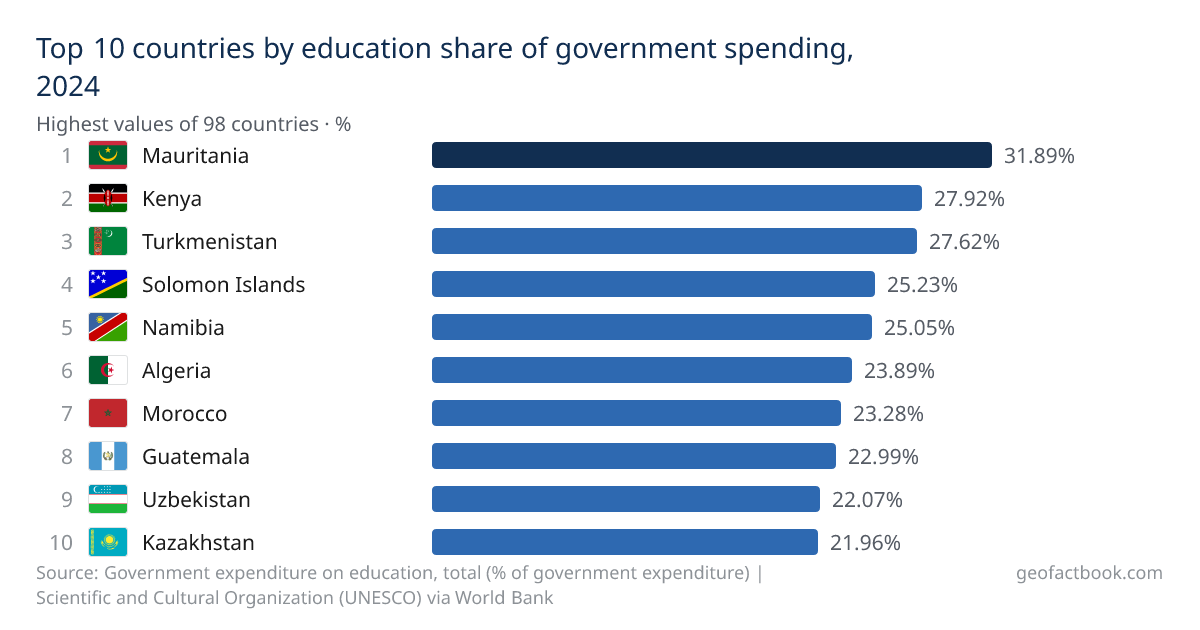
1 |  Mauritania | 31.887 % | |
2 |  Kenya | 27.925 % | |
3 |  Turkmenistan | 27.625 % | |
4 |  Solomon Islands | 25.229 % | |
5 |  Namibia | 25.052 % | |
6 |  Algeria | 23.888 % | |
7 |  Morocco | 23.279 % | |
8 |  Guatemala | 22.994 % | |
9 |  Uzbekistan | 22.075 % | |
10 |  Kazakhstan | 21.955 % | |
11 |  Dominican Republic | 21.864 % | |
12 |  Bolivia | 20.16 % | |
13 |  Kiribati | 20.115 % | |
14 |  Sierra Leone | 19.959 % | |
15 |  Kyrgyzstan | 19.648 % | |
16 |  Eswatini | 19.354 % | |
17 |  Vanuatu | 19.308 % | |
18 |  Tajikistan | 19.255 % | |
19 |  Peru | 19.205 % | |
20 |  Belize | 18.903 % | |
21 |  South Africa | 18.515 % | |
22 |  Sao Tome and Principe | 18.087 % | |
23 |  Benin | 17.968 % | |
24 |  Jamaica | 17.866 % | |
25 |  Mali | 17.824 % | |
26 |  Tunisia | 17.81 % | |
27 |  Côte d'Ivoire | 17.623 % | |
28 |  Bhutan | 17.176 % | |
29 |  Puerto Rico | 17.147 % | |
30 |  Tuvalu | 16.979 % | |
31 |  Paraguay | 16.834 % | |
32 |  Ethiopia | 16.695 % | |
33 |  Philippines | 16.549 % | |
34 |  Curaçao | 16.438 % | |
35 |  Zimbabwe | 16.32 % | |
36 |  Panama | 16.28 % | |
37 |  Malawi | 16 % | |
38 |  Republic of Moldova | 15.965 % | |
39 |  China, Hong Kong SAR | 15.741 % | |
40 |  Saudi Arabia | 15.636 % | |
41 |  Zambia | 15.377 % | |
42 |  Gambia | 15.103 % | |
43 |  Fiji | 14.7 % | |
44 |  Grenada | 14.519 % | |
45 |  Mauritius | 14.193 % | |
46 |  Rwanda | 14.191 % | |
47 |  Saint Lucia | 13.849 % | |
48 |  Cameroon | 13.83 % | |
49 |  Mongolia | 13.777 % | |
50 |  North Korea | 13.677 % | |
51 |  Cabo Verde | 13.409 % | |
52 |  Tanzania | 13.408 % | |
53 |  Seychelles | 13.142 % | |
54 |  Thailand | 13.091 % | |
55 |  Haiti | 13.019 % | |
56 |  Samoa | 12.871 % | |
57 |  Singapore | 12.861 % | |
58 |  Kuwait | 12.689 % | |
59 |  Saint Vincent and the Grenadines | 12.627 % | |
60 |  Belarus | 12.342 % | |
61 |  Georgia | 12.207 % | |
62 |  Andorra | 12.005 % | |
63 |  Bangladesh | 11.993 % | |
64 |  Barbados | 11.84 % | |
65 |  Togo | 11.645 % | |
66 |  Azerbaijan | 11.45 % | |
67 |  Nepal | 11.265 % | |
68 |  Cambodia | 11.234 % | |
69 |  Antigua and Barbuda | 11.036 % | |
70 |  Nicaragua | 11.013 % | |
71 |  British Virgin Islands | 10.86 % | |
72 |  Bahamas | 10.846 % | |
73 |  Turks and Caicos Islands | 10.734 % | |
74 |  Maldives | 10.717 % | |
75 |  El Salvador | 10.576 % | |
76 |  Lesotho | 10.373 % | |
77 |  Venezuela | 10.254 % | |
78 |  Saint Kitts and Nevis | 10.203 % | |
79 |  Comoros | 9.933 % | |
80 |  Palau | 9.845 % | |
81 |  Jordan | 9.786 % | |
82 |  Ecuador | 9.694 % | |
83 |  Gibraltar | 9.482 % | |
84 |  Armenia | 9.44 % | |
85 |  Tonga | 9.33 % | |
86 |  Guinea | 9.294 % | |
87 |  Trinidad and Tobago | 9.147 % | |
88 |  Bahrain | 8.741 % | |
89 |  Suriname | 8.553 % | |
90 |  Laos | 8.242 % | |
91 |  Sri Lanka | 7.223 % | |
92 |  Dominica | 7.091 % | |
93 |  Somalia | 6.956 % | |
94 |  Angola | 6.37 % | |
95 |  Timor-Leste | 6.275 % | |
96 |  Lebanon | 6.114 % | |
97 |  Nauru | 5.333 % | |
98 |  Nigeria | 2.978 % |
- #1Mauritania
- #2Kenya
- #3Turkmenistan
- #4Solomon Islands
- #5Namibia
- #6Algeria
- #7Morocco
- #8Guatemala
- #9Uzbekistan
- #10Kazakhstan
Analysis: These countries represent the highest values in this dataset, showcasing significant scale and impact on global statistics.
- #98Nigeria
- #97Nauru
- #96Lebanon
- #95Timor-Leste
- #94Angola
- #93Somalia
- #92Dominica
- #91Sri Lanka
- #90Laos
- #89Suriname
Context: These countries or territories have the lowest values, often due to geographic size, administrative status, or specific characteristics.
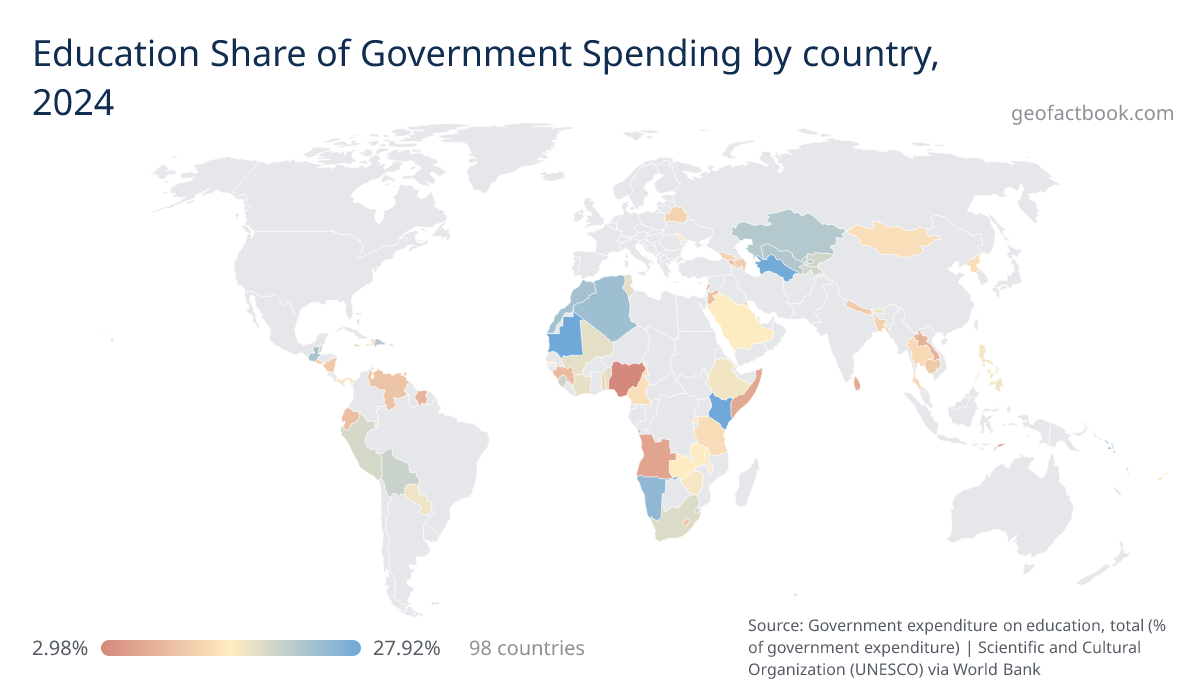
Education Share of Government Spending by country, 2024: map image
Top 10 countries by education share of government spending, 2024: chart
Insights by country
Jamaica
In 2024, Jamaica ranks #24 globally with an Education Share of Government Spending of 17.8657703399658 %. This figure is notably higher than the global average, indicating a strong commitment to education compared to many other countries. Key drivers of this investment include Jamaica's focus on improving literacy rates and addressing educational disparities, which are critical for its socio-economic development.
Palau
In 2024, Palau's Education Share of Government Spending is 9.84509852392636 %, ranking #80 out of 98 countries. This figure is notably lower than the global average, reflecting challenges in educational funding compared to higher-ranking nations. Contributing factors include Palau's small population and limited economic resources, which impact the overall budget allocation for education. Additionally, the country's reliance on tourism and external aid can affect sustained investment in its educational infrastructure.
Morocco
In 2024, Morocco ranks #7 globally in Education Share of Government Spending, allocating 23.2788788012312 % of its budget to education. This figure is significantly higher than the global average, highlighting Morocco's commitment to improving educational outcomes. Key drivers of this investment include ongoing reforms aimed at enhancing access to education and addressing regional disparities, alongside a youthful population that demands quality educational opportunities.
Zimbabwe
In 2024, Zimbabwe ranks #35 globally with an Education Share of Government Spending of 16.320335104302 %. This figure is notably higher than the regional average in Southern Africa, indicating a strong commitment to education despite economic challenges. The country's prioritization of education spending is driven by a need to improve literacy rates and skills development in a workforce affected by years of economic instability and demographic shifts.
Turks and Caicos Islands
In 2024, the Turks and Caicos Islands ranks #73 globally for Education Share of Government Spending, allocating 10.7342526058546 % of its budget to education. This figure is below the global average, indicating a relatively lower prioritization of educational funding compared to many other nations. The country's economic reliance on tourism and limited population size can constrain government resources, thus affecting investment in education.
Thailand
In 2024, Thailand ranks #54 globally with an Education Share of Government Spending of 13.0909885057471 %. This figure is below the global average of approximately 15%, indicating room for improvement in prioritizing educational investment. Contributing factors include Thailand's ongoing economic challenges and a focus on infrastructure development, which often diverts funds away from education. Additionally, the country's demographic shifts and urbanization trends are influencing educational needs and resource allocation.
Saint Lucia
In 2024, Saint Lucia ranks #47 globally with an Education Share of Government Spending of 13.8487936507937 %. This figure is above the global average, reflecting a commitment to education amidst regional challenges. The country's focus on improving educational outcomes is driven by its need to enhance workforce skills and adapt to a changing economy, particularly in tourism and services.
China, Hong Kong SAR
In 2024, China, Hong Kong SAR ranks #39 globally for Education Share of Government Spending, allocating 15.7411403656006 % of its government budget to education. This figure is slightly below the global average, highlighting a focus on other pressing economic needs. The region's high population density and competitive job market drive significant investment in education, while government policies prioritize vocational training to meet labor market demands.
British Virgin Islands
The British Virgin Islands ranks #71 globally with an Education Share of Government Spending of 10.8600279817268 % in 2024. This figure is below the global average, indicating a relatively lower prioritization of education funding compared to other nations. Economic reliance on tourism and financial services often leads to budget constraints, impacting the allocation for education. Additionally, the small population size may influence the scale of educational investments and policy decisions.
Bolivia
In 2024, Bolivia ranks #12 globally for Education Share of Government Spending, allocating 20.1601600646973 % of its budget to education. This figure is notably higher than the regional average for South America, reflecting a strong commitment to educational investment compared to its neighbor Peru, which spends significantly less. Key drivers of this high education spending include Bolivia's emphasis on improving literacy rates and expanding access to education in rural areas, supported by government policies aimed at enhancing social equity.
Analysis & Context
In 2024, Mauritania leads the world in Education Share of Government Spending with a remarkable 31.89%, while the global range extends from 2.98% to 31.89%. This metric, which measures the percentage of national budgets allocated to education, provides critical insights into governmental priorities. The global average for Education Share of Government Spending in 2024 stands at 14.51%, offering a benchmark for analyzing national commitments to educational funding.
Economic Priorities and Education Funding
The allocation of government budgets to education often reflects broader economic priorities and constraints. In Mauritania, where education spending is the highest at 31.89%, government policy may be driven by a pressing need to improve educational infrastructure and outcomes in a developing economy. Similarly, Kenya and Turkmenistan, with allocations of 27.92% and 27.62% respectively, suggest a strong governmental focus on education, possibly as a means to foster economic growth and human capital development.
Conversely, countries like Nigeria, with the lowest allocation at 2.98%, may reflect different economic pressures or policy priorities. Despite being Africa's largest economy, Nigeria's minimal investment in education could indicate challenges such as economic diversification or fiscal constraints that prioritize other sectors.
Regional Disparities in Education Investment
Regional analysis reveals significant disparities in education funding. In Africa, Namibia and Algeria invest 25.05% and 23.89% respectively, highlighting a regional commitment to educational development. This contrasts sharply with Angola and Somalia, where spending is only 6.37% and 6.96%, suggesting varying governmental priorities and economic conditions across the continent.
In Asia, Uzbekistan and Kazakhstan allocate 22.07% and 21.96% respectively, reflecting a strategic focus on education to support economic transition and regional competitiveness. Meanwhile, Lebanon and Laos have lower allocations of 6.11% and 8.24%, potentially due to economic instability or different developmental challenges.
Year-over-Year Changes and Their Implications
Analyzing year-over-year changes in Education Share of Government Spending reveals dynamic shifts in national priorities. Mauritania experienced the largest increase, with a 13.00% rise, marking a strategic pivot towards education. This significant increase, along with Algeria's rise of 10.63%, may indicate governmental recognition of education as a catalyst for economic and social development.
On the other hand, Nicaragua saw the most substantial decrease, with a reduction of 6.68%, followed by Paraguay and Gambia with decreases of 5.16% and 3.59% respectively. These declines could reflect shifting economic conditions or policy adjustments in response to external pressures, such as debt obligations or economic downturns.
Policy Drivers Behind Education Spending
Understanding the policy drivers behind education spending can provide insights into national priorities. In countries like Solomon Islands and Morocco, where education allocations are 25.23% and 23.28%, policy frameworks likely emphasize education as a pillar for sustainable development and poverty alleviation. This approach reflects a long-term vision of education as a means to enhance economic resilience and social equity.
In contrast, countries with lower allocations, such as Timor-Leste and Dominica, spending 6.28% and 7.09% respectively, might prioritize immediate economic concerns over educational investment. These decisions can be influenced by factors such as limited fiscal space, competing demands from other critical sectors, or differing governmental philosophies on the role of education in national development.
Frequently Asked Questions About Education Share of Government Spending in 2024
Which country has the highest education share of government spending in 2024?
Mauritania has the highest education share of government spending in 2024, with 31.89%.
Which country has the lowest education share of government spending in 2024?
Nigeria has the lowest education share of government spending in 2024, with 2.98%.
What is the average education share of government spending across all countries in 2024?
The average education share of government spending across all countries in 2024 is 14.51%.
What is the median education share of government spending in 2024?
The median education share of government spending in 2024 is 13.73%.
Which countries are in the top 3 for education share of government spending in 2024?
The top 3 countries for education share of government spending in 2024 are Mauritania, Kenya, and Turkmenistan.
How many countries are included in the dataset for education share of government spending in 2024?
There are 98 countries included in the dataset for education share of government spending in 2024.
Data Source
Government expenditure on education, total (% of government expenditure) | Scientific and Cultural Organization (UNESCO) via World Bank
Data produced by Data API, UN Educational, Scientific and Cultural Organization (UNESCO), compiled and published by World Bank as "Government expenditure on education, total (% of government expenditure)".
Visit Data SourceCite this page
Geo Factbook. (n.d.). Education Share of Government Spending by Country, 2024. Retrieved November 28, 2026, from https://geofactbook.com/fact/education-share-of-government-spending/2024
The figures on this page come from Government expenditure on education, total (% of government expenditure) | Scientific and Cultural Organization (UNESCO) via World Bank. For academic work, cite the original source as well.
›Embed this ranking on your site
Free to embed with attribution. Shows the top 10 countries and links back to the full ranking.
Historical Data by Year
Explore Education Share of Government Spending data across different years. Compare trends and see how statistics have changed over time.
More Government Facts
See all Government facts →Prison Population Rate
Explore prison population rate per 100,000 people; measure incarceration levels across countries and understand justice system trends.
Highest: Panama533 per 100,000Governance Effectiveness Rating
Governance Effectiveness Rating assesses the quality of public services and government policy implementation.
Highest: Singapore95.17LGBT Rights Index Score
LGBT Rights Index Score assesses legal protections and societal attitudes towards LGBT individuals in a country.
 Highest: Malta20.28
You might also like
Human Capital Index
FeaturedThe Human Capital Index measures a country's investment in education and health, reflecting its potential for economic growth and productivity. This vital statistic highlights the importance of nurturing human resources for sustainable development.
Highest: Singapore0.91Percentage of land area by degree of urbanization
FeaturedExplore the percentage of land area by degree of urbanization, highlighting how urban development shapes countries' landscapes and influences economic growth. Understanding this statistic reveals the balance between urban and rural spaces, essential for sustainable planning.
 Highest: Holy See100%
Total population
FeaturedDiscover the latest total population statistics for every country and region worldwide. Explore accurate, up-to-date data on global population growth, density, and demographic trends — sourced from trusted international databases like the UN and World Bank. Perfect for researchers, students, and data enthusiasts looking to understand how the world’s population is changing.
 Highest: India1.48B persons