
Singapore Education Share of Government Spending 2025: 11.99 %
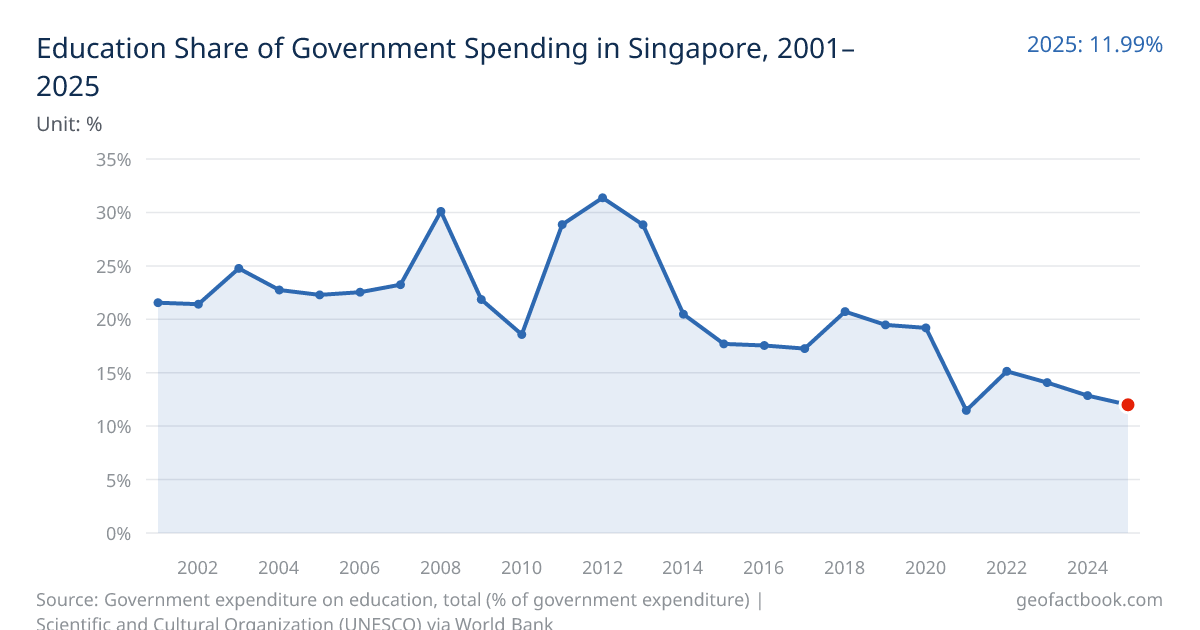
Singapore's education share of government spending in 2025 is 11.99 %, down 6.7% from 2024. It ranks #32 of 60 countries.
Education share of government spending reveals priorities; measures the percentage of national budgets allocated to education.
Source (2025): Education share of government spending
Where Singapore ranks (2025)
#32 of 60- #30
 Trinidad and Tobago12.57%
- #31
 Andorra12.13%
- #32
 Singapore11.99%
- #33
 Azerbaijan11.92%
- #34
 Bangladesh11.88%
Education Share of Government Spending over time
| Year | Value | Change | % Change | Actions |
|---|---|---|---|---|
| 2025 | 11.99 % | 0.87 % | -6.75% | |
| 2024 | 12.86 % | 1.21 % | -8.59% | |
| 2023 | 14.07 % | 1.06 % | -7.03% | |
| 2022 | 15.13 % | +3.66 % | +31.93% | |
| 2021 | 11.47 % | 7.72 % | -40.24% | |
| 2020 | 19.19 % | 0.28 % | -1.44% | |
| 2019 | 19.47 % | 1.25 % | -6.01% | |
| 2018 | 20.72 % | +3.47 % | +20.09% | |
| 2017 | 17.25 % | 0.3 % | -1.69% | |
| 2016 | 17.55 % | 0.14 % | -0.82% | |
| 2015 | 17.7 % | 2.78 % | -13.57% | |
| 2014 | 20.47 % | 8.36 % | -29.00% | |
| 2013 | 28.84 % | 2.53 % | -8.07% | |
| 2012 | 31.37 % | +2.51 % | +8.70% | |
| 2011 | 28.86 % | +10.29 % | +55.41% | |
| 2010 | 18.57 % | 3.28 % | -15.02% | |
| 2009 | 21.85 % | 8.25 % | -27.40% | |
| 2008 | 30.1 % | +6.87 % | +29.56% | |
| 2007 | 23.23 % | +0.7 % | +3.09% | |
| 2006 | 22.54 % | +0.26 % | +1.16% | |
| 2005 | 22.28 % | 0.47 % | -2.05% | |
| 2004 | 22.74 % | 2.02 % | -8.14% | |
| 2003 | 24.76 % | +3.34 % | +15.61% | |
| 2002 | 21.42 % | 0.14 % | -0.65% | |
| 2001 | 21.56 % | — | — |
Education Share of Government Spending in Singapore, 2001–2025: chart
Cite this page
Geo Factbook. (n.d.). Singapore: Education Share of Government Spending. Retrieved November 28, 2026, from https://geofactbook.com/countries/singapore/education-share-of-government-spending
The figures on this page come from Government expenditure on education, total (% of government expenditure) | Scientific and Cultural Organization (UNESCO) via World Bank. For academic work, cite the original source as well.
Frequently Asked Questions About Singapore Education Share of Government Spending
What is Singapore's education share of government spending in 2025?▾
Singapore's education share of government spending is 11.99 % in 2025, according to Government expenditure on education, total (% of government expenditure) | Scientific and Cultural Organization (UNESCO) via World Bank.
Is Singapore's education share of government spending increasing or decreasing?▾
Singapore's education share of government spending fell by 6.7% from 2024 (12.86 %) to 2025 (11.99 %). Over the past decade (2015–2025) it fell by 32.2%.
How does Singapore rank for education share of government spending?▾
In 2025, Singapore has the 32nd highest education share of government spending out of 60 countries with data.
What was Singapore's education share of government spending in 2001?▾
In 2001, Singapore's education share of government spending was 21.56 %. By 2025 it fell by 44.4%.
Explore additional statistical insights
Corruption Perceptions Index in Singapore
Corruption Perceptions Index scores countries based on perceived levels of public sector corruption according to experts and businesspeople.
Police Officers Per 1,000 People in Singapore
Police officers per 1,000 people measures law enforcement density and public safety across countries.
Share of Women in Ministerial Positions in Singapore
Share of women in ministerial roles shows gender equality in government leadership worldwide.
Government Effectiveness Index in Singapore
Government effectiveness index evaluates the quality of public services and policy implementation efficiency, influencing public trust.
Women, Business and the Law Index in Singapore
Measures women's legal rights in business and work across countries; higher scores indicate more equitable laws.
Rule of Law Index by Country in Singapore
Compare countries by Rule of Law percentile rank, reflecting confidence in laws, courts, police, property rights, and protection from crime and violence.