
Education Share of Government Spending 2025
Education share of government spending reveals priorities; measures the percentage of national budgets allocated to education.
Where does your country rank? Pick it to see its position.
Related Government statistics
More ↓

Interactive Map
Complete Data Rankings
Rank | Actions | ||
|---|---|---|---|
1 |  Kenya | 28.541 % | |
2 |  Namibia | 24.577 % | |
3 |  Bhutan | 22.217 % | |
4 |  Senegal | 20.911 % | |
5 |  Dominican Republic | 20.875 % | |
6 |  Sierra Leone | 20.546 % | |
7 |  Eswatini | 19.212 % | |
8 |  South Africa | 19.141 % | |
9 |  Benin | 18.022 % | |
10 |  Zimbabwe | 17.899 % | |
11 |  Tunisia | 17.279 % | |
12 |  Guatemala | 17.27 % | |
13 |  Tuvalu | 16.792 % | |
14 |  Puerto Rico | 15.962 % | |
15 |  El Salvador | 15.893 % | |
16 |  Algeria | 15.543 % | |
17 |  Ecuador | 15.487 % | |
18 |  Philippines | 15.195 % | |
19 |  North Korea | 14.625 % | |
20 |  Zambia | 14.506 % | |
21 |  Gambia | 14.211 % | |
22 |  Barbados | 14.188 % | |
23 |  Rwanda | 13.931 % | |
24 |  Kuwait | 13.845 % | |
25 |  Fiji | 13.787 % | |
26 |  British Virgin Islands | 13.591 % | |
27 |  Haiti | 13.179 % | |
28 |  Saint Lucia | 12.748 % | |
29 |  Thailand | 12.617 % | |
30 |  Trinidad and Tobago | 12.574 % | |
31 |  Andorra | 12.129 % | |
32 |  Singapore | 11.993 % | |
33 |  Azerbaijan | 11.924 % | |
34 |  Bangladesh | 11.883 % | |
35 |  Samoa | 11.714 % | |
36 |  Paraguay | 11.653 % | |
37 |  Cambodia | 11.551 % | |
38 |  Comoros | 11.525 % | |
39 |  Grenada | 11.445 % | |
40 |  Saint Kitts and Nevis | 11.002 % | |
41 |  Nepal | 10.751 % | |
42 |  Seychelles | 10.686 % | |
43 |  Bahamas | 10.619 % | |
44 |  Indonesia | 10.557 % | |
45 |  Burundi | 10.291 % | |
46 |  Turks and Caicos Islands | 9.812 % | |
47 |  Maldives | 9.645 % | |
48 |  Guinea | 9.199 % | |
49 |  Palau | 9.133 % | |
50 |  Armenia | 8.708 % | |
51 |  Lebanon | 8.593 % | |
52 |  Gibraltar | 8.553 % | |
53 |  Bahrain | 8.337 % | |
54 |  Somalia | 8.127 % | |
55 |  Guyana | 7.236 % | |
56 |  Nauru | 6.648 % | |
57 |  Angola | 6.525 % | |
58 |  Antigua and Barbuda | 5.87 % | |
59 |  Dominica | 5.795 % | |
60 |  Timor-Leste | 4.331 % |
- #1Kenya
- #2Namibia
- #3Bhutan
- #4Senegal
- #5Dominican Republic
- #6Sierra Leone
- #7Eswatini
- #8South Africa
- #9Benin
- #10Zimbabwe
Analysis: These countries represent the highest values in this dataset, showcasing significant scale and impact on global statistics.
- #60Timor-Leste
- #59Dominica
- #58Antigua and Barbuda
- #57Angola
- #56Nauru
- #55Guyana
- #54Somalia
- #53Bahrain
- #52Gibraltar
- #51Lebanon
Context: These countries or territories have the lowest values, often due to geographic size, administrative status, or specific characteristics.
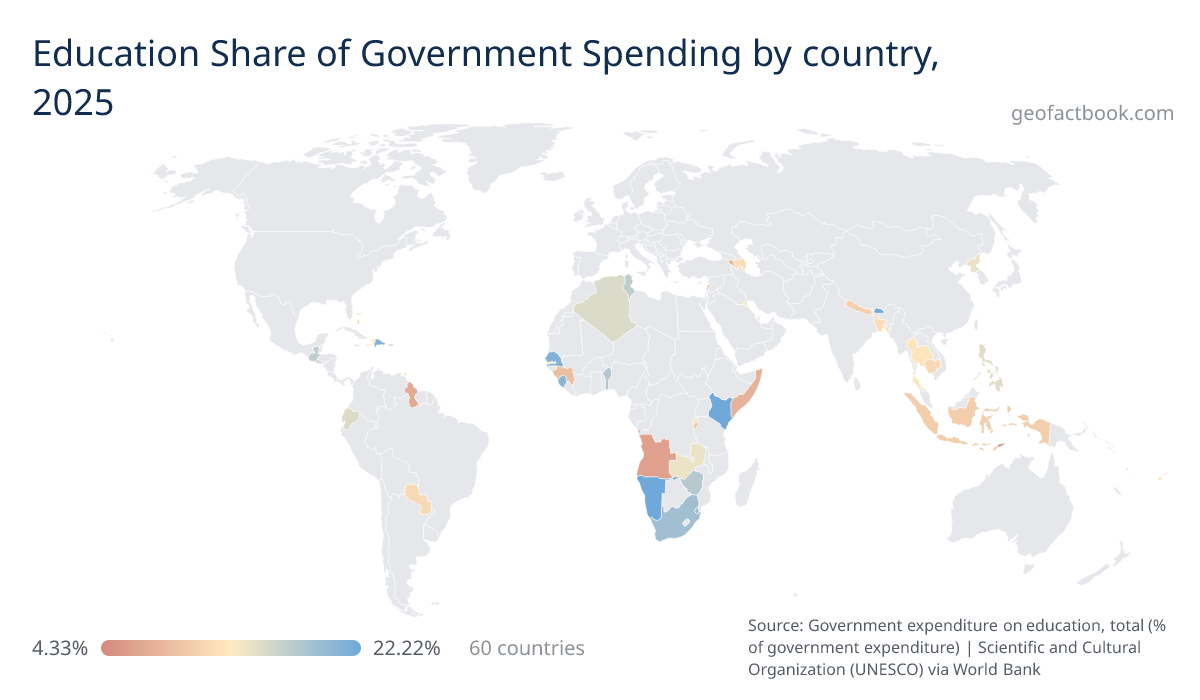
Education Share of Government Spending by country, 2025: map image
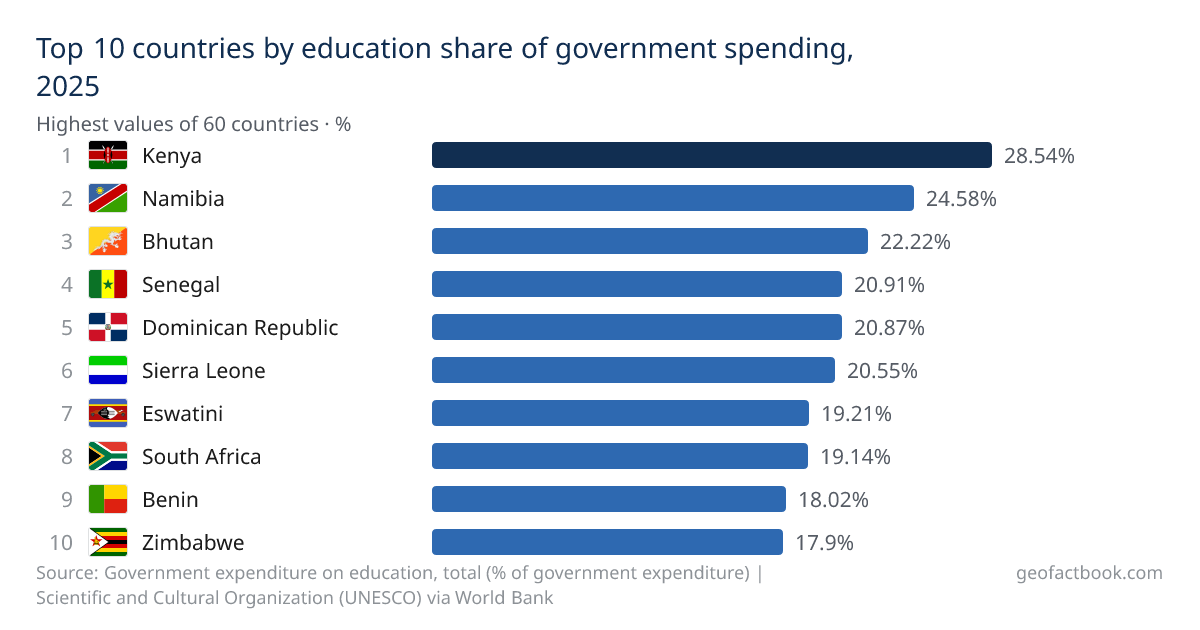
Top 10 countries by education share of government spending, 2025: chart
Insights by country
Tuvalu
In 2025, Tuvalu ranks #13 globally with an Education Share of Government Spending of 16.7921940098812 %. This figure is notably higher than the global average, indicating a strong commitment to education relative to many other nations. The country's limited resources and small population necessitate prioritizing education as a vital investment for sustainable development and economic resilience. Additionally, Tuvalu's geographic isolation emphasizes the importance of education in enhancing social mobility and adapting to climate change challenges.
Namibia
In 2025, Namibia ranks #2 globally for Education Share of Government Spending at 24.5766531675005 %. This figure significantly exceeds the average for sub-Saharan Africa, where education spending often falls below 20%. A strong commitment to education policy, driven by the government's recognition of its importance for economic development and social equity, has positioned Namibia as a leader in prioritizing educational investment.
Haiti
In 2025, Haiti ranks #27 globally with an Education Share of Government Spending of 13.1785226894835 %. This figure is notably higher than the average for the Caribbean region, indicating a prioritization of education in the national budget. Contributing factors include ongoing efforts to rebuild the education system post-earthquake, alongside international support aimed at improving literacy and access to education for its young population.
Guyana
In 2025, Guyana ranks #55 globally in Education Share of Government Spending, allocating 7.23643585047051 % of its budget to education. This figure is notably lower than the global average, positioning Guyana among the bottom tier of countries in this metric. The country's limited investment in education can be attributed to economic challenges and a focus on resource extraction, which often diverts funds from social services. Additionally, demographic factors such as a small population and high emigration rates impact the demand for educational resources.
Zambia
Zambia ranks #20 globally in 2025 for Education Share of Government Spending, allocating 14.5059984415104 % of its government budget to education. This is notably higher than the global average, reflecting a strong commitment to educational investment. Key drivers for this allocation include Zambia's demographic need for skilled labor to support economic growth and government policies aimed at improving educational access and quality in response to historical disparities.
Samoa
Samoa ranks #35 globally with an Education Share of Government Spending of 11.7144985078868 % in 2025. This figure is higher than the global average, reflecting a strong commitment to education in the Pacific region. Key drivers include Samoa's focus on improving educational outcomes through government initiatives and international aid, which aim to enhance access and quality in its education system.
Nauru
Nauru ranks #56 globally in Education Share of Government Spending, allocating 6.64816644734206 % of its government budget to education in 2025. This figure is notably lower than the global average, reflecting challenges faced by small island nations in prioritizing educational investment. The limited economic resources and a small population hinder Nauru's ability to enhance its education funding, impacting long-term development and workforce skills.
Ecuador
Ecuador ranks #17 globally in Education Share of Government Spending for 2025, dedicating 15.4874468876329 % of its budget to education. This figure is notably higher than the regional average in South America, indicating a strong commitment to educational investment. Key drivers for this statistic include recent government policies aimed at improving educational access and quality, as well as an increasing recognition of education as vital for economic development and social equity in the country.
Algeria
In 2025, Algeria ranks #16 globally in Education Share of Government Spending, allocating 15.542678598755 % of its budget to education. This figure is notably higher than the global average, reflecting a strong commitment to improving educational outcomes. Key drivers include government policies prioritizing education as a means to foster economic development and a young population that demands quality educational services.
Kuwait
Kuwait ranks #24 globally in 2025 for Education Share of Government Spending, allocating 13.8452209326003 % of its budget to education. This figure is above the global average but lower than its neighbor Saudi Arabia, which invests more in education. The emphasis on education spending in Kuwait is driven by its small population and high GDP per capita, allowing for substantial investment in human capital development to diversify the economy beyond oil dependency.
Analysis & Context
In 2025, the country with the highest Education Share of Government Spending is Kenya, allocating 28.54% of its national budget to education. The global range for this metric spans from 4.33% to 28.54%. The global average stands at 13.19%, providing a benchmark for evaluating national priorities in education funding.
Economic Priorities and Education Funding
The data reveals a notable disparity in how countries prioritize education within their budgets. Countries like Kenya (28.54%), Namibia (24.57%), and Bhutan (22.22%) allocate a significant portion of their government spending to education. These nations often view education as a critical driver for economic development and social stability. In contrast, countries such as Timor-Leste (4.33%) and Dominica (5.80%) allocate the least, possibly reflecting economic constraints or different governmental priorities.
A high education share often correlates with policy decisions aimed at fostering long-term development goals. For instance, Kenya has been focusing on expanding educational access as part of its Vision 2030 strategy, which aims to transform the country into a middle-income economy.
Geographic and Demographic Influences
Geography and demographics also play a significant role in education funding. African countries such as Kenya, Namibia, and Senegal feature prominently among the top spenders on education. This trend may be attributed to the continent's young population and the urgent need to equip a burgeoning youth demographic with skills necessary for future economic participation.
In contrast, smaller island nations like Antigua and Barbuda (5.87%) and Dominica (5.80%) may face unique challenges such as limited fiscal resources and higher costs of educational infrastructure, influencing their lower spending percentages.
Year-over-Year Trends and Significant Changes
The data from 2025 also highlights significant changes in education spending. Notably, Ecuador increased its education budget by 5.79%, a substantial 59.8% rise from the previous year. This increase may reflect a strategic investment in human capital to boost economic resilience and productivity.
Conversely, Algeria saw the most significant decrease, reducing its education spending by 8.35% or 34.9%. Such a decline could be attributed to economic difficulties or reallocations to other pressing sectors. Similarly, Antigua and Barbuda reduced its education budget by 5.17%, marking a 46.8% decrease, which might indicate shifts in policy focus or fiscal adjustments.
Policy Implications and Future Outlook
The varying shares of government spending on education underscore different national strategies and challenges. Countries with higher allocations often prioritize education as a means of addressing socio-economic disparities and fostering innovation. For example, Bhutan (22.22%) has seen a 29.3% increase, aligning with its Gross National Happiness philosophy, which emphasizes holistic development.
Looking forward, the global landscape of education funding will likely continue to evolve as nations adapt to changing economic conditions, technological advancements, and demographic shifts. Countries with declining education shares might need to reassess their strategies to ensure sustainable development and competitiveness in a globalized economy.
Frequently Asked Questions About Education Share of Government Spending in 2025
Which country has the highest education share of government spending in 2025?
Kenya has the highest education share of government spending in 2025, with 28.54%.
Which country has the lowest education share of government spending in 2025?
Timor-Leste has the lowest education share of government spending in 2025, with 4.33%.
What is the average education share of government spending across all countries in 2025?
The average education share of government spending across all countries in 2025 is 13.19%.
What is the median education share of government spending in 2025?
The median education share of government spending in 2025 is 12.35%.
Which countries are in the top 3 for education share of government spending in 2025?
The top 3 countries for education share of government spending in 2025 are Kenya (28.54%), Namibia (24.58%), and Bhutan (22.22%).
What is the range of education share of government spending in 2025?
The range of education share of government spending in 2025 is from Timor-Leste's 4.33% to Kenya's 28.54%.
Data Source
Government expenditure on education, total (% of government expenditure) | Scientific and Cultural Organization (UNESCO) via World Bank
Data produced by Data API, UN Educational, Scientific and Cultural Organization (UNESCO), compiled and published by World Bank as "Government expenditure on education, total (% of government expenditure)".
Visit Data SourceCite this page
Geo Factbook. (n.d.). Education Share of Government Spending by Country, 2025. Retrieved November 28, 2026, from https://geofactbook.com/fact/education-share-of-government-spending/2025
The figures on this page come from Government expenditure on education, total (% of government expenditure) | Scientific and Cultural Organization (UNESCO) via World Bank. For academic work, cite the original source as well.
›Embed this ranking on your site
Free to embed with attribution. Shows the top 10 countries and links back to the full ranking.
Historical Data by Year
Explore Education Share of Government Spending data across different years. Compare trends and see how statistics have changed over time.
More Government Facts
See all Government facts →Prison Population Rate
Explore prison population rate per 100,000 people; measure incarceration levels across countries and understand justice system trends.
 Highest: Panama533 per 100,000
Governance Effectiveness Rating
Governance Effectiveness Rating assesses the quality of public services and government policy implementation.
Highest: Singapore95.17LGBT Rights Index Score
LGBT Rights Index Score assesses legal protections and societal attitudes towards LGBT individuals in a country.
 Highest: Malta20.28
You might also like
Human Capital Index
FeaturedThe Human Capital Index measures a country's investment in education and health, reflecting its potential for economic growth and productivity. This vital statistic highlights the importance of nurturing human resources for sustainable development.
Highest: Singapore0.91Percentage of land area by degree of urbanization
FeaturedExplore the percentage of land area by degree of urbanization, highlighting how urban development shapes countries' landscapes and influences economic growth. Understanding this statistic reveals the balance between urban and rural spaces, essential for sustainable planning.
 Highest: Holy See100%
Total population
FeaturedDiscover the latest total population statistics for every country and region worldwide. Explore accurate, up-to-date data on global population growth, density, and demographic trends — sourced from trusted international databases like the UN and World Bank. Perfect for researchers, students, and data enthusiasts looking to understand how the world’s population is changing.
 Highest: India1.48B persons