
Paraguay Female population of reproductive age 2026: 1.85 Million
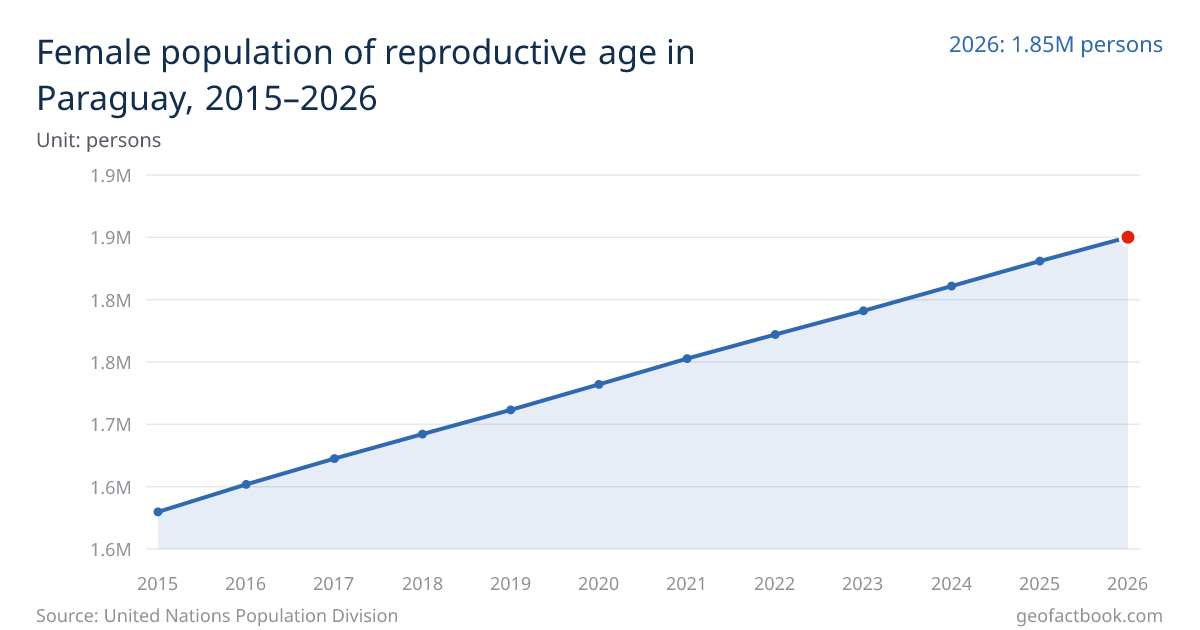
Paraguay's female population of reproductive age in 2026 is 1.85 Million (estimate), up 1.0% from 2025. It ranks #107 of 236 countries.
The female population of reproductive age is a crucial demographic statistic that influences healthcare, economic growth, and social policies in countries. Understanding this population helps address reproductive health needs and support family planning initiatives.
Estimated value for 2026 (interpolated, no direct source).
Where Paraguay ranks (2026)
#107 of 236- #105
 Switzerland1.91M persons
- #106
 Austria1.91M persons
- #107
 Paraguay1.85M persons
- #108
 Kyrgyzstan1.85M persons
- #109
 El Salvador1.78M persons
Female population of reproductive age over timeSome values are estimated based on historical trends
| Year | Value | Change | % Change | Actions |
|---|---|---|---|---|
| 2026 | 1.85M persons | +19.15K persons | +1.05% | |
| 2025 | 1.83M persons | +20.05K persons | +1.11% | |
| 2024 | 1.81M persons | +19.84K persons | +1.11% | |
| 2023 | 1.79M persons | +18.99K persons | +1.07% | |
| 2022 | 1.77M persons | +19.30K persons | +1.10% | |
| 2021 | 1.75M persons | +20.74K persons | +1.20% | |
| 2020 | 1.73M persons | +20.43K persons | +1.19% | |
| 2019 | 1.71M persons | +19.37K persons | +1.14% | |
| 2018 | 1.69M persons | +19.71K persons | +1.18% | |
| 2017 | 1.67M persons | +20.68K persons | +1.25% | |
| 2016 | 1.65M persons | +22.04K persons | +1.35% | |
| 2015 | 1.63M persons | — | — |
Female population of reproductive age in Paraguay, 2015–2026: chart
Cite this page
Geo Factbook. (n.d.). Paraguay: Female population of reproductive age. Retrieved November 28, 2026, from https://geofactbook.com/countries/paraguay/female-population-of-reproductive-age
The figures on this page come from United Nations Population Division. For academic work, cite the original source as well.
Frequently Asked Questions About Paraguay Female population of reproductive age
What is Paraguay's female population of reproductive age in 2026?▾
Paraguay's female population of reproductive age is 1.85 Million in 2026 (estimate), according to United Nations Population Division.
Is Paraguay's female population of reproductive age increasing or decreasing?▾
Paraguay's female population of reproductive age rose by 1.0% from 2025 (1.83 Million) to 2026 (1.85 Million). Over the past decade (2016–2026) it rose by 12.0%.
How does Paraguay rank for female population of reproductive age?▾
In 2026, Paraguay has the 107th highest female population of reproductive age out of 236 countries with data.
What was Paraguay's female population of reproductive age in 2015?▾
In 2015, Paraguay's female population of reproductive age was 1.63 Million. By 2026 it rose by 13.5%.
Explore additional statistical insights
Female Homicide Rate in Paraguay
Female homicide rate measures the number of women murdered per 100,000 women annually, highlighting gender-based violence levels.
Total fertility rate in Paraguay
The total fertility rate measures the average number of children a woman is expected to have during her lifetime, reflecting population growth and demographic trends. Understanding this statistic is crucial for analyzing economic development, healthcare needs, and societal changes across countries.
Share of Students Studying Abroad in Paraguay
Share of students studying abroad tracks the percentage of tertiary-level students enrolled outside their home country.
Under-five mortality rate in Paraguay
The under-five mortality rate measures the number of deaths per 1,000 live births for children under five. This critical statistic highlights child health and development, reflecting a country's healthcare quality and socioeconomic conditions. Understanding these rates is vital for improving global health initiatives.
Population Growth Rate in Paraguay
Explore the Population Growth Rate across 266+ countries. Compare trends, view rankings, and interact with detailed maps.
Military Service Age and Obligation in Paraguay
Military service age and obligation details for 266+ countries. Compare requirements, explore rankings, and view interactive maps.