
El Salvador Female population of reproductive age 2026: 1.78 Million
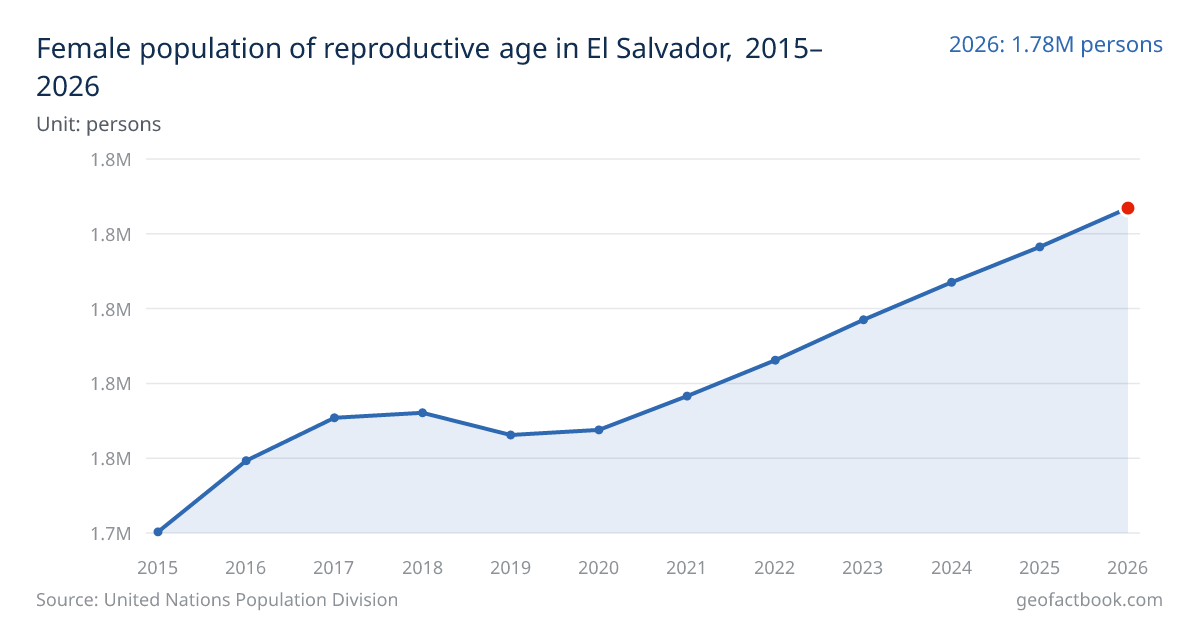
El Salvador's female population of reproductive age in 2026 is 1.78 Million (estimate), up 0.3% from 2025. It ranks #109 of 236 countries.
The female population of reproductive age is a crucial demographic statistic that influences healthcare, economic growth, and social policies in countries. Understanding this population helps address reproductive health needs and support family planning initiatives.
Estimated value for 2026 (interpolated, no direct source).
Where El Salvador ranks (2026)
#109 of 236- #107
 Paraguay1.85M persons
- #108
 Kyrgyzstan1.85M persons
- #109
 El Salvador1.78M persons
- #110
 China, Hong Kong SAR1.71M persons
- #111
 Congo1.61M persons
Female population of reproductive age over timeSome values are estimated based on historical trends
| Year | Value | Change | % Change | Actions |
|---|---|---|---|---|
| 2026 | 1.78M persons | +5.18K persons | +0.29% | |
| 2025 | 1.78M persons | +4.73K persons | +0.27% | |
| 2024 | 1.77M persons | +5.02K persons | +0.28% | |
| 2023 | 1.77M persons | +5.41K persons | +0.31% | |
| 2022 | 1.76M persons | +4.79K persons | +0.27% | |
| 2021 | 1.76M persons | +4.52K persons | +0.26% | |
| 2020 | 1.75M persons | +687 persons | +0.04% | |
| 2019 | 1.75M persons | 2.97K persons | -0.17% | |
| 2018 | 1.76M persons | +667 persons | +0.04% | |
| 2017 | 1.76M persons | +5.74K persons | +0.33% | |
| 2016 | 1.75M persons | +9.51K persons | +0.55% | |
| 2015 | 1.74M persons | — | — |
Female population of reproductive age in El Salvador, 2015–2026: chart
Cite this page
Geo Factbook. (n.d.). El Salvador: Female population of reproductive age. Retrieved November 29, 2026, from https://geofactbook.com/countries/el-salvador/female-population-of-reproductive-age
The figures on this page come from United Nations Population Division. For academic work, cite the original source as well.
Frequently Asked Questions About El Salvador Female population of reproductive age
What is El Salvador's female population of reproductive age in 2026?▾
El Salvador's female population of reproductive age is 1.78 Million in 2026 (estimate), according to United Nations Population Division.
Is El Salvador's female population of reproductive age increasing or decreasing?▾
El Salvador's female population of reproductive age rose by 0.3% from 2025 (1.78 Million) to 2026 (1.78 Million). Over the past decade (2016–2026) it rose by 1.9%.
How does El Salvador rank for female population of reproductive age?▾
In 2026, El Salvador has the 109th highest female population of reproductive age out of 236 countries with data.
What was El Salvador's female population of reproductive age in 2015?▾
In 2015, El Salvador's female population of reproductive age was 1.74 Million. By 2026 it rose by 2.5%.
Explore additional statistical insights
Contraceptive Prevalence Rate in El Salvador
Contraceptive Prevalence Rate indicates the percentage of women using contraception. Explore global rankings, compare countries, and view trends.
Population Change in El Salvador
This statistic measures population change across countries, highlighting shifts in demographics. Understanding these changes is crucial for planning resources, economic growth, and social services.
Life expectancy at birth in El Salvador
Life expectancy at birth measures the average years a newborn is expected to live, reflecting a country's health standards and quality of life. This vital statistic highlights disparities in healthcare and living conditions across nations, making it essential for global health assessments.
Total demand for family planning (Percent) in El Salvador
Total demand for family planning measures the percentage of individuals seeking access to reproductive health services. Understanding this statistic is crucial for addressing global population growth and improving health outcomes.
Share of Population Born Abroad in El Salvador
Share of the population born in another country; reflects immigration impact on demographics; varies widely across nations.
Milk Consumption per Capita in El Salvador
Milk consumption per capita indicates dietary habits and dairy dependence across countries.