
Switzerland Female population of reproductive age 2026: 1.91 Million
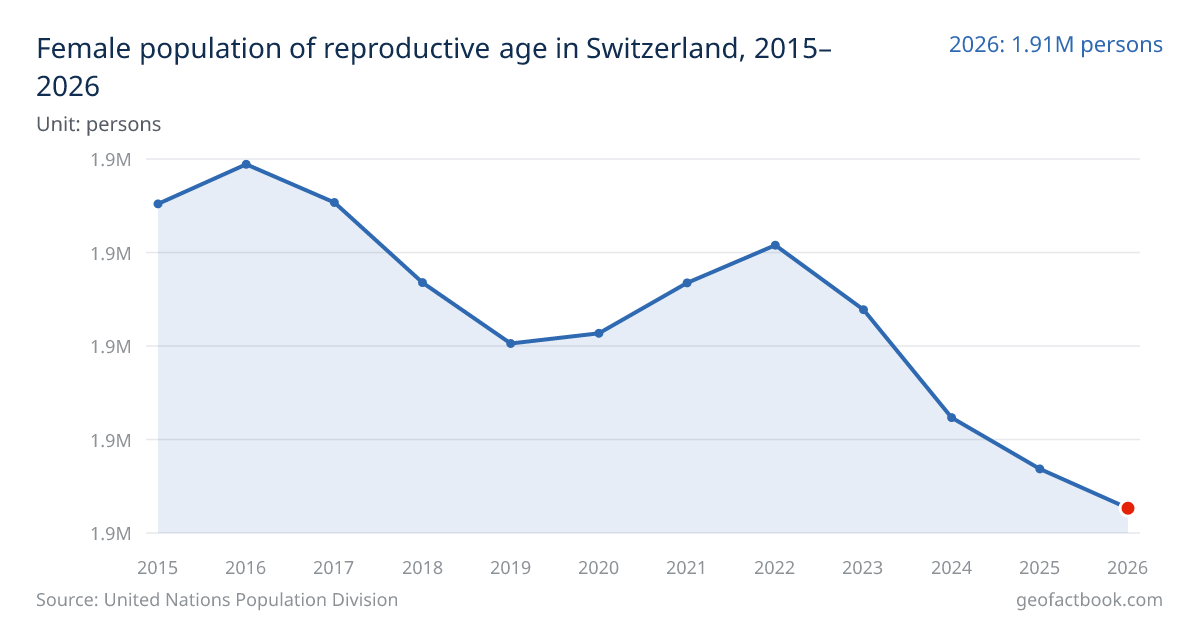
Switzerland's female population of reproductive age in 2026 is 1.91 Million (estimate), down 0.1% from 2025. It ranks #105 of 236 countries.
The female population of reproductive age is a crucial demographic statistic that influences healthcare, economic growth, and social policies in countries. Understanding this population helps address reproductive health needs and support family planning initiatives.
Estimated value for 2026 (interpolated, no direct source).
Where Switzerland ranks (2026)
#105 of 236- #103
 Turkmenistan1.95M persons
- #104
 Greece1.91M persons
- #105
 Switzerland1.91M persons
- #106
 Austria1.91M persons
- #107
 Paraguay1.85M persons
Female population of reproductive age over timeSome values are estimated based on historical trends
| Year | Value | Change | % Change | Actions |
|---|---|---|---|---|
| 2026 | 1.91M persons | 2.10K persons | -0.11% | |
| 2025 | 1.91M persons | 2.74K persons | -0.14% | |
| 2024 | 1.92M persons | 5.77K persons | -0.30% | |
| 2023 | 1.92M persons | 3.45K persons | -0.18% | |
| 2022 | 1.93M persons | +2.01K persons | +0.10% | |
| 2021 | 1.92M persons | +2.70K persons | +0.14% | |
| 2020 | 1.92M persons | +546.5 persons | +0.03% | |
| 2019 | 1.92M persons | 3.26K persons | -0.17% | |
| 2018 | 1.92M persons | 4.28K persons | -0.22% | |
| 2017 | 1.93M persons | 2.04K persons | -0.11% | |
| 2016 | 1.93M persons | +2.12K persons | +0.11% | |
| 2015 | 1.93M persons | — | — |
Female population of reproductive age in Switzerland, 2015–2026: chart
Cite this page
Geo Factbook. (n.d.). Switzerland: Female population of reproductive age. Retrieved November 28, 2026, from https://geofactbook.com/countries/switzerland/female-population-of-reproductive-age
The figures on this page come from United Nations Population Division. For academic work, cite the original source as well.
Frequently Asked Questions About Switzerland Female population of reproductive age
What is Switzerland's female population of reproductive age in 2026?▾
Switzerland's female population of reproductive age is 1.91 Million in 2026 (estimate), according to United Nations Population Division.
Is Switzerland's female population of reproductive age increasing or decreasing?▾
Switzerland's female population of reproductive age fell by 0.1% from 2025 (1.91 Million) to 2026 (1.91 Million). Over the past decade (2016–2026) it fell by 1.0%.
How does Switzerland rank for female population of reproductive age?▾
In 2026, Switzerland has the 105th highest female population of reproductive age out of 236 countries with data.
What was Switzerland's female population of reproductive age in 2015?▾
In 2015, Switzerland's female population of reproductive age was 1.93 Million. By 2026 it fell by 0.8%.
Explore additional statistical insights
Voter Turnout (% of Voting-Age Population) in Switzerland
Voting age population denotes individuals eligible to vote based on age, providing insights into electoral demographics.
Total deaths in Switzerland
Total deaths in countries measure the number of individuals who have passed away within a specific timeframe. This statistic is crucial for understanding health trends, mortality rates, and the impact of various factors on population dynamics.
Population Change in Switzerland
This statistic measures population change across countries, highlighting shifts in demographics. Understanding these changes is crucial for planning resources, economic growth, and social services.
Female Tertiary Enrollment Rate (%) in Switzerland
This measures the percentage of female students enrolling in tertiary education, reflecting gender parity in higher education globally.
Total fertility rate in Switzerland
The total fertility rate measures the average number of children a woman is expected to have during her lifetime, reflecting population growth and demographic trends. Understanding this statistic is crucial for analyzing economic development, healthcare needs, and societal changes across countries.
Average Spirits Consumption Per Capita in Switzerland
Average spirits consumption per capita highlights drinking habits in different countries, measured in liters annually.