
Suffrage Participation Rate 2023
Suffrage Participation Rate reflects voter engagement across countries. Compare rates, explore rankings, and visualize trends with interactive maps.
Interactive Map
Complete Data Rankings

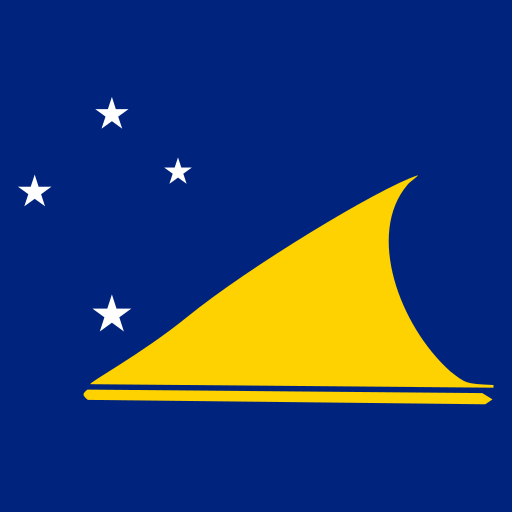









































































































































































































Analysis: These countries represent the highest values in this dataset, showcasing significant scale and impact on global statistics.
- #218
 Austria
 - #217
 Nicaragua
 - #216
 Cuba
Cuba - #215
 Greece
 - #214
 Timor-Leste
 - #213
 North Korea
 - #212
 Indonesia
 - #211
 Pakistan
 - #210
 Nepal
Nepal - #209
 Maldives
Context: These countries or territories have the lowest values, often due to geographic size, administrative status, or specific characteristics.
Analysis & Context
In 2023, the country with the highest Suffrage Participation Rate is shared by several nations, including Kuwait, Tokelau, and Oman, each with a rate of 21. Globally, the Suffrage Participation Rate ranges from 18.00 to 21.00. The average rate across the 200 countries with available data is 18.16, while the median is 18.00.
Geopolitical Factors Influencing High Participation Rates
The countries with the highest Suffrage Participation Rate of 21 include Kuwait, Tokelau, and Oman. This uniformity in high participation can be attributed to several geopolitical factors. For instance, in Kuwait and Oman, strong governmental structures and limited electoral choices may incentivize voter turnout by emphasizing the importance of each vote in determining policy directions. Additionally, in smaller regions like Tokelau, the intimate nature of local governance can lead to higher engagement as citizens feel a direct impact from their participation.
Economic Stability and Voter Engagement
Economic conditions often play a significant role in suffrage participation. Countries like Singapore and Bahrain, both with high rates of 21 and 20 respectively, have stable economies, which can foster a politically engaged populace. Economic stability tends to increase trust in governmental systems, empowering citizens to participate actively in electoral processes. Conversely, economic challenges can sometimes lead to voter apathy, yet in these nations, robust economic health appears to bolster civic involvement.
The Role of Policy and Cultural Norms
Policy frameworks and cultural norms are pivotal in driving voter turnout. In nations such as Tonga and Samoa, where the participation rate is also at the maximum of 21, cultural emphasis on civic duty and community participation is prevalent. These norms can be reinforced by policies that facilitate or mandate voting, thereby ensuring high participation. In contrast, countries with lower participation rates, such as the United States and Canada (both at 18), might reflect more complex electoral systems or cultural attitudes that do not prioritize voting as strongly.
Stability in Year-Over-Year Trends
Interestingly, the year-over-year analysis reveals no significant changes in the Suffrage Participation Rate across the board, with an average change of 0.00. This stability suggests entrenched voter behaviors and possibly the effectiveness of existing electoral systems in maintaining consistent engagement levels. The lack of both increases and decreases, as seen in countries like Oman and Tonga, indicates that these nations may have reached a saturation point in voter engagement, where participation is maximized given current conditions.
In summary, the Suffrage Participation Rate in 2023 highlights diverse factors influencing voter engagement, from geopolitical and economic stability to cultural norms and policy structures. The consistency in participation rates across the globe reflects both challenges and successes in fostering democratic participation, with some countries achieving high engagement through tailored approaches to governance and civic involvement.
Frequently Asked Questions About Suffrage Participation Rate in 2023
Which country has the highest suffrage participation rate in 2023?
Kuwait has the highest suffrage participation rate in 2023, with a value of 21.
What is the lowest suffrage participation rate recorded in 2023 and which country has it?
The lowest suffrage participation rate in 2023 is 16, recorded by Nicaragua.
What is the average suffrage participation rate across all countries in 2023?
The average suffrage participation rate across all 215 countries in 2023 is 18.1.
What is the median suffrage participation rate in 2023?
The median suffrage participation rate in 2023 is 18.
Which countries are in the top 10 for suffrage participation rate in 2023?
The top 10 countries for suffrage participation rate in 2023 are Kuwait, Tokelau, Oman, Tonga, Singapore, Lebanon, Samoa, Solomon Islands, Nauru, and Bahrain.
How many countries are included in the suffrage participation rate dataset for 2023?
The dataset includes suffrage participation rate data for 215 countries in 2023.
Data Source
CIA World Factbook
The World Factbook, also known as the CIA World Factbook, was a reference resource produced by the US Central Intelligence Agency between 1962 and 2026 with almanac-style information about the countries of the world. From 1971 it was not classified, and available to the public in print since 1975, initially by the CIA, and later the Government Publishing Office.
Visit Data SourceHistorical Data by Year
Explore Suffrage Participation Rate data across different years. Compare trends and see how statistics have changed over time.
More Government Facts
Rule of Law Index by Country
Compare countries by Rule of Law percentile rank, reflecting confidence in laws, courts, police, property rights, and protection from crime and violence.
View dataBrowse All Government
Explore more facts and statistics in this category
All Categories
Discover more categories with comprehensive global data