
Suffrage Participation Rate 2018
Suffrage Participation Rate reflects voter engagement across countries. Compare rates, explore rankings, and visualize trends with interactive maps.
Interactive Map
Complete Data Rankings














































































































































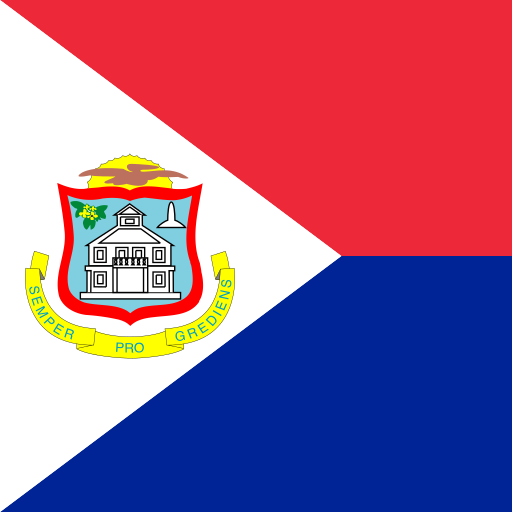































































Analysis: These countries represent the highest values in this dataset, showcasing significant scale and impact on global statistics.
- #218
 Nicaragua
 - #217
 Cuba
Cuba - #216
 North Korea
 - #215
 Indonesia
 - #214
 Greece
 - #213
 Wallis and Futuna Islands
 - #212
 Holy See
 - #211
 Timor-Leste
 - #210
 Zimbabwe
 - #209
 Zambia
Context: These countries or territories have the lowest values, often due to geographic size, administrative status, or specific characteristics.
Analysis & Context
In 2018, the countries with the highest Suffrage Participation Rate were Malaysia, Tokelau, Oman, Solomon Islands, Tonga, Singapore, Samoa, Lebanon, and Kuwait, all achieving a rate of 21. The global range for this metric spanned from a minimum of 18.00 to a maximum of 21.00. The median suffrage participation rate across the 200 countries with available data was 18.00, providing a clear benchmark for comparison.
Uniformity in Suffrage Participation: A Global Overview
The minimal variation in the Suffrage Participation Rate across countries in 2018 suggests a global uniformity in voter engagement practices. The majority of countries, including Ukraine, United Kingdom, and Uganda, reported a participation rate of 18. This clustering around the lower end of the spectrum indicates a widespread standardization of suffrage metrics, potentially influenced by similar electoral systems and voter registration processes. Countries like Malaysia and Singapore reaching the upper limit of 21 might reflect more inclusive or mandatory voting policies, which are less common globally.
Economic and Policy Influences on Suffrage Participation
Economic and policy factors significantly influence the Suffrage Participation Rate. For instance, countries with higher participation rates such as Kuwait and Oman often have robust governmental structures that emphasize civic duty, possibly through compulsory voting laws. Conversely, nations like Turkey and Tunisia with rates at the lower end might face challenges such as voter apathy or disenfranchisement stemming from economic instability or political unrest. The uniformity observed in the data suggests that while economic conditions vary, policy frameworks regarding suffrage remain a critical determinant of participation rates.
Geopolitical Factors and Regional Patterns
Geopolitical factors also play a role in shaping suffrage participation. The clustering of high participation rates in countries such as Singapore and Bahrain could be attributed to their strategic geopolitical positions, which necessitate stable governance and active citizen participation. In contrast, countries like Sao Tome and Principe and Tuvalu with a rate of 18 may face logistical challenges in voter engagement due to their geographic isolation. This suggests that while geographic positioning can either bolster or hinder voter participation, regional political stability remains a pivotal factor.
Stability in Year-over-Year Changes
The Suffrage Participation Rate data for 2018 reveals no substantial year-over-year changes, with an average change of 0.00 across all countries. This stability might reflect entrenched electoral processes that do not fluctuate significantly on an annual basis. The lack of variation in both increases and decreases, as seen in countries like Tokelau and Solomon Islands, suggests that once established, voter engagement mechanisms remain consistent barring major political reforms or upheavals. This steadiness offers insights into the durability of electoral systems and their resistance to rapid change.
Overall, the 2018 Suffrage Participation Rate data showcases a remarkably consistent global landscape, where economic, policy, and geopolitical factors collectively mold voter engagement. Understanding these dynamics is essential for comprehending how nations can enhance or sustain voter participation in the future.
Frequently Asked Questions About Suffrage Participation Rate in 2018
Which country had the highest suffrage participation rate in 2018?
Malaysia had the highest suffrage participation rate in 2018, with a value of 21.
What was the average suffrage participation rate across all countries in 2018?
The average suffrage participation rate across all countries in 2018 was 18.12.
Which country had the lowest suffrage participation rate in 2018?
Nicaragua had the lowest suffrage participation rate in 2018, with a value of 16.
What is the median suffrage participation rate in 2018?
The median suffrage participation rate in 2018 was 18.
How many countries are included in the suffrage participation rate dataset for 2018?
The dataset includes 215 countries for the suffrage participation rate in 2018.
What is the range of suffrage participation rates in 2018?
The range of suffrage participation rates in 2018 spans from 16 to 21.
Data Source
CIA World Factbook
The World Factbook, also known as the CIA World Factbook, was a reference resource produced by the US Central Intelligence Agency between 1962 and 2026 with almanac-style information about the countries of the world. From 1971 it was not classified, and available to the public in print since 1975, initially by the CIA, and later the Government Publishing Office.
Visit Data SourceHistorical Data by Year
Explore Suffrage Participation Rate data across different years. Compare trends and see how statistics have changed over time.
More Government Facts
Rule of Law Index by Country
Compare countries by Rule of Law percentile rank, reflecting confidence in laws, courts, police, property rights, and protection from crime and violence.
View dataBrowse All Government
Explore more facts and statistics in this category
All Categories
Discover more categories with comprehensive global data