
Lithuania Female population of reproductive age 2026: 612,275
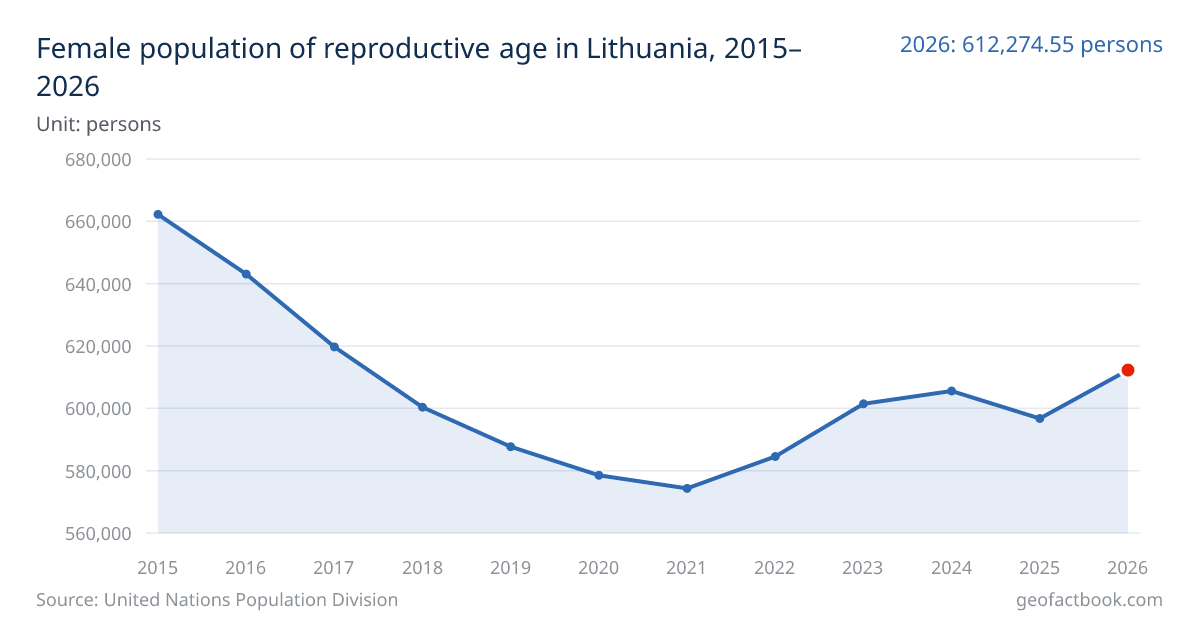
Lithuania's female population of reproductive age in 2026 is 612,275 (estimate), up 2.6% from 2025. It ranks #146 of 236 countries.
The female population of reproductive age is a crucial demographic statistic that influences healthcare, economic growth, and social policies in countries. Understanding this population helps address reproductive health needs and support family planning initiatives.
Estimated value for 2026 (interpolated, no direct source).
Where Lithuania ranks (2026)
#146 of 236- #144
 Bosnia and Herzegovina639,071.55 persons
- #145
 Albania636,210.8 persons
- #146
 Lithuania612,274.55 persons
- #147
 Qatar590,690.4 persons
- #148
 Guinea-Bissau589,854.55 persons
Female population of reproductive age over timeSome values are estimated based on historical trends
| Year | Value | Change | % Change | Actions |
|---|---|---|---|---|
| 2026 | 612.27K persons | +15.54K persons | +2.60% | |
| 2025 | 596.73K persons | 8.83K persons | -1.46% | |
| 2024 | 605.56K persons | +4.09K persons | +0.68% | |
| 2023 | 601.46K persons | +16.93K persons | +2.90% | |
| 2022 | 584.53K persons | +10.21K persons | +1.78% | |
| 2021 | 574.32K persons | 4.20K persons | -0.73% | |
| 2020 | 578.52K persons | 9.16K persons | -1.56% | |
| 2019 | 587.68K persons | 12.70K persons | -2.11% | |
| 2018 | 600.38K persons | 19.32K persons | -3.12% | |
| 2017 | 619.70K persons | 23.36K persons | -3.63% | |
| 2016 | 643.06K persons | 19.17K persons | -2.89% | |
| 2015 | 662.23K persons | — | — |
Female population of reproductive age in Lithuania, 2015–2026: chart
Cite this page
Geo Factbook. (n.d.). Lithuania: Female population of reproductive age. Retrieved November 28, 2026, from https://geofactbook.com/countries/lithuania/female-population-of-reproductive-age
The figures on this page come from United Nations Population Division. For academic work, cite the original source as well.
Frequently Asked Questions About Lithuania Female population of reproductive age
What is Lithuania's female population of reproductive age in 2026?▾
Lithuania's female population of reproductive age is 612,275 in 2026 (estimate), according to United Nations Population Division.
Is Lithuania's female population of reproductive age increasing or decreasing?▾
Lithuania's female population of reproductive age rose by 2.6% from 2025 (596,731) to 2026 (612,275). Over the past decade (2016–2026) it fell by 4.8%.
How does Lithuania rank for female population of reproductive age?▾
In 2026, Lithuania has the 146th highest female population of reproductive age out of 236 countries with data.
What was Lithuania's female population of reproductive age in 2015?▾
In 2015, Lithuania's female population of reproductive age was 662,226. By 2026 it fell by 7.5%.
Explore additional statistical insights
Primary School Pupil-Teacher Ratio in Lithuania
Pupil-teacher ratio in primary schools reflects educational quality; lower ratios indicate more personalized attention.
Currently married (Percent) in Lithuania
The percentage of currently married individuals by country highlights societal trends in family structure and relationships. Understanding these statistics can provide insights into cultural norms and demographic shifts, influencing policies and social programs.
Learning-adjusted years of school in Lithuania
Learning-adjusted years of school measures educational quality by accounting for both enrollment and learning outcomes. This statistic highlights the effectiveness of education systems across countries, emphasizing the need for improved learning environments.
Voter Turnout (% of Voting-Age Population) in Lithuania
Voting age population denotes individuals eligible to vote based on age, providing insights into electoral demographics.
Military Service Age and Obligation in Lithuania
Military service age and obligation details for 266+ countries. Compare requirements, explore rankings, and view interactive maps.
Total deaths in Lithuania
Total deaths in countries measure the number of individuals who have passed away within a specific timeframe. This statistic is crucial for understanding health trends, mortality rates, and the impact of various factors on population dynamics.