
Guinea-Bissau Female population of reproductive age 2026: 589,855
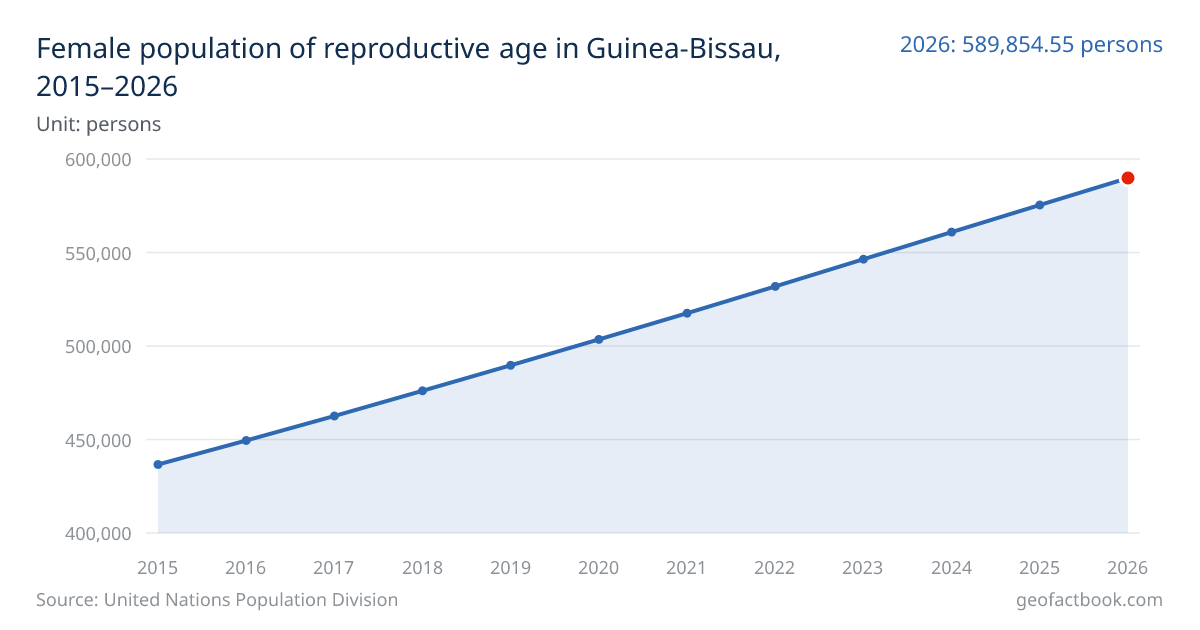
Guinea-Bissau's female population of reproductive age in 2026 is 589,855 (estimate), up 2.5% from 2025. It ranks #148 of 236 countries.
The female population of reproductive age is a crucial demographic statistic that influences healthcare, economic growth, and social policies in countries. Understanding this population helps address reproductive health needs and support family planning initiatives.
Estimated value for 2026 (interpolated, no direct source).
Where Guinea-Bissau ranks (2026)
#148 of 236- #146
 Lithuania612,274.55 persons
- #147
 Qatar590,690.4 persons
- #148
 Guinea-Bissau589,854.55 persons
- #149
 Equatorial Guinea453,535.6 persons
- #150
 Kosovo430,235.4 persons
Female population of reproductive age over timeSome values are estimated based on historical trends
| Year | Value | Change | % Change | Actions |
|---|---|---|---|---|
| 2026 | 589.85K persons | +14.45K persons | +2.51% | |
| 2025 | 575.41K persons | +14.50K persons | +2.59% | |
| 2024 | 560.90K persons | +14.46K persons | +2.65% | |
| 2023 | 546.44K persons | +14.56K persons | +2.74% | |
| 2022 | 531.88K persons | +14.32K persons | +2.77% | |
| 2021 | 517.55K persons | +14.02K persons | +2.78% | |
| 2020 | 503.54K persons | +13.84K persons | +2.83% | |
| 2019 | 489.70K persons | +13.67K persons | +2.87% | |
| 2018 | 476.03K persons | +13.46K persons | +2.91% | |
| 2017 | 462.56K persons | +13.12K persons | +2.92% | |
| 2016 | 449.44K persons | +12.79K persons | +2.93% | |
| 2015 | 436.65K persons | — | — |
Female population of reproductive age in Guinea-Bissau, 2015–2026: chart
Cite this page
Geo Factbook. (n.d.). Guinea-Bissau: Female population of reproductive age. Retrieved November 29, 2026, from https://geofactbook.com/countries/guinea-bissau/female-population-of-reproductive-age
The figures on this page come from United Nations Population Division. For academic work, cite the original source as well.
Frequently Asked Questions About Guinea-Bissau Female population of reproductive age
What is Guinea-Bissau's female population of reproductive age in 2026?▾
Guinea-Bissau's female population of reproductive age is 589,855 in 2026 (estimate), according to United Nations Population Division.
Is Guinea-Bissau's female population of reproductive age increasing or decreasing?▾
Guinea-Bissau's female population of reproductive age rose by 2.5% from 2025 (575,407) to 2026 (589,855). Over the past decade (2016–2026) it rose by 31.2%.
How does Guinea-Bissau rank for female population of reproductive age?▾
In 2026, Guinea-Bissau has the 148th highest female population of reproductive age out of 236 countries with data.
What was Guinea-Bissau's female population of reproductive age in 2015?▾
In 2015, Guinea-Bissau's female population of reproductive age was 436,652. By 2026 it rose by 35.1%.
Explore additional statistical insights
Labor Force in Guinea-Bissau
Labor force participation rate measures the active workforce in each country. Explore rankings, compare nations, and view historical trends.
Crude Birth Rate in Guinea-Bissau
Crude birth rate measures births per 1,000 people. Identify regions with high or low birth rates globally.
Population Change in Guinea-Bissau
This statistic measures population change across countries, highlighting shifts in demographics. Understanding these changes is crucial for planning resources, economic growth, and social services.
Percentage of population by degree of urbanization in Guinea-Bissau
Explore the percentage of population by degree of urbanization across countries, highlighting the shift towards urban living and its impact on economic growth and development. Understanding these trends is crucial for addressing urban planning and resource allocation.
Physician Density in Guinea-Bissau
Physician density measures healthcare access, showing the number of doctors per square kilometer. Compare countries and explore interactive maps.
Global Average Sex Ratio at Birth in Guinea-Bissau
Explore the global average sex ratio at birth, highlighting the natural baseline in different countries.