
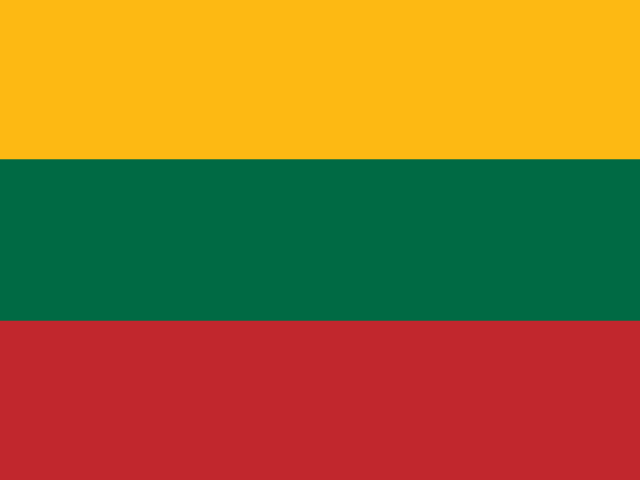
Location
Lithuania is in Eastern Europe, bordering the Baltic Sea, between Latvia and Russia, west of Belarus. It shares land borders with Belarus (640 km), Latvia (544 km), Russia (Kaliningrad) (261 km) and Poland (100 km) and has 90 km of coastline. The capital is Vilnius.
Lithuania population 2026: 2.8 Million — growth, rank & history →Key Statistics for 2026
Total population
Population Change
Median age of population
Population density
Life expectancy at birth
Agricultural land
Apple Import Volume
Dam capacity per capita
Female population of reproductive age
Health Care Spending per Capita
Learning-adjusted years of school
History
Lithuania's early history traces back to the prehistoric period, with evidence of human settlement dating as far back as 10,000 BC. The formation of the Baltic tribes, particularly the Lithuanians, began around the 4th century AD. The name "Lithuania" is believed to have originated from the word "litva," referring to the region's many rivers and lakes. By the 13th century, these tribes began consolidating into a more unified entity, laying the groundwork for the Grand Duchy of Lithuania, which would become a significant political power in Eastern Europe.
During the medieval period, specifically in the late 14th century, the Grand Duchy of Lithuania emerged as one of the largest and most influential states in Europe. It expanded its territory significantly, encompassing parts of modern-day Belarus, Ukraine, and Poland. In 1386, Lithuania entered a dynastic union with Poland through the marriage of Grand Duke Jogaila to Queen Jadwiga, forming the Polish-Lithuanian Commonwealth. This union brought about a cultural and political flourishing, although it also led to conflicts over territorial governance and the balance of power within the Commonwealth.
The modern history of Lithuania is marked by a series of significant events that shaped its national identity. Following the partitions of the Polish-Lithuanian Commonwealth in the late 18th century, Lithuania was absorbed into the Russian Empire. After the turmoil of World War I, Lithuania declared independence on February 16, 1918. However, this independence was short-lived due to World War II; Lithuania was occupied by the Soviet Union in 1940, then briefly by Nazi Germany, and re-occupied by the Soviets until the eventual collapse of the Soviet Union in 1990, when Lithuania declared independence once again.
In recent years, Lithuania has gained recognition for its rapid economic growth and democratic governance. Since joining the European Union and NATO in 2004, Lithuania has positioned itself as a significant player in regional politics and economic development. The country has also been notable for its advocacy of democracy and human rights within the post-Soviet landscape, serving as a model for other nations transitioning from authoritarian regimes. Lithuania's historical significance, particularly its resilience and cultural revival, continues to influence its contemporary identity and international relations.
Geography
Lithuania is situated in the northeastern part of Europe and is one of the three Baltic states, bordered by Latvia to the north, Belarus to the east and south, Poland to the south, and the Russian exclave of Kaliningrad to the west. The country has a coastline along the Baltic Sea, stretching approximately 90 kilometers. Its strategic location has historically made it a significant crossroads for trade and cultural exchange between Western and Eastern Europe.
The terrain of Lithuania is predominantly flat, characterized by vast plains and low hills. The highest point in the country is Aukštojas Hill, which reaches an elevation of 294 meters. Despite its general flatness, Lithuania is interspersed with numerous rivers and lakes, including the Neman River, which is the longest river in the country, flowing through a variety of landscapes. The country is also home to several large lakes, such as Lake Drūkšiai, which is the largest natural lake in Lithuania, and Lake Vištytis, known for its picturesque surroundings and biodiversity.
Lithuania experiences a temperate maritime climate, characterized by mild summers and cold winters. Average summer temperatures range from 20°C to 25°C, while winter temperatures can drop below -5°C. The coastal regions tend to have milder temperatures due to the influence of the Baltic Sea, whereas inland areas experience more significant temperature variations. Precipitation is relatively evenly distributed throughout the year, with a slight increase in summer months, making it a region where seasonal changes are distinctly observed.
The natural resources of Lithuania primarily include forests, which cover about one-third of the country's land area, and fertile agricultural land. The country is also rich in mineral resources such as limestone, clay, and peat. Environmental characteristics are marked by a commitment to conservation, with numerous protected areas, including national parks and nature reserves, that aim to preserve the rich biodiversity and natural landscapes. Lithuania's environmental policies focus on sustainable development and the protection of its natural heritage, reflecting the country's dedication to maintaining its ecological balance amidst economic growth.
Government
Lithuania operates as a parliamentary republic, characterized by a democratic system where the President serves as the head of state and the Prime Minister as the head of government. The political framework is structured to ensure a separation of powers among the executive, legislative, and judicial branches. This system promotes a robust democratic process and a commitment to civil liberties, which are integral to Lithuanian governance. The country is a member of the European Union and NATO, emphasizing its democratic values and international cooperation.
The executive branch of Lithuania is led by the President, who is elected for a five-year term and can serve a maximum of two consecutive terms. The President appoints the Prime Minister, who must secure the support of the Seimas, Lithuania's unicameral parliament. The Seimas consists of 141 members elected through a mixed electoral system, combining both proportional representation and single-member districts. This legislative body is responsible for enacting laws, approving the budget, and overseeing the executive branch, thus playing a critical role in the governance of the country.
The judicial system in Lithuania is independent and includes various courts, with the Supreme Court of Lithuania being the highest judicial authority. The judiciary is tasked with interpreting laws and ensuring justice, maintaining the rule of law within the country. Additionally, Lithuania has a Constitutional Court responsible for upholding the Constitution and reviewing the constitutionality of laws and acts passed by the parliament.
The political landscape in Lithuania is characterized by a multi-party system, with several parties representing a wide range of ideologies. Major political parties include the Lithuanian Farmers and Greens Union, the Homeland Union, and the Social Democratic Party of Lithuania. Elections are held every four years, and the electoral system employs proportional representation, allowing for a diverse array of political voices in the Seimas. This dynamic political environment reflects the active engagement of Lithuanian citizens in the democratic process, fostering a vibrant civil society.
Economy
Lithuania operates under a mixed economic system, characterized by a blend of free-market principles and government intervention. As of 2023, the country's Gross Domestic Product (GDP) stands at approximately $64 billion USD, with a GDP per capita of about $22,000 USD. The economy has shown resilience and growth following recovery from the global financial crisis, with an annual growth rate averaging around 3.5% in recent years. Lithuania's transition from a centrally planned economy to a market-oriented one has been marked by significant reforms, encouraging foreign investment and fostering a competitive business environment.
The major industries contributing to Lithuania's economy include manufacturing, information technology, and services. The manufacturing sector is diverse, encompassing food processing, machinery, and chemical production, which collectively account for a substantial portion of the country's exports. The information technology sector has rapidly expanded, with Lithuania becoming a regional hub for startups and tech companies, bolstered by a highly educated workforce. Additionally, the service sector, particularly in finance and tourism, plays a crucial role in economic activity, showcasing the country’s potential in attracting international business.
In terms of trade, Lithuania maintains robust relationships with several key partners, including Germany, Poland, and Latvia. The country is an active member of the European Union, which facilitates trade with other member states. Exports primarily consist of machinery, mineral products, agricultural goods, and textiles, while imports mainly include energy resources, machinery, and vehicles. As of 2023, Lithuania's export-to-GDP ratio is around 80%, reflecting its strong integration into global markets. However, the country faces challenges related to its heavy reliance on energy imports, particularly from Russia, which necessitates a focus on diversifying energy sources and enhancing energy security.
Despite these challenges, Lithuania presents numerous economic opportunities, particularly in the fields of innovation and sustainability. The government has initiated various strategies to promote green technologies and digital transformation, aiming to position the country as a leader in these sectors within the Baltic region. Moreover, increasing investment in infrastructure and the education sector could further enhance Lithuania's economic landscape, attracting talent and fostering entrepreneurship. As Lithuania continues to navigate the complexities of the global economy, its resilience and adaptability will be key to leveraging its strengths and addressing its vulnerabilities.
Culture
Lithuania is a country rich in cultural diversity, with its population primarily comprising ethnic Lithuanians, who make up about 85% of the inhabitants. Other significant ethnic groups include Poles, Russians, and Belarusians. The official language is Lithuanian, a Baltic language that is one of the oldest languages in Europe, recognized for its unique phonetics and grammatical structure. In terms of religion, Lithuania is predominantly Roman Catholic, with around 77% of the population adhering to the faith. This strong Catholic tradition influences many aspects of Lithuanian life, from festivals to daily customs.
The cultural traditions and customs of Lithuania are deeply rooted in its history and folklore. Celebrations such as Užgavėnės, which marks the end of winter, showcase traditional foods and vibrant costumes. Another important event is Jūratė and Kastytis, a summer festival that celebrates the ancient Baltic mythology with music, dance, and theatrical performances. Lithuanians also cherish their heritage through various folk arts, including weaving, wood carving, and pottery. These customs are often passed down through generations, ensuring that the nation’s cultural identity remains vibrant and alive.
In the realm of arts, Lithuania boasts a rich tapestry of music, literature, and visual art. The country has produced numerous renowned composers, including Mikalojus Konstantinas Čiurlionis, whose works blend painting and music. Folk music plays a vital role in the cultural landscape, with traditional songs often performed at festivals and community gatherings. Lithuanian literature has also flourished, with writers like Romain Gary achieving international acclaim. The nation’s artistic expressions are celebrated through various festivals, such as the Vilnius International Film Festival and the Klaipėda Sea Festival, which highlight both contemporary and traditional art forms.
Cuisine in Lithuania reflects the country's agricultural roots, with potato, rye, and beetroot as staple ingredients. Traditional dishes such as cepelinai (potato dumplings stuffed with meat) and šaltibarščiai (cold beet soup) are widely enjoyed. Meals often include hearty portions and are accompanied by local beverages like kvass and mead. Daily life in Lithuania is characterized by a strong sense of community and family, with meals often serving as a time for families to come together. The blending of ancient customs with modern influences creates a unique cultural atmosphere that continues to evolve while respecting its rich heritage.
About This Data
This page displays comprehensive statistical data for Lithuania for the year 2026. All data points are sourced from authoritative international organizations and are regularly updated to ensure accuracy and reliability.
Click on any statistic to explore more detailed information, see how Lithuania compares with other countries, and view historical trends.
Primary Data Sources
CIA World Factbook
Comprehensive country profiles and demographic statistics from the Central Intelligence Agency
Learn moreUnited Nations Statistics
Global demographic data and population projections from UN agencies and research divisions
Learn moreWorld Bank Open Data
Development indicators and comprehensive population metrics from the World Bank database
Learn moreCompare Lithuania with other countries
Side-by-side comparisons across population, GDP, geography, and more.
Frequently Asked Questions About Lithuania
Which continent is Lithuania in?▾
Lithuania is in Europe, in the Northern Europe subregion according to the UN geoscheme.
What is the population of Lithuania in 2026?▾
The population of Lithuania in 2026 is approximately 2,801,179.5 persons.
What is the GDP of Lithuania in 2026?▾
The GDP of Lithuania in 2026 is 99,095,231,541.27 US dollars.
What is the total fertility rate in Lithuania?▾
The total fertility rate in Lithuania is 1.1493517999995362 per woman.
What is the life expectancy in Lithuania?▾
The life expectancy at birth in Lithuania is 81.75851999998383 years.
What is the population density of Lithuania?▾
The population density of Lithuania is 45.75147634177739 persons per square kilometer.
What is the Human Capital Index of Lithuania?▾
The Human Capital Index of Lithuania is 0.7333375476188859.