
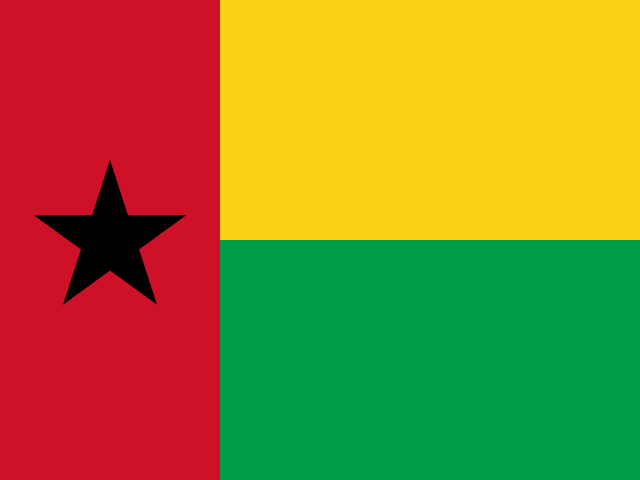
Location
Guinea-Bissau is in Western Africa, bordering the North Atlantic Ocean, between Guinea and Senegal. It shares land borders with Guinea (421 km) and Senegal (341 km) and has 350 km of coastline. The capital is Bissau.
Guinea-Bissau population 2026: 2.3 Million — growth, rank & history →Key Statistics for 2026
Total population
Population Change
Median age of population
Population density
Life expectancy at birth
Agricultural land
Dam capacity per capita
Female population of reproductive age
Health Care Spending per Capita
Length of paid parental leave for mother
Percentage of population by degree of urbanization
History
Guinea-Bissau, located in West Africa, has a history that is both rich and complex, with its origins tracing back to ancient times. The region was initially inhabited by various ethnic groups, including the Balanta, Fula, and Mandinka, who engaged in agricultural practices and trade. Archaeological evidence suggests that the area has been populated for thousands of years, with the presence of ancient artifacts indicating interactions with other West African cultures. The early history of Guinea-Bissau is marked by the establishment of trade routes that connected it to the larger empires of the region, such as the Mali Empire, which flourished from the 13th to the 16th century.
During the medieval period, Guinea-Bissau became increasingly significant in the transatlantic trade networks, particularly through the activities of Portuguese explorers in the 15th century. The Portuguese established trading posts along the coast, leading to the colonization of the region. By the late 19th century, Guinea-Bissau became a Portuguese colony, with the capital, Bissau, serving as a strategic port for the export of agricultural products, particularly cashew nuts and palm oil. This period saw the introduction of European political structures and the imposition of foreign rule, which significantly impacted the local cultures and economies.
The struggle for independence began in the mid-20th century, with the emergence of the African Party for the Independence of Guinea and Cape Verde (PAIGC), led by Amílcar Cabral. A protracted liberation war ensued, culminating in the declaration of independence on September 24, 1973, although full recognition by Portugal did not occur until 1974. Post-independence, Guinea-Bissau faced political instability, including a series of coups and civil conflicts that hindered development and governance. The country struggled with the legacies of colonialism and political division, leading to economic challenges that persist to this day.
In recent years, Guinea-Bissau has gained attention due to its strategic location in the drug trafficking routes from South America to Europe, which has exacerbated its political instability. The assassination of President João Bernardo Vieira in 2009 and the subsequent military coup in 2012 have underscored the ongoing volatility within the nation. Despite these challenges, Guinea-Bissau remains significant in discussions about post-colonial governance and the impact of external forces on West African nations. The country continues to strive for political stability and economic growth while preserving its rich cultural heritage.
Geography
Guinea-Bissau is located on the west coast of Africa, bordered by Senegal to the north and Guinea to the southeast. The Atlantic Ocean lies to the west, providing a coastline that stretches approximately 350 kilometers. This strategic position along the coast allows for a variety of maritime activities, including fishing and trade. The country covers an area of about 36,125 square kilometers, making it one of the smaller nations in West Africa, with a population that predominantly resides in the coastal regions and the capital city of Bissau.
The physical features of Guinea-Bissau are characterized by a predominantly low-lying terrain, with the majority of the country comprising coastal plains and mangrove swamps. The interior consists of rolling hills and low mountains, with the highest elevation reaching around 300 meters in the eastern part of the country. Major rivers, such as the Cacheu and the Geba, flow through the landscape, providing essential water resources for agriculture and supporting biodiversity. The natural environment includes numerous islands and islets, particularly in the Bijagós Archipelago, which is recognized for its unique ecosystems.
Guinea-Bissau experiences a tropical climate, with a distinct wet and dry season. The wet season occurs from June to October, influenced by the West African monsoon, bringing heavy rainfall that can exceed 2,500 millimeters in some regions. Conversely, the dry season lasts from November to May, characterized by lower humidity and temperatures averaging between 25°C to 30°C. The climate significantly affects agriculture, which is a crucial part of the economy, particularly the cultivation of cashew nuts, rice, and other crops.
The country is rich in natural resources, including fertile land and an extensive coastline that supports a vibrant fishing industry. However, deforestation and environmental degradation pose challenges to sustainable management of these resources. Guinea-Bissau is also home to various protected areas and national parks, which are essential for preserving its biodiversity, including numerous species of birds and marine life. The unique environmental characteristics of Guinea-Bissau, including its wetlands and forests, contribute to its ecological significance in the region.
Government
Guinea-Bissau operates as a presidential republic, characterized by a multi-party political system. The government is divided into three branches: the executive, legislative, and judicial. The President of Guinea-Bissau serves as both the head of state and the head of government, wielding significant authority over national affairs. The president is elected by popular vote for a five-year term and may be re-elected for one additional term. The political landscape is marked by a history of instability, including coups and political crises, which have influenced the governance and democratic processes within the country.
The executive branch is led by the President, who appoints the Prime Minister and other members of the government. The legislative authority is vested in a unicameral National People's Assembly, comprised of 102 members who are elected to serve four-year terms. This assembly is responsible for making laws, approving the budget, and overseeing the government’s actions. Key institutions within the government include the Ministry of Justice, which oversees the legal framework, and the National Electoral Commission, which manages elections and ensures their integrity.
Guinea-Bissau's judicial system operates independently from the executive and legislative branches, although it has faced challenges regarding effectiveness and impartiality. The judiciary includes a Supreme Court, which is the highest court in the land, alongside various lower courts. Despite the constitutional provisions for an independent judiciary, political interference has often hindered the judicial process, leading to public skepticism regarding the rule of law.
The electoral system in Guinea-Bissau is based on a proportional representation framework, which aims to ensure that the composition of the National People's Assembly reflects the political preferences of the electorate. Elections are held for both the presidency and the parliamentary seats, with the most recent elections occurring in 2019. The political landscape is dominated by several parties, with the African Party for the Independence of Guinea and Cape Verde (PAIGC) historically being one of the most influential. However, political fragmentation and the emergence of new parties have added complexity to the electoral environment, impacting governance and coalition-building efforts.
Economy
Guinea-Bissau operates a mixed economy, characterized by a combination of traditional agricultural practices and a growing sector of small-scale manufacturing and services. As of 2023, the country’s Gross Domestic Product (GDP) is estimated to be around $1.73 billion, reflecting challenges in economic growth and development. The economy is heavily reliant on agriculture, which accounts for approximately 60% of the GDP and employs around 80% of the workforce. Despite possessing rich natural resources, including cashew nuts, fisheries, and timber, the economy struggles with infrastructure deficits and political instability that impede sustainable growth.
The major industries in Guinea-Bissau include agriculture, fishing, and forestry. The cashew nut sector is particularly vital, as it represents the largest export commodity, contributing significantly to national income. Other important agricultural products include rice, palm oil, and groundnuts. Additionally, the fishing industry plays a crucial role in both domestic consumption and export revenues, with the country's coastal waters teeming with diverse marine life. Although there are small manufacturing industries, they are not sufficiently developed to significantly impact the economy, thus underscoring the reliance on primary sectors.
Guinea-Bissau's trade relationships are primarily centered around its regional partners and the European Union. The country exports mainly cashew nuts, fish, and agricultural products to countries such as India, Portugal, and Senegal. On the import side, Guinea-Bissau relies on machinery, foodstuffs, and fuel, primarily sourced from countries like China, Portugal, and the United States. The trade balance is often unfavorable due to a higher volume of imports compared to exports, which creates ongoing challenges in foreign exchange reserves and national budgeting.
Despite its rich natural resources, Guinea-Bissau faces several economic challenges, including political instability, poor infrastructure, and a lack of investment in human capital. These factors contribute to a cycle of poverty and hinder economic diversification. However, there are opportunities for growth, particularly in the areas of sustainable agriculture and eco-tourism. By leveraging its natural beauty and biodiversity, Guinea-Bissau has the potential to attract foreign investment and develop a more resilient economy, provided that governance and stability improve significantly.
Culture
Guinea-Bissau is a culturally rich nation located in West Africa, characterized by a diverse tapestry of languages, religions, and ethnic groups. The country is home to several ethnic groups, with the largest being the Balante, Fula, Mandinka, and Papel. Portuguese is the official language, a remnant of colonial rule, while Crioulo, a Portuguese-based creole, serves as the lingua franca among the population. In terms of religious beliefs, about 45% of the people adhere to Islam, predominantly Sunni, while a significant portion practices traditional African religions, which often coexist harmoniously with Christianity. This intricate blend of beliefs shapes the cultural landscape of Guinea-Bissau, influencing daily life and social norms.
Traditional customs and cultural practices in Guinea-Bissau are vibrant and deeply rooted in the community's history. Ceremonies and rituals play a crucial role in the social fabric, often marking important life events such as births, marriages, and funerals. The initiation rites, especially for young men and women, are significant communal events that reinforce social bonds and cultural identity. Additionally, the country celebrates various festivals, including the Baião and Tabanca, which showcase traditional music, dance, and attire, allowing communities to express their unique heritage and foster unity.
The arts in Guinea-Bissau are a reflection of its dynamic cultural identity, with music and dance being integral components of social life. Traditional music often incorporates instruments such as the berimbau and djembe, with rhythms that are used in both celebratory and spiritual contexts. The country's literature, while less internationally recognized, features oral traditions that convey moral lessons and historical narratives, passed down through generations. Contemporary writers are beginning to gain attention, contributing to a growing literary scene that reflects both local themes and global influences.
Cuisine in Guinea-Bissau is a flavorful expression of its cultural diversity, with a diet largely based on rice, fish, and vegetables. Dishes such as jollof rice, often prepared during festivities, and caldeirada, a fish stew, highlight the country's reliance on its coastal resources. Daily life is influenced by both traditional practices and modernity, with markets bustling with vendors selling local produce and crafts. Family and community are central to social interactions, with gatherings often centered around shared meals and storytelling, reinforcing the importance of cultural continuity in the face of globalization.
About This Data
This page displays comprehensive statistical data for Guinea-Bissau for the year 2026. All data points are sourced from authoritative international organizations and are regularly updated to ensure accuracy and reliability.
Click on any statistic to explore more detailed information, see how Guinea-Bissau compares with other countries, and view historical trends.
Primary Data Sources
CIA World Factbook
Comprehensive country profiles and demographic statistics from the Central Intelligence Agency
Learn moreUnited Nations Statistics
Global demographic data and population projections from UN agencies and research divisions
Learn moreWorld Bank Open Data
Development indicators and comprehensive population metrics from the World Bank database
Learn moreCompare Guinea-Bissau with other countries
Side-by-side comparisons across population, GDP, geography, and more.
Frequently Asked Questions About Guinea-Bissau
Which continent is Guinea-Bissau in?▾
Guinea-Bissau is in Africa, in the Western Africa subregion according to the UN geoscheme.
What is the population of Guinea-Bissau in 2026?▾
The population of Guinea-Bissau in 2026 is approximately 2,297,678 persons.
What is the GDP of Guinea-Bissau?▾
The GDP of Guinea-Bissau is approximately 2,462,273,529.70 US dollars.
What is the life expectancy in Guinea-Bissau?▾
The life expectancy at birth in Guinea-Bissau is approximately 67.79 years.
What is the total fertility rate in Guinea-Bissau?▾
The total fertility rate in Guinea-Bissau is approximately 3.60 children per woman.
What percentage of Guinea-Bissau's population lives in urban areas?▾
Approximately 54.11% of Guinea-Bissau's population lives in urban areas.
What is the under-five mortality rate in Guinea-Bissau?▾
The under-five mortality rate in Guinea-Bissau is approximately 64.82 per 1,000 live births.