
South Korea Total Armed Forces Personnel (PPP) 2020: 569,000
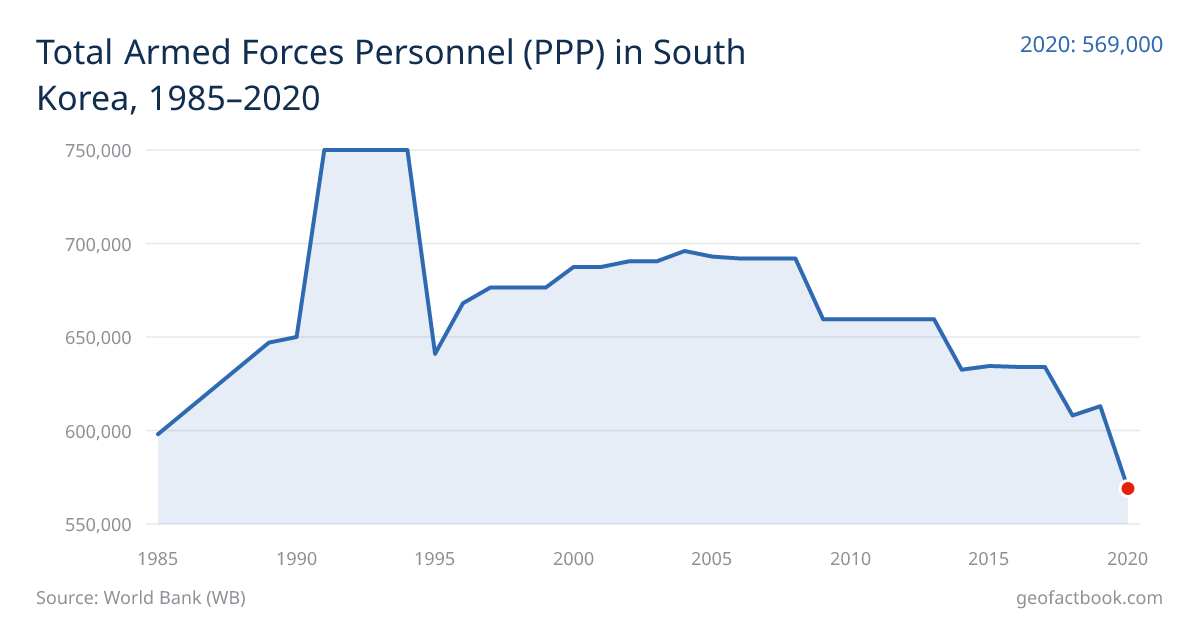
South Korea's total armed forces personnel (ppp) in 2020 is 569,000, down 7.2% from 2019. It ranks #11 of 170 countries.
Explore total armed forces personnel across 266+ countries. Compare military size, view rankings, and analyze historical trends on our interactive map.
Where South Korea ranks (2020)
#11 of 170- #9
 Indonesia676,000
- #10
 Iran650,000
- #11
 South Korea569,000
- #12
 Vietnam522,000
- #13
 Turkey512,000
Total Armed Forces Personnel (PPP) over time
| Year | Value | Change | % Change | Actions |
|---|---|---|---|---|
| 2020 | 569.00K | 44.00K | -7.18% | |
| 2019 | 613.00K | +5.00K | +0.82% | |
| 2018 | 608.00K | 26.00K | -4.10% | |
| 2017 | 634.00K | 0 | 0.00% | |
| 2016 | 634.00K | 500 | -0.08% | |
| 2015 | 634.50K | +2.00K | +0.32% | |
| 2014 | 632.50K | 27.00K | -4.09% | |
| 2013 | 659.50K | 0 | 0.00% | |
| 2012 | 659.50K | 0 | 0.00% | |
| 2011 | 659.50K | 0 | 0.00% | |
| 2010 | 659.50K | 0 | 0.00% | |
| 2009 | 659.50K | 32.50K | -4.70% | |
| 2008 | 692.00K | 0 | 0.00% | |
| 2007 | 692.00K | 0 | 0.00% | |
| 2006 | 692.00K | 1.00K | -0.14% | |
| 2005 | 693.00K | 3.00K | -0.43% | |
| 2004 | 696.00K | +5.50K | +0.80% | |
| 2003 | 690.50K | 0 | 0.00% | |
| 2002 | 690.50K | +3.00K | +0.44% | |
| 2001 | 687.50K | 0 | 0.00% | |
| 2000 | 687.50K | +11.00K | +1.63% | |
| 1999 | 676.50K | 0 | 0.00% | |
| 1998 | 676.50K | 0 | 0.00% | |
| 1997 | 676.50K | +8.50K | +1.27% | |
| 1996 | 668.00K | +27.00K | +4.21% | |
| 1995 | 641.00K | 109.00K | -14.53% | |
| 1994 | 750.00K | 0 | 0.00% | |
| 1993 | 750.00K | 0 | 0.00% | |
| 1992 | 750.00K | 0 | 0.00% | |
| 1991 | 750.00K | +100.00K | +15.38% | |
| 1990 | 650.00K | +3.00K | +0.46% | |
| 1989 | 647.00K | +49.00K | +8.19% | |
| 1985 | 598.00K | — | — |
Total Armed Forces Personnel (PPP) in South Korea, 1985–2020: chart
Cite this page
Geo Factbook. (n.d.). South Korea: Total Armed Forces Personnel (PPP). Retrieved November 28, 2026, from https://geofactbook.com/countries/south-korea/armed-forces-personnel-total
The figures on this page come from World Bank (WB). For academic work, cite the original source as well.
Frequently Asked Questions About South Korea Total Armed Forces Personnel (PPP)
What is South Korea's total armed forces personnel (ppp) in 2020?▾
South Korea's total armed forces personnel (ppp) is 569,000 in 2020, according to World Bank (WB).
Is South Korea's total armed forces personnel (ppp) increasing or decreasing?▾
South Korea's total armed forces personnel (ppp) fell by 7.2% from 2019 (613,000) to 2020 (569,000). Over the past decade (2010–2020) it fell by 13.7%.
How does South Korea rank for total armed forces personnel (ppp)?▾
In 2020, South Korea has the 11th highest total armed forces personnel (ppp) out of 170 countries with data.
What was South Korea's total armed forces personnel (ppp) in 1985?▾
In 1985, South Korea's total armed forces personnel (ppp) was 598,000. By 2020 it fell by 4.8%.
Explore additional statistical insights
Military Service Age and Obligation in South Korea
Military service age and obligation details for 266+ countries. Compare requirements, explore rankings, and view interactive maps.
Gross Domestic Product (GDP) by Country in Current US Dollars in South Korea
Discover the Gross Domestic Product (GDP) by country in current US dollars, a key indicator of economic performance. This statistic reveals the financial health and growth potential of nations, making it essential for investors and policymakers.
Primary School Pupil-Teacher Ratio in South Korea
Pupil-teacher ratio in primary schools reflects educational quality; lower ratios indicate more personalized attention.
Container Port Traffic Volume in South Korea
Container Port Traffic Volume measures the total container throughput in TEUs at major ports in a given country.
Average Hourly Earnings in South Korea
Average hourly earnings compare employee pay rates globally, offering insights into wage disparities and economic strength.
Carbon Intensity of GDP in South Korea
Carbon intensity of GDP measures CO2 emissions per unit of GDP, indicating economic efficiency and environmental impact.