
Indonesia Total Armed Forces Personnel (PPP) 2020: 676,000
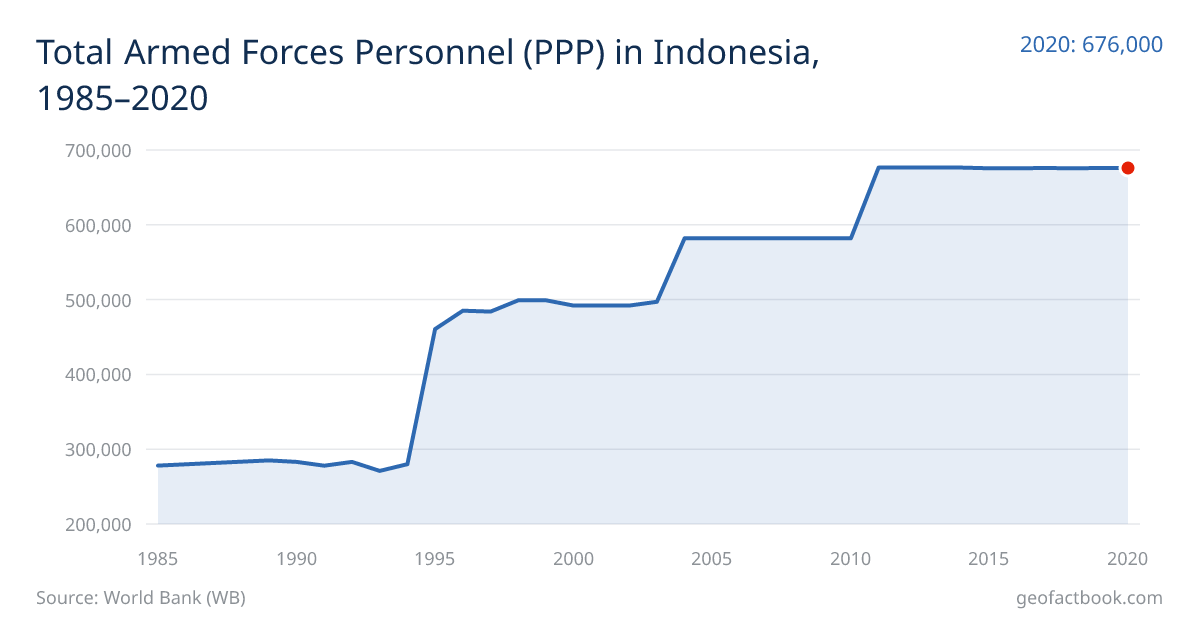
Indonesia's total armed forces personnel (ppp) in 2020 is 676,000, unchanged from 2019. It ranks #9 of 170 countries.
Explore total armed forces personnel across 266+ countries. Compare military size, view rankings, and analyze historical trends on our interactive map.
Where Indonesia ranks (2020)
#9 of 170- #7
 Egypt836,000
- #8
 Brazil762,000
- #9
 Indonesia676,000
- #10
 Iran650,000
- #11
 South Korea569,000
Total Armed Forces Personnel (PPP) over time
| Year | Value | Change | % Change | Actions |
|---|---|---|---|---|
| 2020 | 676.00K | 0 | 0.00% | |
| 2019 | 676.00K | +500 | +0.07% | |
| 2018 | 675.50K | 500 | -0.07% | |
| 2017 | 676.00K | +500 | +0.07% | |
| 2016 | 675.50K | 0 | 0.00% | |
| 2015 | 675.50K | 1.00K | -0.15% | |
| 2014 | 676.50K | 0 | 0.00% | |
| 2013 | 676.50K | 0 | 0.00% | |
| 2012 | 676.50K | 0 | 0.00% | |
| 2011 | 676.50K | +94.50K | +16.24% | |
| 2010 | 582.00K | 0 | 0.00% | |
| 2009 | 582.00K | 0 | 0.00% | |
| 2008 | 582.00K | 0 | 0.00% | |
| 2007 | 582.00K | 0 | 0.00% | |
| 2006 | 582.00K | 0 | 0.00% | |
| 2005 | 582.00K | 0 | 0.00% | |
| 2004 | 582.00K | +85.00K | +17.10% | |
| 2003 | 497.00K | +5.00K | +1.02% | |
| 2002 | 492.00K | 0 | 0.00% | |
| 2001 | 492.00K | 0 | 0.00% | |
| 2000 | 492.00K | 7.00K | -1.40% | |
| 1999 | 499.00K | 0 | 0.00% | |
| 1998 | 499.00K | +15.00K | +3.10% | |
| 1997 | 484.00K | 1.20K | -0.25% | |
| 1996 | 485.20K | +24.70K | +5.36% | |
| 1995 | 460.50K | +180.50K | +64.46% | |
| 1994 | 280.00K | +9.00K | +3.32% | |
| 1993 | 271.00K | 12.00K | -4.24% | |
| 1992 | 283.00K | +5.00K | +1.80% | |
| 1991 | 278.00K | 5.00K | -1.77% | |
| 1990 | 283.00K | 2.00K | -0.70% | |
| 1989 | 285.00K | +6.90K | +2.48% | |
| 1985 | 278.10K | — | — |
Total Armed Forces Personnel (PPP) in Indonesia, 1985–2020: chart
Cite this page
Geo Factbook. (n.d.). Indonesia: Total Armed Forces Personnel (PPP). Retrieved November 27, 2026, from https://geofactbook.com/countries/indonesia/armed-forces-personnel-total
The figures on this page come from World Bank (WB). For academic work, cite the original source as well.
Frequently Asked Questions About Indonesia Total Armed Forces Personnel (PPP)
What is Indonesia's total armed forces personnel (ppp) in 2020?▾
Indonesia's total armed forces personnel (ppp) is 676,000 in 2020, according to World Bank (WB).
Is Indonesia's total armed forces personnel (ppp) increasing or decreasing?▾
Indonesia's total armed forces personnel (ppp) was essentially unchanged from 2019 (676,000) to 2020 (676,000). Over the past decade (2010–2020) it rose by 16.2%.
How does Indonesia rank for total armed forces personnel (ppp)?▾
In 2020, Indonesia has the 9th highest total armed forces personnel (ppp) out of 170 countries with data.
What was Indonesia's total armed forces personnel (ppp) in 1985?▾
In 1985, Indonesia's total armed forces personnel (ppp) was 278,100. By 2020 it rose by 143.1%.
Explore additional statistical insights
Military Expenditure (% of GDP) in Indonesia
Military expenditure as a percentage of GDP reflects a country's military focus relative to its economy.
Energy Consumption per Capita (USD) in Indonesia
Energy Consumption per Capita (USD) measures how much energy is consumed per person. Compare countries and explore interactive maps.
Population Change in Indonesia
This statistic measures population change across countries, highlighting shifts in demographics. Understanding these changes is crucial for planning resources, economic growth, and social services.
Human Capital Index in Indonesia
The Human Capital Index measures a country's investment in education and health, reflecting its potential for economic growth and productivity. This vital statistic highlights the importance of nurturing human resources for sustainable development.
Female Labor Force Participation Rate in Indonesia
Female labor force participation rate measures the active engagement of women in the workforce, indicating economic inclusivity.
Top FDI Inflows (% of GDP) in Indonesia
Top FDI inflows as a percentage of GDP highlight countries attracting significant foreign investments relative to their economy size.