
Pakistan Total Armed Forces Personnel (PPP) 2020: 943,000
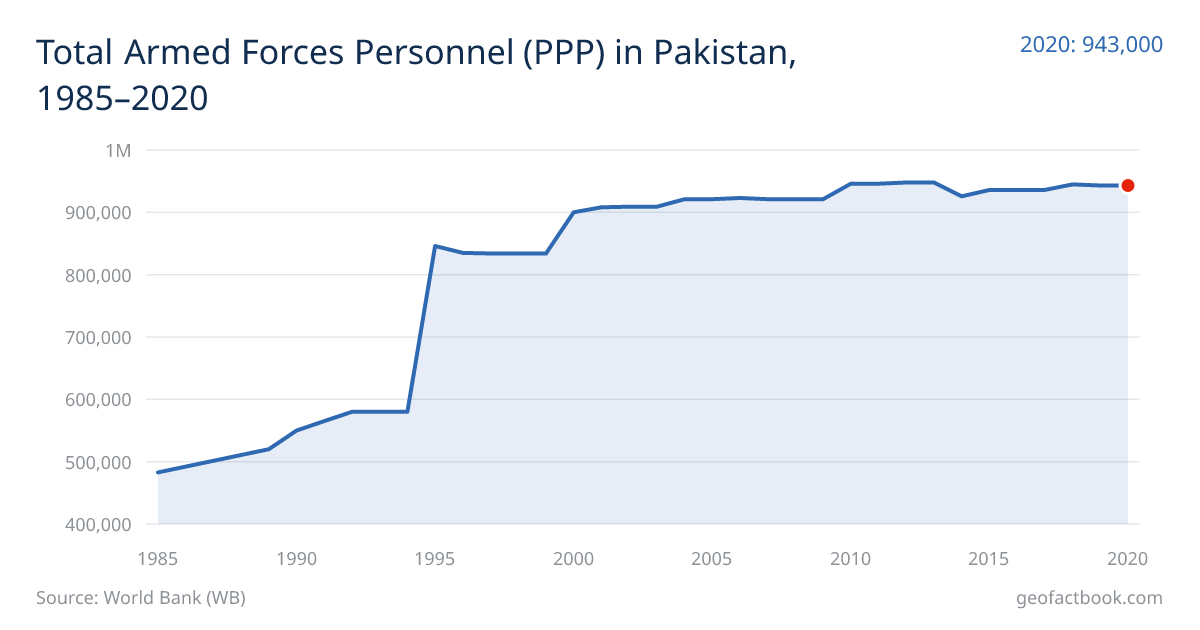
Pakistan's total armed forces personnel (ppp) in 2020 is 943,000, unchanged from 2019. It ranks #6 of 170 countries.
Explore total armed forces personnel across 266+ countries. Compare military size, view rankings, and analyze historical trends on our interactive map.
Where Pakistan ranks (2020)
#6 of 170- #4
 Russia1.45M
- #5
 United States1.4M
- #6
 Pakistan943,000
- #7
 Egypt836,000
- #8
 Brazil762,000
Total Armed Forces Personnel (PPP) over time
| Year | Value | Change | % Change | Actions |
|---|---|---|---|---|
| 2020 | 943.00K | 0 | 0.00% | |
| 2019 | 943.00K | 1.80K | -0.19% | |
| 2018 | 944.80K | +8.80K | +0.94% | |
| 2017 | 936.00K | +200 | +0.02% | |
| 2016 | 935.80K | 0 | 0.00% | |
| 2015 | 935.80K | +10.00K | +1.08% | |
| 2014 | 925.80K | 22.00K | -2.32% | |
| 2013 | 947.80K | 0 | 0.00% | |
| 2012 | 947.80K | +1.80K | +0.19% | |
| 2011 | 946.00K | 0 | 0.00% | |
| 2010 | 946.00K | +25.00K | +2.71% | |
| 2009 | 921.00K | 0 | 0.00% | |
| 2008 | 921.00K | 0 | 0.00% | |
| 2007 | 921.00K | 2.00K | -0.22% | |
| 2006 | 923.00K | +2.00K | +0.22% | |
| 2005 | 921.00K | 0 | 0.00% | |
| 2004 | 921.00K | +12.00K | +1.32% | |
| 2003 | 909.00K | 0 | 0.00% | |
| 2002 | 909.00K | +1.00K | +0.11% | |
| 2001 | 908.00K | +8.00K | +0.89% | |
| 2000 | 900.00K | +66.00K | +7.91% | |
| 1999 | 834.00K | 0 | 0.00% | |
| 1998 | 834.00K | 0 | 0.00% | |
| 1997 | 834.00K | 1.00K | -0.12% | |
| 1996 | 835.00K | 11.00K | -1.30% | |
| 1995 | 846.00K | +266.00K | +45.86% | |
| 1994 | 580.00K | 0 | 0.00% | |
| 1993 | 580.00K | 0 | 0.00% | |
| 1992 | 580.00K | +15.00K | +2.65% | |
| 1991 | 565.00K | +15.00K | +2.73% | |
| 1990 | 550.00K | +30.00K | +5.77% | |
| 1989 | 520.00K | +37.20K | +7.71% | |
| 1985 | 482.80K | — | — |
Total Armed Forces Personnel (PPP) in Pakistan, 1985–2020: chart
Cite this page
Geo Factbook. (n.d.). Pakistan: Total Armed Forces Personnel (PPP). Retrieved November 27, 2026, from https://geofactbook.com/countries/pakistan/armed-forces-personnel-total
The figures on this page come from World Bank (WB). For academic work, cite the original source as well.
Frequently Asked Questions About Pakistan Total Armed Forces Personnel (PPP)
What is Pakistan's total armed forces personnel (ppp) in 2020?▾
Pakistan's total armed forces personnel (ppp) is 943,000 in 2020, according to World Bank (WB).
Is Pakistan's total armed forces personnel (ppp) increasing or decreasing?▾
Pakistan's total armed forces personnel (ppp) was essentially unchanged from 2019 (943,000) to 2020 (943,000). Over the past decade (2010–2020) it fell by 0.3%.
How does Pakistan rank for total armed forces personnel (ppp)?▾
In 2020, Pakistan has the 6th highest total armed forces personnel (ppp) out of 170 countries with data.
What was Pakistan's total armed forces personnel (ppp) in 1985?▾
In 1985, Pakistan's total armed forces personnel (ppp) was 482,800. By 2020 it rose by 95.3%.
Explore additional statistical insights
Military Expenditure (% of GDP) in Pakistan
Military expenditure as a percentage of GDP reflects a country's military focus relative to its economy.
Female population of reproductive age in Pakistan
The female population of reproductive age is a crucial demographic statistic that influences healthcare, economic growth, and social policies in countries. Understanding this population helps address reproductive health needs and support family planning initiatives.
Tourism Revenue (% of GDP) in Pakistan
Tourism revenue as a percentage of GDP shows the economic importance of tourism in a country. Higher values indicate greater reliance.
Orange Yield Per Hectare in Pakistan
Examine orange yield per hectare across countries; learn which regions maximize citrus production efficiency.
CO2 Emissions from Transport in Pakistan
CO2 emissions from transport highlight countries' impact on climate change through vehicles and infrastructure.
Electricity from Nuclear Fuels in Pakistan
Electricity from nuclear fuels measures energy production in countries. Compare data, explore rankings, and visualize trends with interactive maps.