
Norway Total Armed Forces Personnel (PPP) 2020: 25,000
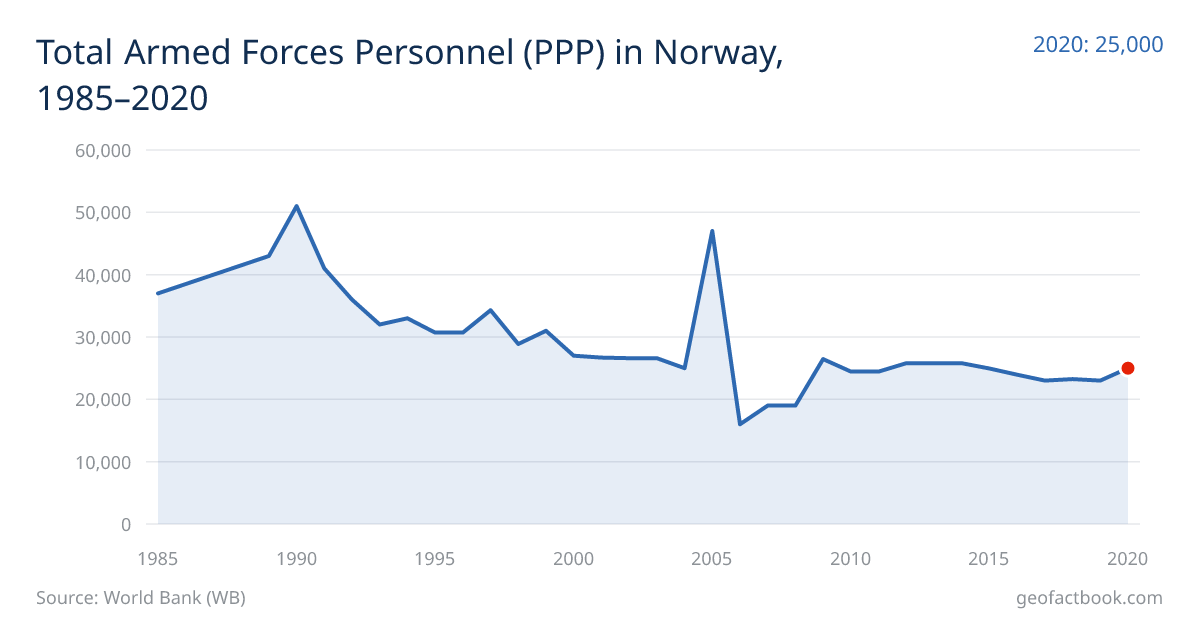
Norway's total armed forces personnel (ppp) in 2020 is 25,000, up 8.7% from 2019. It ranks #94 of 170 countries.
Explore total armed forces personnel across 266+ countries. Compare military size, view rankings, and analyze historical trends on our interactive map.
Where Norway ranks (2020)
#94 of 170




Total Armed Forces Personnel (PPP) over time
| Year | Value | Change | % Change | Actions |
|---|---|---|---|---|
| 2020 | 25.00K | +2.00K | +8.70% | |
| 2019 | 23.00K | 250 | -1.08% | |
| 2018 | 23.25K | +250 | +1.09% | |
| 2017 | 23.00K | 950 | -3.97% | |
| 2016 | 23.95K | 1.00K | -4.01% | |
| 2015 | 24.95K | 850 | -3.29% | |
| 2014 | 25.80K | 0 | 0.00% | |
| 2013 | 25.80K | 0 | 0.00% | |
| 2012 | 25.80K | +1.35K | +5.52% | |
| 2011 | 24.45K | 0 | 0.00% | |
| 2010 | 24.45K | 2.00K | -7.56% | |
| 2009 | 26.45K | +7.45K | +39.21% | |
| 2008 | 19.00K | 0 | 0.00% | |
| 2007 | 19.00K | +3.00K | +18.75% | |
| 2006 | 16.00K | 31.00K | -65.96% | |
| 2005 | 47.00K | +22.00K | +88.00% | |
| 2004 | 25.00K | 1.60K | -6.02% | |
| 2003 | 26.60K | 0 | 0.00% | |
| 2002 | 26.60K | 100 | -0.37% | |
| 2001 | 26.70K | 300 | -1.11% | |
| 2000 | 27.00K | 4.00K | -12.90% | |
| 1999 | 31.00K | +2.13K | +7.38% | |
| 1998 | 28.87K | 5.43K | -15.83% | |
| 1997 | 34.30K | +3.60K | +11.73% | |
| 1996 | 30.70K | 0 | 0.00% | |
| 1995 | 30.70K | 2.30K | -6.97% | |
| 1994 | 33.00K | +1.00K | +3.13% | |
| 1993 | 32.00K | 4.00K | -11.11% | |
| 1992 | 36.00K | 5.00K | -12.20% | |
| 1991 | 41.00K | 10.00K | -19.61% | |
| 1990 | 51.00K | +8.00K | +18.60% | |
| 1989 | 43.00K | +6.00K | +16.22% | |
| 1985 | 37.00K | — | — |
Total Armed Forces Personnel (PPP) in Norway, 1985–2020: chart
Cite this page
Geo Factbook. (n.d.). Norway: Total Armed Forces Personnel (PPP). Retrieved November 27, 2026, from https://geofactbook.com/countries/norway/armed-forces-personnel-total
The figures on this page come from World Bank (WB). For academic work, cite the original source as well.
Frequently Asked Questions About Norway Total Armed Forces Personnel (PPP)
What is Norway's total armed forces personnel (ppp) in 2020?▾
Norway's total armed forces personnel (ppp) is 25,000 in 2020, according to World Bank (WB).
Is Norway's total armed forces personnel (ppp) increasing or decreasing?▾
Norway's total armed forces personnel (ppp) rose by 8.7% from 2019 (23,000) to 2020 (25,000). Over the past decade (2010–2020) it rose by 2.2%.
How does Norway rank for total armed forces personnel (ppp)?▾
In 2020, Norway has the 94th highest total armed forces personnel (ppp) out of 170 countries with data.
What was Norway's total armed forces personnel (ppp) in 1985?▾
In 1985, Norway's total armed forces personnel (ppp) was 37,000. By 2020 it fell by 32.4%.
Explore additional statistical insights
Deaths in Armed Conflicts in Norway
Deaths in armed conflicts highlight the human cost of wars. Track fatalities in countries with ongoing conflicts.
Learning-adjusted years of school in Norway
Learning-adjusted years of school measures educational quality by accounting for both enrollment and learning outcomes. This statistic highlights the effectiveness of education systems across countries, emphasizing the need for improved learning environments.
Diabetes Prevalence (% of Population) in Norway
Diabetes prevalence measures the percentage of adults aged 20 to 79 affected. Explore country comparisons, rankings, and interactive maps.
Psychiatrist Density Per 100,000 People in Norway
Psychiatrist density measures the number of psychiatrists available per 100,000 people, indicating mental health access.
Water Withdrawals Per Capita in Norway
Water withdrawals per capita measure the average water use per person, reflecting demand on water resources.
Total population in Norway
Discover the latest total population statistics for every country and region worldwide. Explore accurate, up-to-date data on global population growth, density, and demographic trends — sourced from trusted international databases like the UN and World Bank. Perfect for researchers, students, and data enthusiasts looking to understand how the world’s population is changing.