
Belgium Total Armed Forces Personnel (PPP) 2020: 24,000
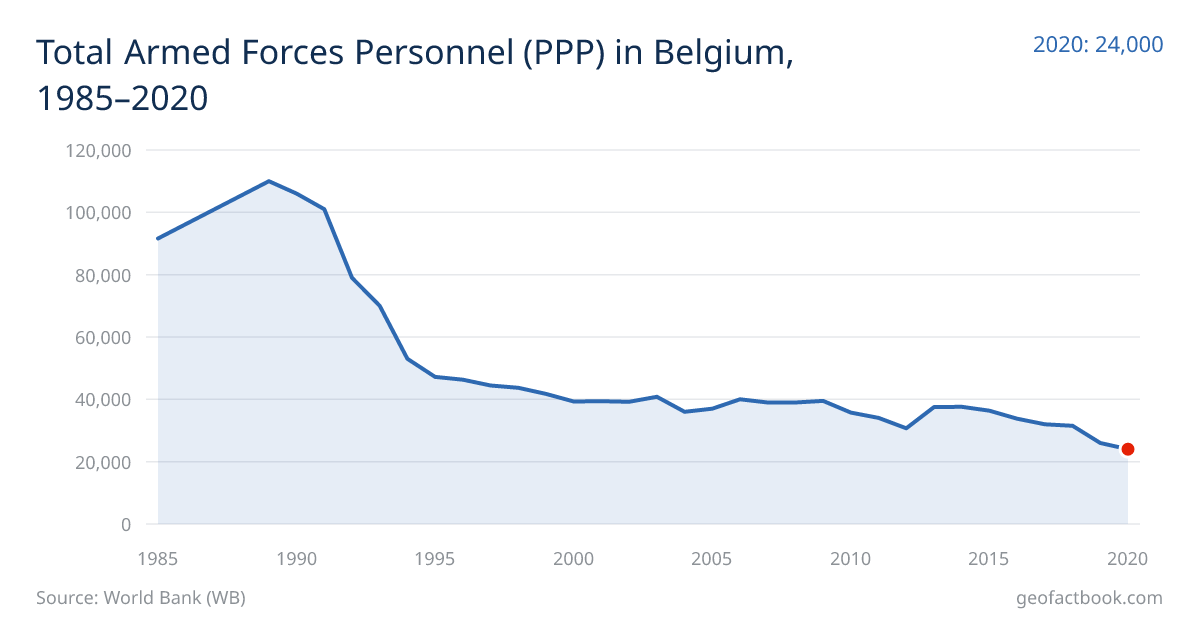
Belgium's total armed forces personnel (ppp) in 2020 is 24,000, down 7.7% from 2019. It ranks #96 of 170 countries.
Explore total armed forces personnel across 266+ countries. Compare military size, view rankings, and analyze historical trends on our interactive map.
Where Belgium ranks (2020)
#96 of 170- #94
 Kuwait25,000
- #94
 Norway25,000
- #96
 Belgium24,000
- #96
 Kenya24,000
- #98
 Austria23,000
Total Armed Forces Personnel (PPP) over time
| Year | Value | Change | % Change | Actions |
|---|---|---|---|---|
| 2020 | 24.00K | 2.00K | -7.69% | |
| 2019 | 26.00K | 5.50K | -17.46% | |
| 2018 | 31.50K | 500 | -1.56% | |
| 2017 | 32.00K | 1.80K | -5.33% | |
| 2016 | 33.80K | 2.55K | -7.02% | |
| 2015 | 36.35K | 1.25K | -3.32% | |
| 2014 | 37.60K | +100 | +0.27% | |
| 2013 | 37.50K | +6.80K | +22.15% | |
| 2012 | 30.70K | 3.35K | -9.84% | |
| 2011 | 34.05K | 1.69K | -4.72% | |
| 2010 | 35.74K | 3.75K | -9.49% | |
| 2009 | 39.48K | +482 | +1.24% | |
| 2008 | 39.00K | 0 | 0.00% | |
| 2007 | 39.00K | 1.00K | -2.50% | |
| 2006 | 40.00K | +3.00K | +8.11% | |
| 2005 | 37.00K | +1.00K | +2.78% | |
| 2004 | 36.00K | 4.80K | -11.76% | |
| 2003 | 40.80K | +1.60K | +4.08% | |
| 2002 | 39.20K | 200 | -0.51% | |
| 2001 | 39.40K | +100 | +0.25% | |
| 2000 | 39.30K | 2.45K | -5.87% | |
| 1999 | 41.75K | 1.95K | -4.46% | |
| 1998 | 43.70K | 750 | -1.69% | |
| 1997 | 44.45K | 1.85K | -4.00% | |
| 1996 | 46.30K | 900 | -1.91% | |
| 1995 | 47.20K | 5.80K | -10.94% | |
| 1994 | 53.00K | 17.00K | -24.29% | |
| 1993 | 70.00K | 9.00K | -11.39% | |
| 1992 | 79.00K | 22.00K | -21.78% | |
| 1991 | 101.00K | 5.00K | -4.72% | |
| 1990 | 106.00K | 4.00K | -3.64% | |
| 1989 | 110.00K | +18.40K | +20.09% | |
| 1985 | 91.60K | — | — |
Total Armed Forces Personnel (PPP) in Belgium, 1985–2020: chart
Cite this page
Geo Factbook. (n.d.). Belgium: Total Armed Forces Personnel (PPP). Retrieved November 27, 2026, from https://geofactbook.com/countries/belgium/armed-forces-personnel-total
The figures on this page come from World Bank (WB). For academic work, cite the original source as well.
Frequently Asked Questions About Belgium Total Armed Forces Personnel (PPP)
What is Belgium's total armed forces personnel (ppp) in 2020?▾
Belgium's total armed forces personnel (ppp) is 24,000 in 2020, according to World Bank (WB).
Is Belgium's total armed forces personnel (ppp) increasing or decreasing?▾
Belgium's total armed forces personnel (ppp) fell by 7.7% from 2019 (26,000) to 2020 (24,000). Over the past decade (2010–2020) it fell by 32.8%.
How does Belgium rank for total armed forces personnel (ppp)?▾
In 2020, Belgium has the 96th highest total armed forces personnel (ppp) out of 170 countries with data.
What was Belgium's total armed forces personnel (ppp) in 1985?▾
In 1985, Belgium's total armed forces personnel (ppp) was 91,600. By 2020 it fell by 73.8%.
Explore additional statistical insights
Military Expenditures (% of GDP) in Belgium
Military Expenditures as a percentage of GDP highlights national defense spending. Compare countries, explore rankings, and view trends.
Death Rate (%) in Belgium
Explore death rate statistics across countries. Compare rates, view historical trends, and interact with dynamic maps for deeper insights.
Total fertility rate in Belgium
The total fertility rate measures the average number of children a woman is expected to have during her lifetime, reflecting population growth and demographic trends. Understanding this statistic is crucial for analyzing economic development, healthcare needs, and societal changes across countries.
Total Number of Billionaires in Belgium
Discover the total number of billionaires in different countries, showcasing wealth concentration and economic potential.
Electricity from Hydroelectric Plants in Belgium
Electricity from hydroelectric plants shows renewable energy production. Explore country rankings, compare data, and view interactive maps.
Refined Petroleum Products Imports in Belgium
Refined petroleum products imports indicate a country's energy demand. Explore rankings, compare nations, and view interactive maps.