
Mozambique Annual Forest Area Change Rate 2025: -267,028 %
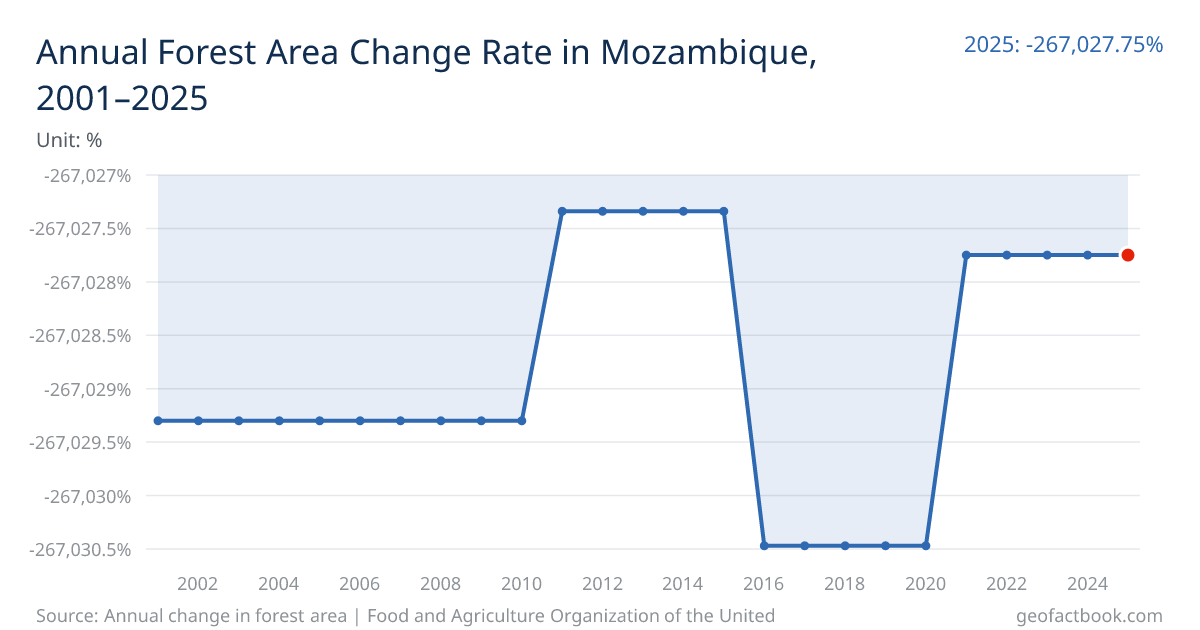
Mozambique's annual forest area change rate in 2025 is -267,028 %, unchanged from 2024. It ranks #209 of 216 countries.
Annual forest area change rate indicates how quickly a country's forests are expanding or shrinking each year.
Source (2025): Annual change in forest area | Our World in Data
Where Mozambique ranks (2025)
#209 of 216- #207
 Argentina-179,517.97%
- #208
 Bolivia-239,760.16%
- #209
 Mozambique-267,027.75%
- #210
 Congo, Democratic Republic of the-282,893.75%
- #211
 Myanmar-289,712.12%
Annual Forest Area Change Rate over time
| Year | Value | Change | % Change | Actions |
|---|---|---|---|---|
| 2025 | -267,027.75 % | 0 % | 0.00% | |
| 2024 | -267,027.75 % | 0 % | 0.00% | |
| 2023 | -267,027.75 % | 0 % | 0.00% | |
| 2022 | -267,027.75 % | 0 % | 0.00% | |
| 2021 | -267,027.75 % | +2.72 % | -0.00% | |
| 2020 | -267,030.47 % | 0 % | 0.00% | |
| 2019 | -267,030.47 % | 0 % | 0.00% | |
| 2018 | -267,030.47 % | 0 % | 0.00% | |
| 2017 | -267,030.47 % | 0 % | 0.00% | |
| 2016 | -267,030.47 % | 3.13 % | +0.00% | |
| 2015 | -267,027.34 % | 0 % | 0.00% | |
| 2014 | -267,027.34 % | 0 % | 0.00% | |
| 2013 | -267,027.34 % | 0 % | 0.00% | |
| 2012 | -267,027.34 % | 0 % | 0.00% | |
| 2011 | -267,027.34 % | +1.96 % | -0.00% | |
| 2010 | -267,029.3 % | 0 % | 0.00% | |
| 2009 | -267,029.3 % | 0 % | 0.00% | |
| 2008 | -267,029.3 % | 0 % | 0.00% | |
| 2007 | -267,029.3 % | 0 % | 0.00% | |
| 2006 | -267,029.3 % | 0 % | 0.00% | |
| 2005 | -267,029.3 % | 0 % | 0.00% | |
| 2004 | -267,029.3 % | 0 % | 0.00% | |
| 2003 | -267,029.3 % | 0 % | 0.00% | |
| 2002 | -267,029.3 % | 0 % | 0.00% | |
| 2001 | -267,029.3 % | — | — |
Annual Forest Area Change Rate in Mozambique, 2001–2025: chart
Cite this page
Geo Factbook. (n.d.). Mozambique: Annual Forest Area Change Rate. Retrieved November 27, 2026, from https://geofactbook.com/countries/mozambique/annual-forest-area-change-rate
The figures on this page come from Annual change in forest area | Food and Agriculture Organization of the United Nations via Our World in Data. For academic work, cite the original source as well.
Frequently Asked Questions About Mozambique Annual Forest Area Change Rate
What is Mozambique's annual forest area change rate in 2025?▾
Mozambique's annual forest area change rate is -267,028 % in 2025, according to Annual change in forest area | Food and Agriculture Organization of the United Nations via Our World in Data.
Is Mozambique's annual forest area change rate increasing or decreasing?▾
Mozambique's annual forest area change rate was essentially unchanged from 2024 (-267,028 %) to 2025 (-267,028 %). Over the past decade (2015–2025) it was essentially unchanged.
How does Mozambique rank for annual forest area change rate?▾
In 2025, Mozambique has the 209th highest annual forest area change rate out of 216 countries with data.
What was Mozambique's annual forest area change rate in 2001?▾
In 2001, Mozambique's annual forest area change rate was -267,029 %. By 2025 it was essentially unchanged.
Explore additional statistical insights
Energy Consumption per Capita (USD) in Mozambique
Energy Consumption per Capita (USD) measures how much energy is consumed per person. Compare countries and explore interactive maps.
Carbon Dioxide Emissions in Mozambique
Carbon dioxide emissions reveal environmental impact. Explore rankings, compare countries, and analyze historical trends with interactive maps.
Tomato Yield per Hectare in Mozambique
Tomato yield per hectare indicates the average amount of tomatoes produced on one hectare of land.
Red List Index Score in Mozambique
The Red List Index Score indicates the overall extinction risk of species within a country based on the IUCN Red List categories.
Agricultural land in Mozambique
Agricultural land measures the area dedicated to farming and cultivation in countries, impacting food production and sustainability. Understanding this statistic is crucial for assessing agricultural capacity and economic development.
Average Annual Temperature in Mozambique
Average annual temperature measures the typical warmth of a country over a year, crucial for climate studies.