
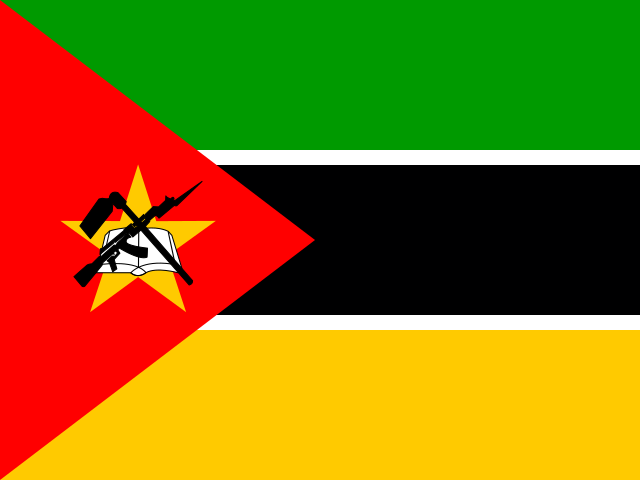
Location
Mozambique is in Southeastern Africa, bordering the Mozambique Channel, between South Africa and Tanzania. It shares land borders with Malawi (1,498 km), Zimbabwe (1,402 km), Tanzania (840 km), South Africa (496 km), Zambia (439 km) and Eswatini (108 km) and has 2,470 km of coastline. The capital is Maputo.
Mozambique population 2026: 36.63 Million — growth, rank & history →Key Statistics for 2026
Total population
Population Change
Median age of population
Population density
Life expectancy at birth
Agricultural land
Apple Import Volume
Current Bank Rate
Dam capacity per capita
Female population of reproductive age
Health Care Spending per Capita
History
Mozambique's history is rich and diverse, with its origins tracing back to ancient times. Evidence suggests that the area has been inhabited for thousands of years, with various Bantu-speaking groups migrating into the region around the 1st millennium AD. These early inhabitants engaged in agriculture and ironworking, establishing trade networks with neighboring regions. The coastal areas, particularly around the present-day cities of Maputo and Beira, became significant for maritime trade as early as the 8th century, with traders from Arabia and Persia engaging in commerce with local communities.
During the medieval period, Mozambique saw the emergence of powerful trading states, notably the Kingdom of Sofala, which flourished from the 11th to the 15th centuries. This kingdom was instrumental in the trade of gold, ivory, and other goods, connecting the interior of Africa with the Indian Ocean trade routes. The arrival of Portuguese explorers in the late 15th century, such as Vasco da Gama in 1498, marked the beginning of European influence in the region. The Portuguese established several coastal settlements, including the city of Mozambique Island, which became a key administrative center for colonial activities in the 16th century.
The modern history of Mozambique is characterized by colonial rule and the struggle for independence. After centuries of Portuguese colonization, the Mozambique Liberation Front (FRELIMO) emerged in the early 1960s to fight for independence. This struggle culminated in 1975 when Mozambique officially gained its independence. However, the post-colonial era was marred by civil conflict, as FRELIMO faced opposition from the Mozambique National Resistance (RENAMO), leading to a brutal civil war that lasted until 1992. This conflict had devastating effects on the country, resulting in significant loss of life and displacement of communities.
In recent years, Mozambique has made significant strides toward recovery and development, although challenges remain. The country has experienced periods of political stability and economic growth, particularly due to its natural resources, including coal and natural gas. However, the impact of natural disasters, such as cyclones and flooding, alongside ongoing political tensions, has posed challenges to sustainable development. As of 2023, Mozambique is still navigating its path towards stability and prosperity, with ongoing efforts to address issues such as poverty, infrastructure development, and governance.
Geography
Mozambique is located in southeastern Africa, bordered by the Indian Ocean to the east and sharing land borders with Tanzania to the north, Malawi and Zambia to the northwest, Zimbabwe to the west, and South Africa and Eswatini to the southwest. The country's strategic location along the coast provides it with significant maritime resources and trade opportunities, particularly through its ports such as Maputo, Beira, and Nacala. Mozambique has a total area of approximately 801,590 square kilometers, making it one of the largest countries in Africa.
The physical geography of Mozambique is characterized by a diverse range of features, including plateaus, mountains, and extensive river systems. The country is largely flat, with the central and northern regions featuring the rugged terrain of the East African Rift Mountains, including the prominent Mount Binga, which is the highest peak at 2,436 meters. Major rivers such as the Zambezi, Limpopo, and
Mozambique experiences a tropical climate, with distinct wet and dry seasons. The rainy season typically spans from November to March, bringing heavy rainfall, particularly in the northern and central regions. The coastal areas maintain a humid climate, while the interior experiences a more arid environment. Average temperatures range from 20°C to 30°C, depending on the region and season. The climatic conditions significantly influence the country's biodiversity, supporting various ecosystems from coastal mangroves to inland savannas.
The natural resources of Mozambique are abundant, comprising minerals, natural gas, coal, and timber, which play a crucial role in the country's economy. The rich biodiversity includes numerous endemic species, making Mozambique an important area for conservation efforts. However, environmental challenges such as deforestation, coastal erosion, and the impacts of climate change threaten these resources. Sustainable management strategies are vital for protecting Mozambique's unique environmental characteristics while supporting economic development.
Government
Mozambique operates as a presidential republic, where the President serves as both the head of state and the head of government. The political system is characterized by a multi-party framework, although the ruling party, the Frelimo Party, has maintained a dominant position since the country's independence from Portugal in 1975. The nation's political landscape has been shaped by a history of civil conflict, which concluded in 1992, and ongoing challenges related to governance, corruption, and political rivalry, particularly with the main opposition party, Renamo.
The structure of government in Mozambique is divided into three branches: the executive, legislative, and judicial. The executive branch is led by the President, who is elected for a five-year term and can serve a maximum of two consecutive terms. The legislative authority is vested in the Assembly of the Republic, a unicameral body comprising 250 members, who are elected through a proportional representation system. The judiciary is independent, with the Supreme Court being the highest court, ensuring the rule of law and the protection of rights, although it faces challenges related to political influence and resource limitations.
Key institutions in Mozambique include the Presidency, the Assembly of the Republic, and the Constitutional Council, which oversees the constitutionality of laws and governmental actions. The current President, as of October 2023, is Filipe Nyusi, who has been in office since January 2015. The political scene is characterized by ongoing debates around economic reforms, social issues, and the need for improved governance, with various civil society organizations actively participating in the discourse.
The electoral system in Mozambique is based on a mixed system combining direct and proportional representation. Elections are held every five years, and while the process is constitutionally mandated to be free and fair, concerns about electoral integrity and transparency persist. The political landscape is often marred by violence and allegations of electoral malpractice, particularly during the electoral cycle. Despite these challenges, Mozambique continues to engage in democratic processes, with efforts to strengthen institutions and promote political pluralism.
Economy
Mozambique operates a mixed economy characterized by a combination of state-owned enterprises and private sector participation. The country's gross domestic product (GDP) was estimated at approximately $15.9 billion in 2022, reflecting a growth rate of around 3.5%. Despite facing challenges such as political instability and infrastructure deficits, Mozambique has significant potential due to its rich natural resources, including coal, natural gas, and minerals, which are crucial for driving economic growth. The nation is classified as one of the fastest-growing economies in Africa, although the benefits of such growth are not evenly distributed across the population.
The major industries in Mozambique include agriculture, mining, and energy. Agriculture remains a cornerstone of the economy, employing over 70% of the workforce and contributing significantly to both domestic consumption and exports. Key agricultural products include cashews, sugarcane, and tobacco. The mining sector has gained prominence in recent years, particularly with the discovery of large coal reserves in the Tete Province and offshore natural gas fields in the Rovuma Basin. Additionally, the energy sector is expanding, with projects aimed at harnessing hydroelectric power and renewable energy sources to meet both local and regional demands.
Mozambique's trade relationships are primarily with neighboring countries and major global economies. The country exports goods valued at approximately $4.82 billion, with major exports including aluminum, coal, and agricultural products. Conversely, imports are estimated at around $8.67 billion, dominated by machinery, fuel, and food products. Mozambique has been working to enhance its trade partnerships through regional integration initiatives, such as participation in the Southern African Development Community (SADC), which aims to facilitate trade and economic cooperation among member states.
Despite its economic potential, Mozambique faces several challenges that could hinder sustainable growth. Issues such as high levels of poverty, unemployment, and inadequate infrastructure remain significant obstacles. Furthermore, the country grapples with the impacts of climate change, which affect agriculture and threaten food security. Nevertheless, opportunities exist, particularly in sectors such as tourism, renewable energy, and infrastructure development, which could attract foreign investment and foster economic diversification. By addressing its challenges and leveraging its resources, Mozambique has the potential to build a more resilient and prosperous economy.
Culture
Mozambique boasts a rich cultural tapestry shaped by its diverse ethnic groups and historical influences. The nation is home to several major ethnic groups, including the Makua, Tsonga, Sena, and Shona, among others. Portuguese, the official language, reflects the colonial history of the country, while various indigenous languages such as Emakhuwa, Xitsua, and Sena enrich the linguistic landscape. In terms of religion, Mozambique is predominantly Christian, with approximately 30% of the population adhering to Catholicism, while significant numbers follow Protestant denominations. Traditional beliefs and practices also play a crucial role in the spiritual lives of many Mozambicans, often coexisting with Christianity.
The cultural traditions and customs of Mozambique are deeply rooted in community and family values. Traditional ceremonies, such as weddings and funerals, are marked by vibrant festivities that include traditional music, dance, and elaborate clothing. The Ubuntu philosophy, emphasizing communal relationships and interconnectedness, is central to social interactions. Festivals such as the Maputo International Festival showcase the nation’s cultural heritage, incorporating traditional and contemporary performances that celebrate Mozambican identity and unity.
The arts scene in Mozambique is a vibrant mix of traditional and modern expressions. The country is renowned for its music, particularly genres like marrabenta and timbila, which utilize traditional instruments and rhythms to convey cultural narratives. Literature has also gained prominence, with writers such as Mia Couto and Paulina Chiziane gaining international recognition for their works that explore social issues and historical contexts. The visual arts, often characterized by colorful motifs and themes drawn from daily life, have gained international acclaim, showcasing the creativity and resilience of Mozambican artists.
Mozambican cuisine reflects the country’s coastal geography and agricultural richness, with an emphasis on seafood, spices, and staple foods such as rice and cassava. Dishes like piri-piri chicken and matapa, made from cassava leaves and peanuts, are popular among locals and visitors alike. Daily life in Mozambique is characterized by a blend of traditional practices and modern influences, with communal living and market activities playing a central role. The bustling markets offer a glimpse into the daily routines of Mozambicans, where social interactions, trade, and cultural exchange flourish, highlighting the importance of community in everyday life.
About This Data
This page displays comprehensive statistical data for Mozambique for the year 2026. All data points are sourced from authoritative international organizations and are regularly updated to ensure accuracy and reliability.
Click on any statistic to explore more detailed information, see how Mozambique compares with other countries, and view historical trends.
Primary Data Sources
CIA World Factbook
Comprehensive country profiles and demographic statistics from the Central Intelligence Agency
Learn moreUnited Nations Statistics
Global demographic data and population projections from UN agencies and research divisions
Learn moreWorld Bank Open Data
Development indicators and comprehensive population metrics from the World Bank database
Learn moreCompare Mozambique with other countries
Side-by-side comparisons across population, GDP, geography, and more.
Frequently Asked Questions About Mozambique
Which continent is Mozambique in?▾
Mozambique is in Africa, in the Eastern Africa subregion according to the UN geoscheme.
What is the population of Mozambique in 2026?▾
The population of Mozambique in 2026 is 36,631,540 persons.
What is the GDP of Mozambique?▾
The Gross Domestic Product (GDP) of Mozambique is 27,299,831,541.31543 US dollars.
What is the life expectancy at birth in Mozambique?▾
The life expectancy at birth in Mozambique is 68.37896000002979 years.
What is the median age of Mozambique's population?▾
The median age of Mozambique's population is 16.57214395251026 years.
What percentage of Mozambique's population lives in urban areas?▾
54.373200000008865% of Mozambique's population lives in urban areas.
What is the official language of Mozambique?▾
The official language of Mozambique is Portuguese.