
Argentina Annual Forest Area Change Rate 2025: -179,518 %
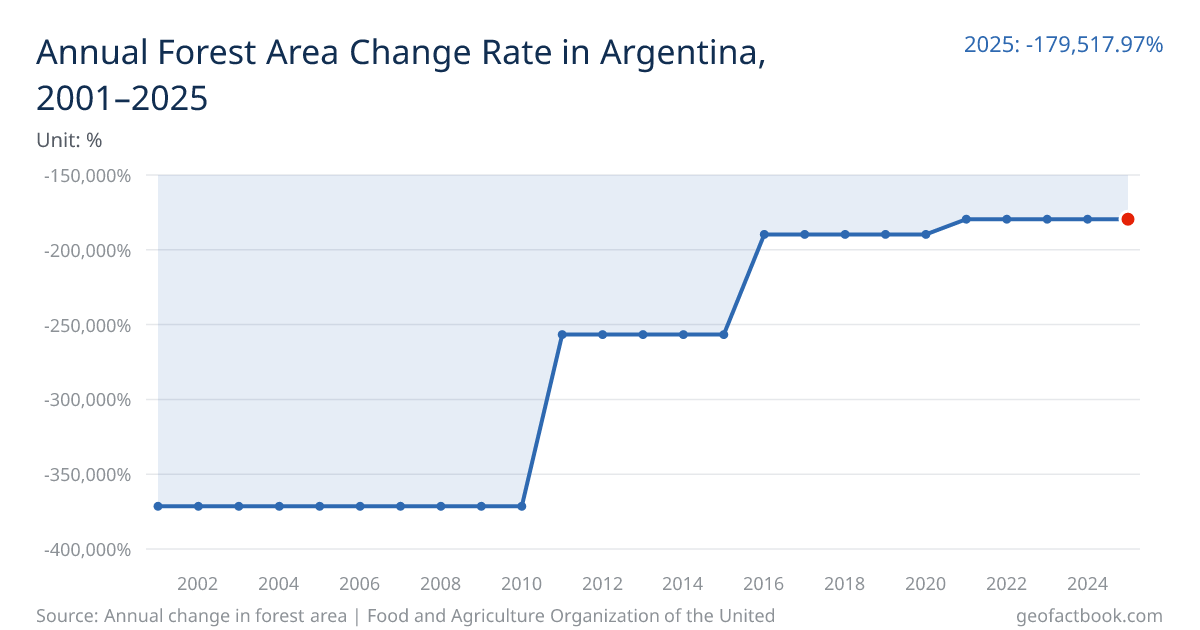
Argentina's annual forest area change rate in 2025 is -179,518 %, unchanged from 2024. It ranks #207 of 216 countries.
Annual forest area change rate indicates how quickly a country's forests are expanding or shrinking each year.
Source (2025): Annual change in forest area | Our World in Data
Where Argentina ranks (2025)
#207 of 216- #205
 Paraguay-163,710.16%
- #206
 Sudan-174,139.84%
- #207
 Argentina-179,517.97%
- #208
 Bolivia-239,760.16%
- #209
 Mozambique-267,027.75%
Annual Forest Area Change Rate over time
| Year | Value | Change | % Change | Actions |
|---|---|---|---|---|
| 2025 | -179,517.97 % | 0 % | 0.00% | |
| 2024 | -179,517.97 % | 0 % | 0.00% | |
| 2023 | -179,517.97 % | 0 % | 0.00% | |
| 2022 | -179,517.97 % | 0 % | 0.00% | |
| 2021 | -179,517.97 % | +10.17K % | -5.36% | |
| 2020 | -189,685.94 % | 0 % | 0.00% | |
| 2019 | -189,685.94 % | 0 % | 0.00% | |
| 2018 | -189,685.94 % | 0 % | 0.00% | |
| 2017 | -189,685.94 % | 0 % | 0.00% | |
| 2016 | -189,685.94 % | +67.00K % | -26.10% | |
| 2015 | -256,685.94 % | 0 % | 0.00% | |
| 2014 | -256,685.94 % | 0 % | 0.00% | |
| 2013 | -256,685.94 % | 0 % | 0.00% | |
| 2012 | -256,685.94 % | 0 % | 0.00% | |
| 2011 | -256,685.94 % | +114.79K % | -30.90% | |
| 2010 | -371,476.94 % | 0 % | 0.00% | |
| 2009 | -371,476.94 % | 0 % | 0.00% | |
| 2008 | -371,476.94 % | 0 % | 0.00% | |
| 2007 | -371,476.94 % | 0 % | 0.00% | |
| 2006 | -371,476.94 % | 0 % | 0.00% | |
| 2005 | -371,476.94 % | 0 % | 0.00% | |
| 2004 | -371,476.94 % | 0 % | 0.00% | |
| 2003 | -371,476.94 % | 0 % | 0.00% | |
| 2002 | -371,476.94 % | 0 % | 0.00% | |
| 2001 | -371,476.94 % | — | — |
Annual Forest Area Change Rate in Argentina, 2001–2025: chart
Cite this page
Geo Factbook. (n.d.). Argentina: Annual Forest Area Change Rate. Retrieved November 27, 2026, from https://geofactbook.com/countries/argentina/annual-forest-area-change-rate
The figures on this page come from Annual change in forest area | Food and Agriculture Organization of the United Nations via Our World in Data. For academic work, cite the original source as well.
Frequently Asked Questions About Argentina Annual Forest Area Change Rate
What is Argentina's annual forest area change rate in 2025?▾
Argentina's annual forest area change rate is -179,518 % in 2025, according to Annual change in forest area | Food and Agriculture Organization of the United Nations via Our World in Data.
Is Argentina's annual forest area change rate increasing or decreasing?▾
Argentina's annual forest area change rate was essentially unchanged from 2024 (-179,518 %) to 2025 (-179,518 %). Over the past decade (2015–2025) it rose by 30.1%.
How does Argentina rank for annual forest area change rate?▾
In 2025, Argentina has the 207th highest annual forest area change rate out of 216 countries with data.
What was Argentina's annual forest area change rate in 2001?▾
In 2001, Argentina's annual forest area change rate was -371,477 %. By 2025 it rose by 51.7%.
Explore additional statistical insights
Red List Index Score in Argentina
The Red List Index Score indicates the overall extinction risk of species within a country based on the IUCN Red List categories.
Electricity from Other Renewables in Argentina
Electricity from other renewables measures alternative energy sources. Explore country comparisons, rankings, and historical trends with interactive maps.
Revenue from Forest Resources in Argentina
Revenue from forest resources reveals economic contributions by country. Explore rankings, compare nations, and view interactive maps.
Population Distribution in Argentina
Explore population distribution across 266+ countries. Compare data, view interactive maps, and analyze trends over time.
Coal Revenue in Argentina
Coal revenue measures earnings from coal production. Compare countries, explore rankings, and view trends with interactive maps.
Population living in slums in Argentina
This statistic measures the percentage of a country's population living in slums, highlighting urban poverty and living conditions. Understanding slum populations is crucial for addressing housing challenges and improving the quality of life.