
Hungary Female population of reproductive age 2026: 2.07 Million
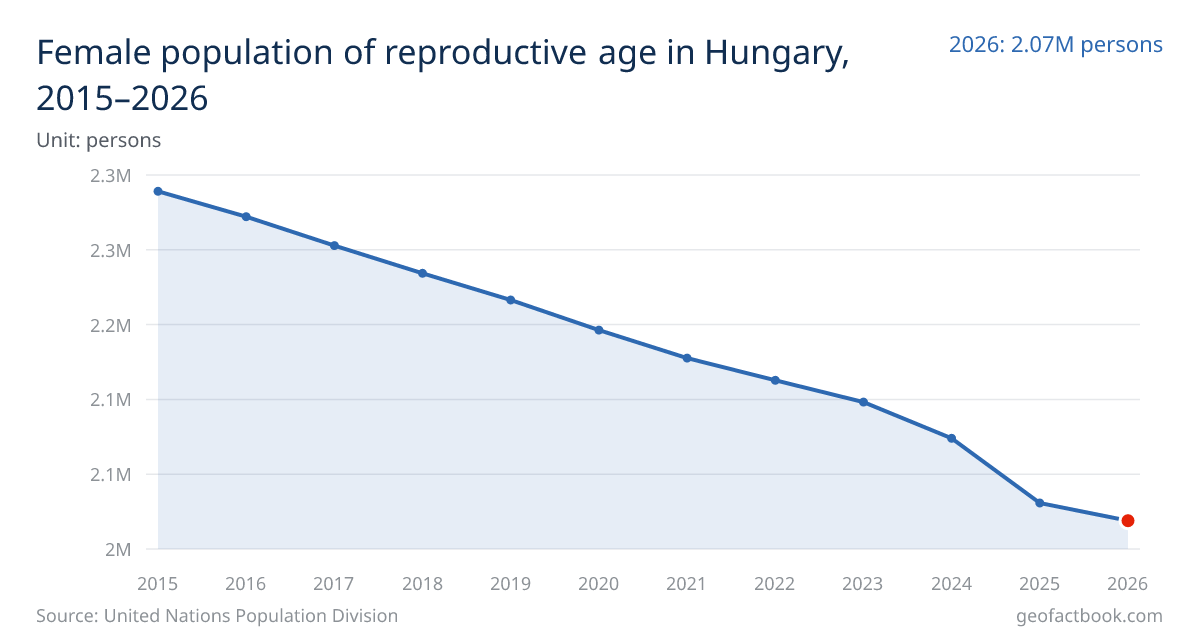
Hungary's female population of reproductive age in 2026 is 2.07 Million (estimate), down 0.6% from 2025. It ranks #99 of 236 countries.
The female population of reproductive age is a crucial demographic statistic that influences healthcare, economic growth, and social policies in countries. Understanding this population helps address reproductive health needs and support family planning initiatives.
Estimated value for 2026 (interpolated, no direct source).
Where Hungary ranks (2026)
#99 of 236- #97
 Laos2.16M persons
- #98
 Portugal2.1M persons
- #99
 Hungary2.07M persons
- #100
 Belarus2M persons
- #101
 Libya1.97M persons
Female population of reproductive age over timeSome values are estimated based on historical trends
| Year | Value | Change | % Change | Actions |
|---|---|---|---|---|
| 2026 | 2.07M persons | 11.82K persons | -0.57% | |
| 2025 | 2.08M persons | 43.29K persons | -2.04% | |
| 2024 | 2.12M persons | 24.17K persons | -1.13% | |
| 2023 | 2.15M persons | 14.59K persons | -0.67% | |
| 2022 | 2.16M persons | 14.83K persons | -0.68% | |
| 2021 | 2.18M persons | 18.69K persons | -0.85% | |
| 2020 | 2.20M persons | 20.13K persons | -0.91% | |
| 2019 | 2.22M persons | 17.86K persons | -0.80% | |
| 2018 | 2.23M persons | 18.55K persons | -0.82% | |
| 2017 | 2.25M persons | 19.31K persons | -0.85% | |
| 2016 | 2.27M persons | 16.96K persons | -0.74% | |
| 2015 | 2.29M persons | — | — |
Female population of reproductive age in Hungary, 2015–2026: chart
Cite this page
Geo Factbook. (n.d.). Hungary: Female population of reproductive age. Retrieved November 28, 2026, from https://geofactbook.com/countries/hungary/female-population-of-reproductive-age
The figures on this page come from United Nations Population Division. For academic work, cite the original source as well.
Frequently Asked Questions About Hungary Female population of reproductive age
What is Hungary's female population of reproductive age in 2026?▾
Hungary's female population of reproductive age is 2.07 Million in 2026 (estimate), according to United Nations Population Division.
Is Hungary's female population of reproductive age increasing or decreasing?▾
Hungary's female population of reproductive age fell by 0.6% from 2025 (2.08 Million) to 2026 (2.07 Million). Over the past decade (2016–2026) it fell by 8.9%.
How does Hungary rank for female population of reproductive age?▾
In 2026, Hungary has the 99th highest female population of reproductive age out of 236 countries with data.
What was Hungary's female population of reproductive age in 2015?▾
In 2015, Hungary's female population of reproductive age was 2.29 Million. By 2026 it fell by 9.6%.
Explore additional statistical insights
Life expectancy at birth in Hungary
Life expectancy at birth measures the average years a newborn is expected to live, reflecting a country's health standards and quality of life. This vital statistic highlights disparities in healthcare and living conditions across nations, making it essential for global health assessments.
Academic Freedom Index in Hungary
Explore the Academic Freedom Index measuring educational liberties globally. Compare countries' scores, view rankings, and analyze historical trends.
Learning-adjusted years of school in Hungary
Learning-adjusted years of school measures educational quality by accounting for both enrollment and learning outcomes. This statistic highlights the effectiveness of education systems across countries, emphasizing the need for improved learning environments.
Primary School Pupil-Teacher Ratio in Hungary
Pupil-teacher ratio in primary schools reflects educational quality; lower ratios indicate more personalized attention.
Population Change in Hungary
This statistic measures population change across countries, highlighting shifts in demographics. Understanding these changes is crucial for planning resources, economic growth, and social services.
Urban Population Share 2050 in Hungary
Urban population share by 2050 shows urbanization trends. Discover which countries will be most urbanized.