
Guinea-Bissau Fertilizer Use Per Hectare 2024: 1.09 kg/ha
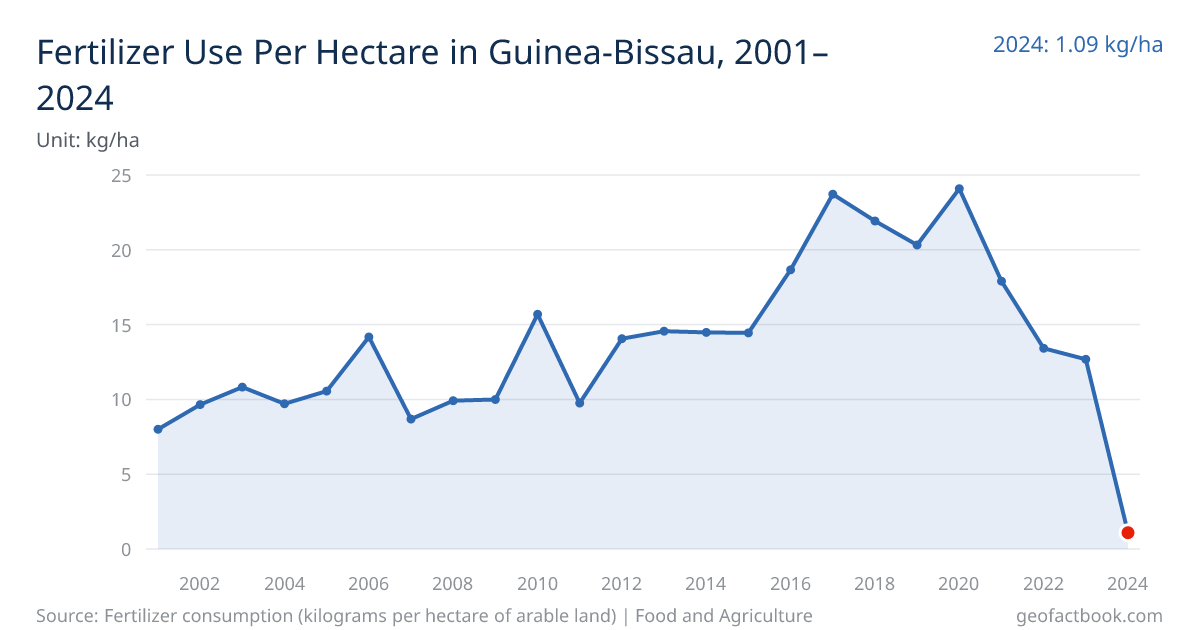
Guinea-Bissau's fertilizer use per hectare in 2024 is 1.09 kg/ha, down 91.4% from 2023. It ranks #183 of 189 countries.
Fertilizer use per hectare shows how much fertilizer is applied to agricultural land in different countries, impacting crop yield.
Source (2024): Fertilizer use per hectare
Where Guinea-Bissau ranks (2024)
#183 of 189- #181
 Congo, Democratic Republic of the2.51 kg/ha
- #182
 Eritrea2.39 kg/ha
- #183
 Guinea-Bissau1.09 kg/ha
- #184
 Niger0.8 kg/ha
- #185
 Samoa0.8 kg/ha
Fertilizer Use Per Hectare over time
| Year | Value | Change | % Change | Actions |
|---|---|---|---|---|
| 2024 | 1.09 kg/ha | 11.59 kg/ha | -91.39% | |
| 2023 | 12.68 kg/ha | 0.74 kg/ha | -5.51% | |
| 2022 | 13.42 kg/ha | 4.48 kg/ha | -25.03% | |
| 2021 | 17.9 kg/ha | 6.18 kg/ha | -25.67% | |
| 2020 | 24.08 kg/ha | +3.76 kg/ha | +18.52% | |
| 2019 | 20.32 kg/ha | 1.61 kg/ha | -7.33% | |
| 2018 | 21.93 kg/ha | 1.79 kg/ha | -7.54% | |
| 2017 | 23.72 kg/ha | +5.05 kg/ha | +27.09% | |
| 2016 | 18.66 kg/ha | +4.21 kg/ha | +29.17% | |
| 2015 | 14.45 kg/ha | 0.03 kg/ha | -0.23% | |
| 2014 | 14.48 kg/ha | 0.08 kg/ha | -0.53% | |
| 2013 | 14.56 kg/ha | +0.5 kg/ha | +3.53% | |
| 2012 | 14.06 kg/ha | +4.31 kg/ha | +44.21% | |
| 2011 | 9.75 kg/ha | 5.94 kg/ha | -37.86% | |
| 2010 | 15.69 kg/ha | +5.7 kg/ha | +57.01% | |
| 2009 | 9.99 kg/ha | +0.08 kg/ha | +0.83% | |
| 2008 | 9.91 kg/ha | +1.23 kg/ha | +14.15% | |
| 2007 | 8.68 kg/ha | 5.49 kg/ha | -38.73% | |
| 2006 | 14.17 kg/ha | +3.61 kg/ha | +34.24% | |
| 2005 | 10.56 kg/ha | +0.85 kg/ha | +8.76% | |
| 2004 | 9.71 kg/ha | 1.12 kg/ha | -10.30% | |
| 2003 | 10.82 kg/ha | +1.17 kg/ha | +12.15% | |
| 2002 | 9.65 kg/ha | +1.65 kg/ha | +20.63% | |
| 2001 | 8 kg/ha | — | — |
Fertilizer Use Per Hectare in Guinea-Bissau, 2001–2024: chart
Cite this page
Geo Factbook. (n.d.). Guinea-Bissau: Fertilizer Use Per Hectare. Retrieved November 27, 2026, from https://geofactbook.com/countries/guinea-bissau/fertilizer-use-per-hectare
The figures on this page come from Fertilizer consumption (kilograms per hectare of arable land) | Food and Agriculture Organization of the United Nations (FAO) via World Bank. For academic work, cite the original source as well.
Frequently Asked Questions About Guinea-Bissau Fertilizer Use Per Hectare
What is Guinea-Bissau's fertilizer use per hectare in 2024?▾
Guinea-Bissau's fertilizer use per hectare is 1.09 kg/ha in 2024, according to Fertilizer consumption (kilograms per hectare of arable land) | Food and Agriculture Organization of the United Nations (FAO) via World Bank.
Is Guinea-Bissau's fertilizer use per hectare increasing or decreasing?▾
Guinea-Bissau's fertilizer use per hectare fell by 91.4% from 2023 (12.68 kg/ha) to 2024 (1.09 kg/ha). Over the past decade (2014–2024) it fell by 92.5%.
How does Guinea-Bissau rank for fertilizer use per hectare?▾
In 2024, Guinea-Bissau has the 183rd highest fertilizer use per hectare out of 189 countries with data.
What was Guinea-Bissau's fertilizer use per hectare in 2001?▾
In 2001, Guinea-Bissau's fertilizer use per hectare was 8 kg/ha. By 2024 it fell by 86.4%.
Explore additional statistical insights
Annual Area Burnt by Wildfires in Guinea-Bissau
Annual area burnt by wildfires measures the total land affected by wildfires each year in hectares.
Total Threatened Mammal Species in Guinea-Bissau
Total threatened mammal species highlight biodiversity risks. Track conservation efforts worldwide.
Protected Land Area Percentage in Guinea-Bissau
Protected land area percentage shows the share of a country's land dedicated to conservation and biodiversity.
Threatened Bird Species Count in Guinea-Bissau
Threatened bird species count measures the number of bird species at risk of extinction in each country.
Red List Index Score in Guinea-Bissau
The Red List Index Score indicates the overall extinction risk of species within a country based on the IUCN Red List categories.
Total Renewable Groundwater Resources by Country in Guinea-Bissau
Total renewable groundwater represents the combined volume of internally generated and externally sourced groundwater that is naturally replenished and available for use.