
Côte d'Ivoire Total fertility rate 2026: 4.11 per woman
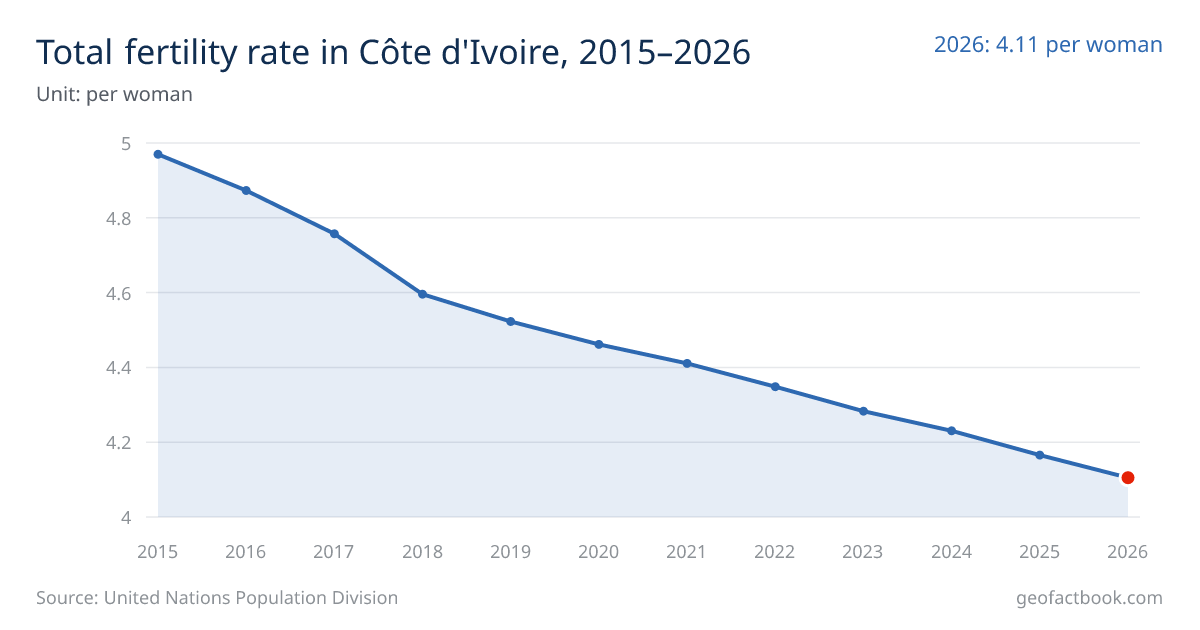
Côte d'Ivoire's total fertility rate in 2026 is 4.11 per woman (estimate), down 1.5% from 2025. It ranks #19 of 236 countries.
The total fertility rate measures the average number of children a woman is expected to have during her lifetime, reflecting population growth and demographic trends. Understanding this statistic is crucial for analyzing economic development, healthcare needs, and societal changes across countries.
Estimated value for 2026 (interpolated, no direct source).
Where Côte d'Ivoire ranks (2026)
#19 of 236- #17
 Sudan4.13 per woman
- #18
 Cameroon4.12 per woman
- #19
 Côte d'Ivoire4.11 per woman
- #20
 Togo4 per woman
- #21
 Congo3.99 per woman
Total fertility rate over timeSome values are estimated based on historical trends
| Year | Value | Change | % Change | Actions |
|---|---|---|---|---|
| 2026 | 4.11 per woman | 0.06 per woman | -1.45% | |
| 2025 | 4.17 per woman | 0.06 per woman | -1.53% | |
| 2024 | 4.23 per woman | 0.05 per woman | -1.22% | |
| 2023 | 4.28 per woman | 0.07 per woman | -1.51% | |
| 2022 | 4.35 per woman | 0.06 per woman | -1.41% | |
| 2021 | 4.41 per woman | 0.05 per woman | -1.14% | |
| 2020 | 4.46 per woman | 0.06 per woman | -1.36% | |
| 2019 | 4.52 per woman | 0.07 per woman | -1.58% | |
| 2018 | 4.6 per woman | 0.16 per woman | -3.40% | |
| 2017 | 4.76 per woman | 0.12 per woman | -2.37% | |
| 2016 | 4.87 per woman | 0.1 per woman | -1.95% | |
| 2015 | 4.97 per woman | — | — |
Total fertility rate in Côte d'Ivoire, 2015–2026: chart
Cite this page
Geo Factbook. (n.d.). Côte d'Ivoire: Total fertility rate. Retrieved November 27, 2026, from https://geofactbook.com/countries/cte-divoire/total-fertility-rate
The figures on this page come from United Nations Population Division. For academic work, cite the original source as well.
Frequently Asked Questions About Côte d'Ivoire Total fertility rate
What is Côte d'Ivoire's total fertility rate in 2026?▾
Côte d'Ivoire's total fertility rate is 4.11 per woman in 2026 (estimate), according to United Nations Population Division.
Is Côte d'Ivoire's total fertility rate increasing or decreasing?▾
Côte d'Ivoire's total fertility rate fell by 1.5% from 2025 (4.17 per woman) to 2026 (4.11 per woman). Over the past decade (2016–2026) it fell by 15.8%.
How does Côte d'Ivoire rank for total fertility rate?▾
In 2026, Côte d'Ivoire has the 19th highest total fertility rate out of 236 countries with data.
What was Côte d'Ivoire's total fertility rate in 2015?▾
In 2015, Côte d'Ivoire's total fertility rate was 4.97 per woman. By 2026 it fell by 17.4%.
Explore additional statistical insights
Death Rate (%) in Côte d'Ivoire
Explore death rate statistics across countries. Compare rates, view historical trends, and interact with dynamic maps for deeper insights.
Urban Population Share 2050 in Côte d'Ivoire
Urban population share by 2050 shows urbanization trends. Discover which countries will be most urbanized.
Urban Population Annual Growth Rate in Côte d'Ivoire
Urban population annual growth rate measures the year-over-year percentage increase in a country's urban population.
Contraceptive Prevalence Rate in Côte d'Ivoire
Contraceptive Prevalence Rate indicates the percentage of women using contraception. Explore global rankings, compare countries, and view trends.
Total population in Côte d'Ivoire
Discover the latest total population statistics for every country and region worldwide. Explore accurate, up-to-date data on global population growth, density, and demographic trends — sourced from trusted international databases like the UN and World Bank. Perfect for researchers, students, and data enthusiasts looking to understand how the world’s population is changing.
Total demand for family planning (Percent) in Côte d'Ivoire
Total demand for family planning measures the percentage of individuals seeking access to reproductive health services. Understanding this statistic is crucial for addressing global population growth and improving health outcomes.