
Côte d'Ivoire Urban Population Share 2050 2025: 54.55 %
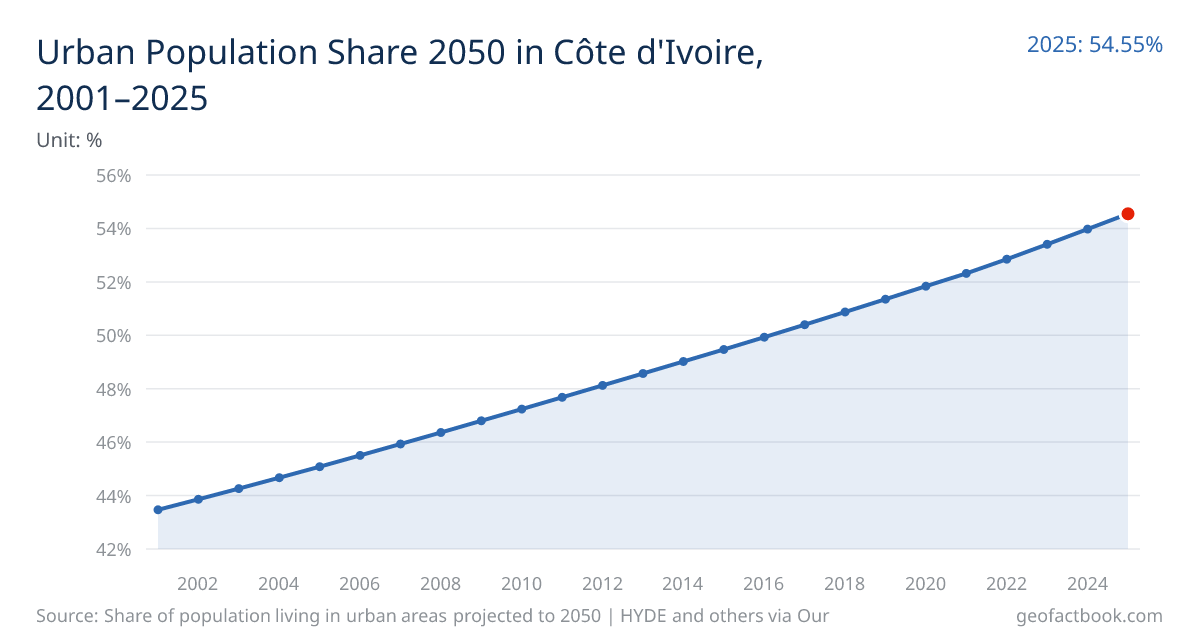
Côte d'Ivoire's urban population share 2050 in 2025 is 54.55 %, up 1.1% from 2024. It ranks #159 of 236 countries.
Urban population share by 2050 shows urbanization trends. Discover which countries will be most urbanized.
Source (2025): Share of population living in urban areas projected to 2050 | Our World in Data
Where Côte d'Ivoire ranks (2025)
#159 of 236- #157
 Haiti55.61%
- #158
 Somalia55.14%
- #159
 Côte d'Ivoire54.55%
- #160
 Trinidad and Tobago53.97%
- #161
 Benin53.36%
Urban Population Share 2050 over time
| Year | Value | Change | % Change | Actions |
|---|---|---|---|---|
| 2025 | 54.55 % | +0.58 % | +1.07% | |
| 2024 | 53.97 % | +0.57 % | +1.06% | |
| 2023 | 53.41 % | +0.56 % | +1.06% | |
| 2022 | 52.85 % | +0.53 % | +1.01% | |
| 2021 | 52.32 % | +0.48 % | +0.93% | |
| 2020 | 51.84 % | +0.48 % | +0.94% | |
| 2019 | 51.35 % | +0.48 % | +0.94% | |
| 2018 | 50.87 % | +0.47 % | +0.94% | |
| 2017 | 50.4 % | +0.47 % | +0.94% | |
| 2016 | 49.93 % | +0.46 % | +0.93% | |
| 2015 | 49.47 % | +0.45 % | +0.92% | |
| 2014 | 49.02 % | +0.45 % | +0.92% | |
| 2013 | 48.57 % | +0.45 % | +0.93% | |
| 2012 | 48.12 % | +0.44 % | +0.93% | |
| 2011 | 47.68 % | +0.44 % | +0.94% | |
| 2010 | 47.24 % | +0.44 % | +0.94% | |
| 2009 | 46.8 % | +0.44 % | +0.94% | |
| 2008 | 46.36 % | +0.43 % | +0.94% | |
| 2007 | 45.93 % | +0.43 % | +0.94% | |
| 2006 | 45.5 % | +0.42 % | +0.93% | |
| 2005 | 45.08 % | +0.41 % | +0.93% | |
| 2004 | 44.67 % | +0.41 % | +0.92% | |
| 2003 | 44.26 % | +0.4 % | +0.91% | |
| 2002 | 43.86 % | +0.39 % | +0.90% | |
| 2001 | 43.47 % | — | — |
Urban Population Share 2050 in Côte d'Ivoire, 2001–2025: chart
Cite this page
Geo Factbook. (n.d.). Côte d'Ivoire: Urban Population Share 2050. Retrieved November 29, 2026, from https://geofactbook.com/countries/cte-divoire/urban-population-share-2050
The figures on this page come from Share of population living in urban areas projected to 2050 | HYDE and others via Our World in Data. For academic work, cite the original source as well.
Frequently Asked Questions About Côte d'Ivoire Urban Population Share 2050
What is Côte d'Ivoire's urban population share 2050 in 2025?▾
Côte d'Ivoire's urban population share 2050 is 54.55 % in 2025, according to Share of population living in urban areas projected to 2050 | HYDE and others via Our World in Data.
Is Côte d'Ivoire's urban population share 2050 increasing or decreasing?▾
Côte d'Ivoire's urban population share 2050 rose by 1.1% from 2024 (53.97 %) to 2025 (54.55 %). Over the past decade (2015–2025) it rose by 10.3%.
How does Côte d'Ivoire rank for urban population share 2050?▾
In 2025, Côte d'Ivoire has the 159th highest urban population share 2050 out of 236 countries with data.
What was Côte d'Ivoire's urban population share 2050 in 2001?▾
In 2001, Côte d'Ivoire's urban population share 2050 was 43.47 %. By 2025 it rose by 25.5%.
Explore additional statistical insights
Population living in slums in Côte d'Ivoire
This statistic measures the percentage of a country's population living in slums, highlighting urban poverty and living conditions. Understanding slum populations is crucial for addressing housing challenges and improving the quality of life.
Academic Freedom Index in Côte d'Ivoire
Explore the Academic Freedom Index measuring educational liberties globally. Compare countries' scores, view rankings, and analyze historical trends.
Voter Turnout (% of Voting-Age Population) in Côte d'Ivoire
Voting age population denotes individuals eligible to vote based on age, providing insights into electoral demographics.
Share of Students Studying Abroad in Côte d'Ivoire
Share of students studying abroad tracks the percentage of tertiary-level students enrolled outside their home country.
Population Growth Rate in Côte d'Ivoire
Explore the Population Growth Rate across 266+ countries. Compare trends, view rankings, and interact with detailed maps.
Percentage of One-Person Households in Côte d'Ivoire
Discover which countries have the highest percentage of one-person households, highlighting trends in living arrangements.