
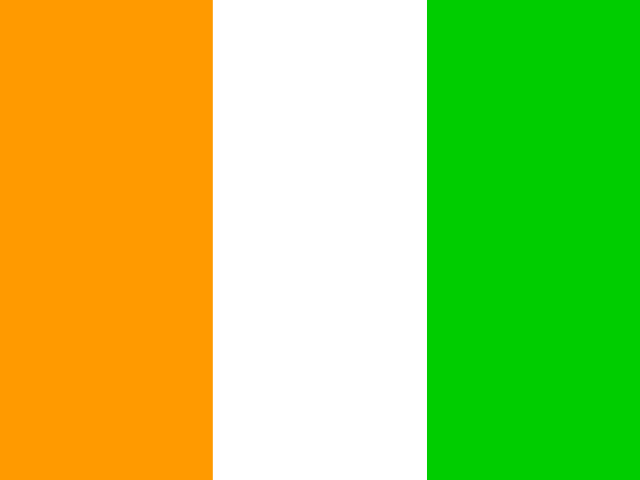
Location
Côte d'Ivoire is in Western Africa, bordering the North Atlantic Ocean, between Ghana and Liberia. It shares land borders with Guinea (816 km), Liberia (778 km), Ghana (720 km), Mali (599 km) and Burkina Faso (545 km) and has 515 km of coastline. Its capitals are Yamoussoukro (legislative capital) and Abidjan (administrative and economic capital).
Côte d'Ivoire population 2026: 33.49 Million — growth, rank & history →Key Statistics for 2026
Total population
Population Change
Median age of population
Population density
Life expectancy at birth
Agricultural land
Apple Import Volume
Dam capacity per capita
Female population of reproductive age
Health Care Spending per Capita
Learning-adjusted years of school
History
Côte d'Ivoire, also known as Ivory Coast, has a rich historical tapestry that reflects its diverse cultures and influences. The region's early history is characterized by the presence of ancient civilizations, including the Akan people, who are believed to have migrated to the area around the 11th century. Archaeological findings indicate the existence of organized settlements and the practice of agriculture, with evidence of ironworking and trade networks that connected the region to other West African societies. This early period laid the foundation for the emergence of powerful kingdoms such as the Kong and the Gyaaman states.
During the medieval period, particularly between the 14th and 17th centuries, Côte d'Ivoire became a significant player in the trans-Saharan trade. The rise of the Akan empires facilitated trade in gold, ivory, and kola nuts, attracting merchants from across Africa and Europe. Notably, the coastal cities like Grand-Bassam and Assinie developed as trading ports that connected inland kingdoms with European traders, particularly the French and the Portuguese. This period saw the establishment of complex social structures and the spread of Islam, which influenced local customs and governance.
The colonial era began in the late 19th century when Côte d'Ivoire became a French protectorate in 1893. The French sought to exploit the country's resources and established plantations for cash crops such as cocoa and coffee, which would later become vital to the Ivorian economy. In 1960, Côte d'Ivoire gained independence from France, led by its first president, Félix Houphouët-Boigny, who focused on economic development and political stability. His tenure was marked by a period of relative peace and prosperity, though it also sowed the seeds for future ethnic tensions.
In the late 20th and early 21st centuries, Côte d'Ivoire experienced significant political turmoil, particularly during the civil wars of 2002 and 2010, which were fueled by ethnic divisions and political rivalries. These conflicts resulted in thousands of deaths and widespread displacement. More recently, the country has made strides toward reconciliation and rebuilding, with a focus on economic recovery and democratic governance. Côte d'Ivoire’s historical significance is underscored by its role as one of the leading economies in West Africa, and its ongoing efforts to navigate the complexities of its diverse heritage and modern identity.
Geography
Côte d'Ivoire, also known as Ivory Coast, is located on the southern coast of West Africa, bordered by the North Atlantic Ocean to the south. It shares land boundaries with five countries: Ghana to the east, Burkina Faso to the north, Mali to the northwest, and Guinea to the west. The nation's geographic coordinates are approximately between latitudes 2° and 11° N and longitudes 2° and 8° W. This strategic location provides Côte d'Ivoire with a rich diversity of ecosystems, making it a vital area for both biodiversity and agriculture in the region.
The physical features of Côte d'Ivoire are characterized by a variety of landscapes, including coastal plains, savannahs, and mountainous regions. The Abidjan Lagoon and the Comoé River are significant water bodies that enhance the country's geographical complexity. The country's highest point is the Mont Nimba, which rises to approximately 1,752 meters (5,748 feet) above sea level, situated in the northeastern part of the country. The terrain generally transitions from coastal lowlands to rolling hills and plateaus in the interior, contributing to the rich agricultural potential of the land.
Côte d'Ivoire experiences a tropical climate, characterized by distinct wet and dry seasons. The coastal regions have a humid climate with average annual rainfall ranging from 1,200 to 2,500 millimeters (47 to 98 inches). The northern areas, however, are influenced by a savannah climate with a more pronounced dry season. Temperatures typically hover between 24°C to 30°C (75°F to 86°F), with humidity levels fluctuating based on the season. The wet season, occurring from May to October, is critical for agricultural activities, while the dry season promotes a more temperate climate conducive to tourism and other economic activities.
The natural resources of Côte d'Ivoire are abundant, with the country being one of the world's largest producers of cocoa and cashew nuts. Additionally, the country is rich in minerals such as gold, diamonds, and oil, contributing significantly to its economy. The environmental characteristics of Côte d'Ivoire include a mix of dense rainforests, savannahs, and wetlands, which are home to a wide range of flora and fauna, some of which are endemic to the region. However, deforestation and environmental degradation pose challenges to the country’s biodiversity, highlighting the need for sustainable management of its natural resources.
Government
Côte d'Ivoire, also known as Ivory Coast, operates under a presidential republic framework, where the President serves as both the head of state and the head of government. The political system is characterized by a multi-party structure, allowing for a broad representation of political views. The Constitution of 2016 defines the roles and responsibilities of the government, emphasizing the principles of democracy and human rights. Since gaining independence from France in 1960, Côte d'Ivoire has experienced various political challenges, including coups and civil conflicts, yet it has maintained a commitment to democratic governance.
The structure of government in Côte d'Ivoire is divided into three branches: the executive, legislative, and judicial. The executive branch is headed by the President, who is elected for a five-year term and can be re-elected. The President appoints the Prime Minister, who assists in the administration of government functions. The legislative branch consists of a bicameral parliament, which includes the National Assembly and the Senate. Members of the National Assembly are elected directly by the citizens, while the Senate is partially appointed and partially elected, reflecting a balance of interests within the country. The judicial branch is independent and includes a Supreme Court, which oversees the interpretation of laws and the constitutionality of legislative acts.
Key institutions within the Ivorian government include the Presidency, the Prime Minister's Office, and the National Assembly. The current President, Alassane Ouattara, has been in office since 2010 and has played a significant role in stabilizing the nation and promoting economic growth. The political landscape is dynamic, with several parties competing for influence, including the Rally of Houphouëtists for Democracy and Peace (RHDP) and the Ivorian Popular Front (FPI). The government has made efforts to foster national reconciliation and unity following periods of civil unrest and political division.
Côte d'Ivoire employs a system of proportional representation for legislative elections, enabling various political parties to secure seats in the National Assembly based on the percentage of votes they receive. The political climate has been marked by both progress and challenges, as the country navigates issues related to governance, economic disparity, and social cohesion. Electoral processes are overseen by the Independent Electoral Commission (CEI), which aims to ensure free and fair elections. This evolving political landscape highlights the ongoing commitment of Côte d'Ivoire to democracy and development amidst its rich cultural heritage and economic potential.
Economy
Côte d'Ivoire, also known as Ivory Coast, operates a mixed economic system characterized by a blend of agriculture, industry, and services. As of 2023, the country's Gross Domestic Product (GDP) is approximately $70 billion, with a growth rate that has consistently outpaced many other African nations. The economy is predominantly driven by agriculture, which accounts for a significant portion of the GDP and employs a large part of the population. The Ivorian economy has shown resilience and potential, with efforts to diversify its economic base and reduce reliance on traditional agricultural exports.
The major industries in Côte d'Ivoire include agriculture, mining, and manufacturing. The country is the world's largest producer of cocoa and a leading producer of coffee, which are crucial to its export economy. Other significant agricultural products include palm oil, cashews, and rubber. The industrial sector, while still developing, is increasingly important, with growth observed in food processing, textiles, and construction materials. Additionally, Côte d'Ivoire has rich mineral resources, including gold and diamonds, which contribute to the mining sector's growth and the overall economy.
Côte d'Ivoire maintains robust trade relationships, particularly with partners such as France, the United States, and China. The country primarily exports agricultural products, with cocoa and coffee being the most notable, alongside rubber and oil palm products. In contrast, imports mainly consist of machinery, petroleum products, and consumer goods. The trade balance has been positively influenced by the increasing global demand for cocoa, although fluctuations in commodity prices can pose risks to economic stability.
Despite its economic progress, Côte d'Ivoire faces several challenges, including infrastructural deficits, political instability, and vulnerability to climate change, which can adversely affect agricultural productivity. However, there are significant opportunities for growth, particularly in renewable energy, technology, and tourism sectors. The government's commitment to improving infrastructure and attracting foreign investment could further enhance economic resilience and foster sustainable development in the coming years.
Culture
Côte d'Ivoire, known for its rich cultural tapestry, is home to over 60 distinct ethnic groups, each contributing to the nation's diverse cultural landscape. The largest groups include the Akan, Krou, and Mandé peoples, with the Akan being particularly prominent. The official language is French, a remnant of colonial rule, but numerous indigenous languages such as Akan, Krou, and Mandé are widely spoken. Religious beliefs are varied, with approximately 42% of the population adhering to Christianity, 40% practicing Islam, and a significant percentage engaging in traditional African religions, highlighting the country's pluralistic nature.
The cultural traditions and customs of Côte d'Ivoire are vibrant and reflect the deep-rooted history of its people. Festivals play a crucial role in Ivorian culture, with celebrations such as the Fête des Masques (Festival of Masks) showcasing traditional music, dance, and elaborate masks representing various spirits. Family and community ties are paramount, often celebrated through communal gatherings and rituals that reinforce social cohesion. Traditional practices, such as marriage ceremonies and rites of passage, are significant, where customary laws often take precedence over formal legal systems.
The arts in Côte d'Ivoire are renowned for their diversity and creativity, particularly in music, dance, and literature. The country has produced world-famous musical genres like Zouglou and Coupé-Décalé, which resonate with themes of social commentary and daily life. Literature has also flourished, with authors like Ahmadou Kourouma gaining international acclaim for their poignant narratives that explore the Ivorian experience. Visual arts, including traditional sculpture and contemporary paintings, reflect both ancestral influences and modern expressions, making the Ivorian art scene dynamic and engaging.
Cuisine in Côte d'Ivoire is a delicious reflection of its cultural heritage, with dishes like attiéké (fermented cassava) and foutou (pounded plantains or yams) forming staples of everyday meals. Street food is prevalent, with vendors offering a variety of snacks such as aloco (fried plantains) and garba (tuna with attiéké), which are cherished by locals and visitors alike. Daily life in Côte d'Ivoire is characterized by a blend of traditional practices and modern influences, as urbanization brings about new lifestyles while preserving cultural identities. As such, the nation's cultural richness is not only celebrated in its traditions but also evolves continuously, reflecting the resilience and adaptability of its people.
About This Data
This page displays comprehensive statistical data for Côte d'Ivoire for the year 2026. All data points are sourced from authoritative international organizations and are regularly updated to ensure accuracy and reliability.
Click on any statistic to explore more detailed information, see how Côte d'Ivoire compares with other countries, and view historical trends.
Primary Data Sources
CIA World Factbook
Comprehensive country profiles and demographic statistics from the Central Intelligence Agency
Learn moreUnited Nations Statistics
Global demographic data and population projections from UN agencies and research divisions
Learn moreWorld Bank Open Data
Development indicators and comprehensive population metrics from the World Bank database
Learn moreCompare Côte d'Ivoire with other countries
Side-by-side comparisons across population, GDP, geography, and more.
Frequently Asked Questions About Côte d'Ivoire
Which continent is Côte d'Ivoire in?▾
Côte d'Ivoire is in Africa, in the Western Africa subregion according to the UN geoscheme.
What is the population of Côte d'Ivoire in 2026?▾
The population of Côte d'Ivoire in 2026 is 33,488,863 persons.
What is the GDP of Côte d'Ivoire?▾
The GDP of Côte d'Ivoire is 97,390,292,639.5918 US dollars.
What is the life expectancy in Côte d'Ivoire?▾
The life expectancy at birth in Côte d'Ivoire is 65.2776 years.
What is the population density of Côte d'Ivoire?▾
The population density of Côte d'Ivoire is 105.2644 persons per square kilometer.
What is the total fertility rate in Côte d'Ivoire?▾
The total fertility rate in Côte d'Ivoire is 4.1051 children per woman.
What percentage of Côte d'Ivoire's population lives in urban areas?▾
69.2667% of Côte d'Ivoire's population lives in urban areas.