
Central African Republic Total Armed Forces Personnel (PPP) 2020: 10,000
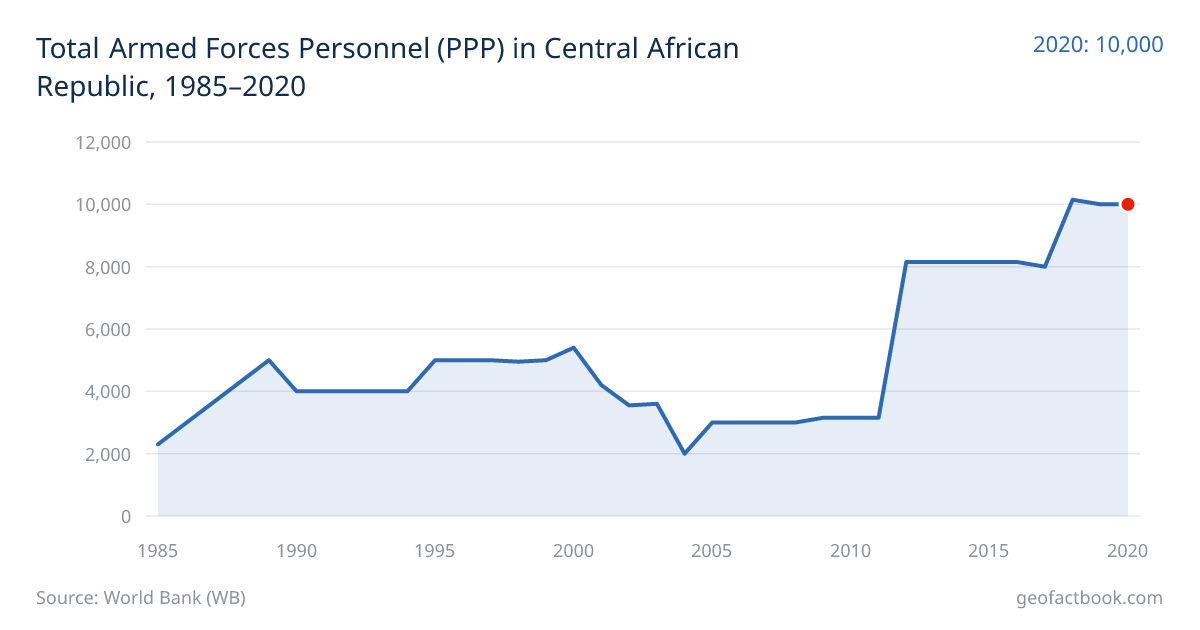
Central African Republic's total armed forces personnel (ppp) in 2020 is 10,000, unchanged from 2019. It ranks #131 of 170 countries.
Explore total armed forces personnel across 266+ countries. Compare military size, view rankings, and analyze historical trends on our interactive map.
Where Central African Republic ranks (2020)
#131 of 170- #128
 Burkina Faso11,000
- #128
 Mozambique11,000
- #131
 Central African Republic10,000
- #131
 Costa Rica10,000
- #131
 New Zealand10,000
Total Armed Forces Personnel (PPP) over time
| Year | Value | Change | % Change | Actions |
|---|---|---|---|---|
| 2020 | 10.00K | 0 | 0.00% | |
| 2019 | 10.00K | 150 | -1.48% | |
| 2018 | 10.15K | +2.15K | +26.88% | |
| 2017 | 8.00K | 150 | -1.84% | |
| 2016 | 8.15K | 0 | 0.00% | |
| 2015 | 8.15K | 0 | 0.00% | |
| 2014 | 8.15K | 0 | 0.00% | |
| 2013 | 8.15K | 0 | 0.00% | |
| 2012 | 8.15K | +5.00K | +158.73% | |
| 2011 | 3.15K | 0 | 0.00% | |
| 2010 | 3.15K | 0 | 0.00% | |
| 2009 | 3.15K | +150 | +5.00% | |
| 2008 | 3.00K | 0 | 0.00% | |
| 2007 | 3.00K | 0 | 0.00% | |
| 2005 | 3.00K | +1.00K | +50.00% | |
| 2004 | 2.00K | 1.60K | -44.44% | |
| 2003 | 3.60K | +50 | +1.41% | |
| 2002 | 3.55K | 650 | -15.48% | |
| 2001 | 4.20K | 1.20K | -22.22% | |
| 2000 | 5.40K | +400 | +8.00% | |
| 1999 | 5.00K | +50 | +1.01% | |
| 1998 | 4.95K | 50 | -1.00% | |
| 1997 | 5.00K | 0 | 0.00% | |
| 1996 | 5.00K | 0 | 0.00% | |
| 1995 | 5.00K | +1.00K | +25.00% | |
| 1994 | 4.00K | 0 | 0.00% | |
| 1993 | 4.00K | 0 | 0.00% | |
| 1992 | 4.00K | 0 | 0.00% | |
| 1991 | 4.00K | 0 | 0.00% | |
| 1990 | 4.00K | 1.00K | -20.00% | |
| 1989 | 5.00K | +2.70K | +117.39% | |
| 1985 | 2.30K | — | — |
Total Armed Forces Personnel (PPP) in Central African Republic, 1985–2020: chart
Cite this page
Geo Factbook. (n.d.). Central African Republic: Total Armed Forces Personnel (PPP). Retrieved November 27, 2026, from https://geofactbook.com/countries/central-african-republic/armed-forces-personnel-total
The figures on this page come from World Bank (WB). For academic work, cite the original source as well.
Frequently Asked Questions About Central African Republic Total Armed Forces Personnel (PPP)
What is Central African Republic's total armed forces personnel (ppp) in 2020?▾
Central African Republic's total armed forces personnel (ppp) is 10,000 in 2020, according to World Bank (WB).
Is Central African Republic's total armed forces personnel (ppp) increasing or decreasing?▾
Central African Republic's total armed forces personnel (ppp) was essentially unchanged from 2019 (10,000) to 2020 (10,000). Over the past decade (2010–2020) it rose by 217.5%.
How does Central African Republic rank for total armed forces personnel (ppp)?▾
In 2020, Central African Republic has the 131st highest total armed forces personnel (ppp) out of 170 countries with data.
What was Central African Republic's total armed forces personnel (ppp) in 1985?▾
In 1985, Central African Republic's total armed forces personnel (ppp) was 2,300. By 2020 it rose by 334.8%.
Explore additional statistical insights
Military Expenditures (% of GDP) in Central African Republic
Military Expenditures as a percentage of GDP highlights national defense spending. Compare countries, explore rankings, and view trends.
Mean Years of Schooling in Central African Republic
Mean Years of Schooling indicates the average number of years of education received by people aged 25 and older.
Rule of Law Index by Country in Central African Republic
Compare countries by Rule of Law percentile rank, reflecting confidence in laws, courts, police, property rights, and protection from crime and violence.
Cotton Yield Per Hectare in Central African Republic
Cotton yield per hectare varies widely. Explore top countries excelling in efficient cotton farming practices.
Number of Clinical Trials in Central African Republic
Explore the number of clinical trials conducted in various countries; critical for medical research and innovation.
Fixed Broadband Penetration Rate in Central African Republic
Fixed broadband penetration rate indicates the proportion of households with broadband access, reflecting connectivity.