
Burkina Faso Total Armed Forces Personnel (PPP) 2020: 11,000
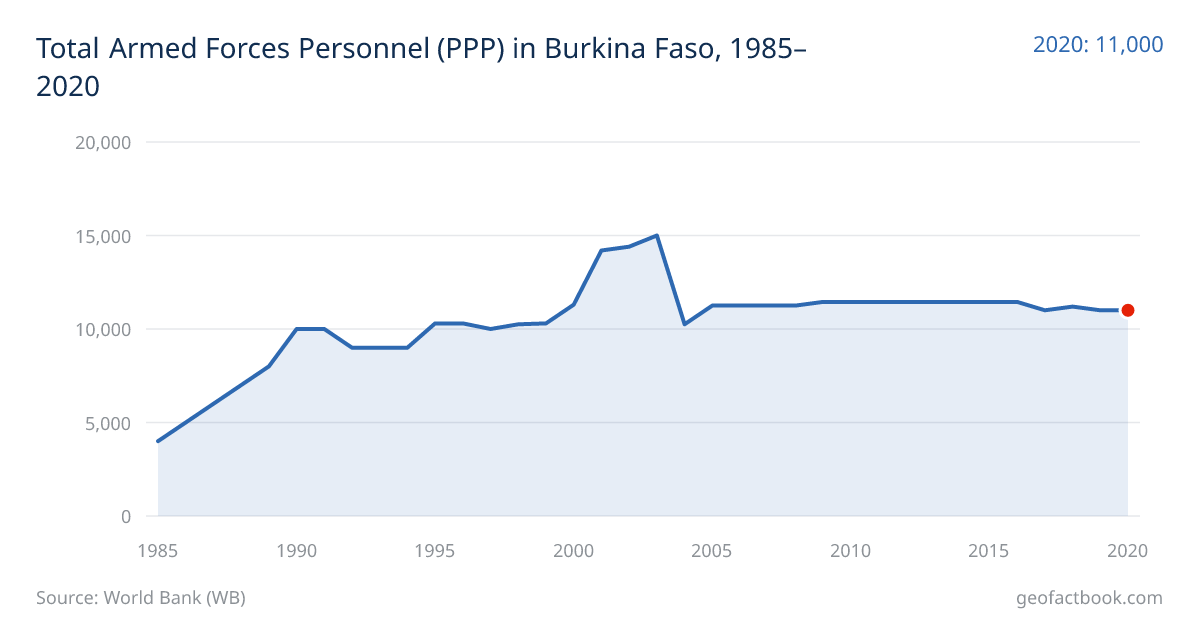
Burkina Faso's total armed forces personnel (ppp) in 2020 is 11,000, unchanged from 2019. It ranks #128 of 170 countries.
Explore total armed forces personnel across 266+ countries. Compare military size, view rankings, and analyze historical trends on our interactive map.
Where Burkina Faso ranks (2020)
#128 of 170- #124
 Nicaragua12,000
- #128
 Bosnia and Herzegovina11,000
- #128
 Burkina Faso11,000
- #128
 Mozambique11,000
- #131
 Central African Republic10,000
Total Armed Forces Personnel (PPP) over time
| Year | Value | Change | % Change | Actions |
|---|---|---|---|---|
| 2020 | 11.00K | 0 | 0.00% | |
| 2019 | 11.00K | 200 | -1.79% | |
| 2018 | 11.20K | +200 | +1.82% | |
| 2017 | 11.00K | 450 | -3.93% | |
| 2016 | 11.45K | 0 | 0.00% | |
| 2015 | 11.45K | 0 | 0.00% | |
| 2014 | 11.45K | 0 | 0.00% | |
| 2013 | 11.45K | 0 | 0.00% | |
| 2012 | 11.45K | 0 | 0.00% | |
| 2011 | 11.45K | 0 | 0.00% | |
| 2010 | 11.45K | 0 | 0.00% | |
| 2009 | 11.45K | +200 | +1.78% | |
| 2008 | 11.25K | 0 | 0.00% | |
| 2007 | 11.25K | 0 | 0.00% | |
| 2005 | 11.25K | +1.00K | +9.76% | |
| 2004 | 10.25K | 4.75K | -31.67% | |
| 2003 | 15.00K | +600 | +4.17% | |
| 2002 | 14.40K | +200 | +1.41% | |
| 2001 | 14.20K | +2.90K | +25.66% | |
| 2000 | 11.30K | +1.00K | +9.71% | |
| 1999 | 10.30K | +50 | +0.49% | |
| 1998 | 10.25K | +250 | +2.50% | |
| 1997 | 10.00K | 300 | -2.91% | |
| 1996 | 10.30K | 0 | 0.00% | |
| 1995 | 10.30K | +1.30K | +14.44% | |
| 1994 | 9.00K | 0 | 0.00% | |
| 1993 | 9.00K | 0 | 0.00% | |
| 1992 | 9.00K | 1.00K | -10.00% | |
| 1991 | 10.00K | 0 | 0.00% | |
| 1990 | 10.00K | +2.00K | +25.00% | |
| 1989 | 8.00K | +4.00K | +100.00% | |
| 1985 | 4.00K | — | — |
Total Armed Forces Personnel (PPP) in Burkina Faso, 1985–2020: chart
Cite this page
Geo Factbook. (n.d.). Burkina Faso: Total Armed Forces Personnel (PPP). Retrieved November 28, 2026, from https://geofactbook.com/countries/burkina-faso/armed-forces-personnel-total
The figures on this page come from World Bank (WB). For academic work, cite the original source as well.
Frequently Asked Questions About Burkina Faso Total Armed Forces Personnel (PPP)
What is Burkina Faso's total armed forces personnel (ppp) in 2020?▾
Burkina Faso's total armed forces personnel (ppp) is 11,000 in 2020, according to World Bank (WB).
Is Burkina Faso's total armed forces personnel (ppp) increasing or decreasing?▾
Burkina Faso's total armed forces personnel (ppp) was essentially unchanged from 2019 (11,000) to 2020 (11,000). Over the past decade (2010–2020) it fell by 3.9%.
How does Burkina Faso rank for total armed forces personnel (ppp)?▾
In 2020, Burkina Faso has the 128th highest total armed forces personnel (ppp) out of 170 countries with data.
What was Burkina Faso's total armed forces personnel (ppp) in 1985?▾
In 1985, Burkina Faso's total armed forces personnel (ppp) was 4,000. By 2020 it rose by 175.0%.
Explore additional statistical insights
Deaths in Armed Conflicts in Burkina Faso
Deaths in armed conflicts highlight the human cost of wars. Track fatalities in countries with ongoing conflicts.
Corruption Perceptions Index in Burkina Faso
Corruption Perceptions Index scores countries based on perceived levels of public sector corruption according to experts and businesspeople.
Red List Index Score in Burkina Faso
The Red List Index Score indicates the overall extinction risk of species within a country based on the IUCN Red List categories.
Old-Age Dependency Ratio in Burkina Faso
Old-age dependency ratio compares the number of elderly dependents to working-age people, affecting economic sustainability.
Tourism Revenue (% of GDP) in Burkina Faso
Tourism revenue as a percentage of GDP shows the economic importance of tourism in a country. Higher values indicate greater reliance.
Total fertility rate in Burkina Faso
The total fertility rate measures the average number of children a woman is expected to have during her lifetime, reflecting population growth and demographic trends. Understanding this statistic is crucial for analyzing economic development, healthcare needs, and societal changes across countries.