
Algeria Female population of reproductive age 2026: 11.6 Million
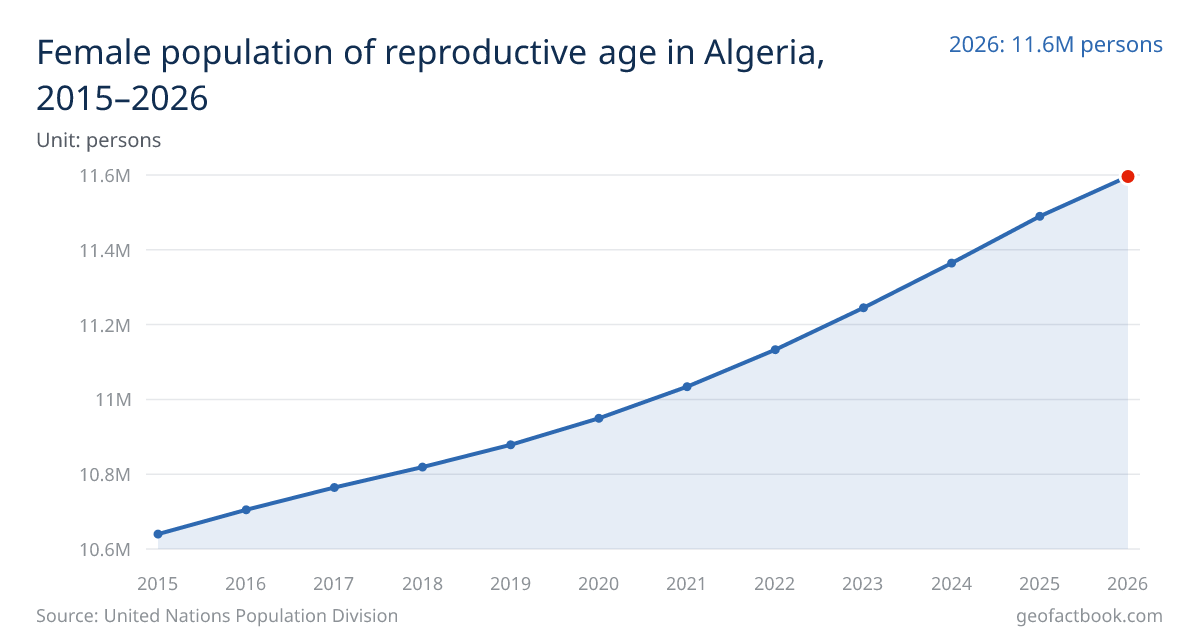
Algeria's female population of reproductive age in 2026 is 11.6 Million (estimate), up 0.9% from 2025. It ranks #32 of 236 countries.
The female population of reproductive age is a crucial demographic statistic that influences healthcare, economic growth, and social policies in countries. Understanding this population helps address reproductive health needs and support family planning initiatives.
Estimated value for 2026 (interpolated, no direct source).
Where Algeria ranks (2026)
#32 of 236- #30
 Iraq12.22M persons
- #31
 Argentina11.64M persons
- #32
 Algeria11.6M persons
- #33
 Italy11.31M persons
- #34
 South Korea10.86M persons
Female population of reproductive age over timeSome values are estimated based on historical trends
| Year | Value | Change | % Change | Actions |
|---|---|---|---|---|
| 2026 | 11.60M persons | +106.39K persons | +0.93% | |
| 2025 | 11.49M persons | +125.07K persons | +1.10% | |
| 2024 | 11.36M persons | +119.56K persons | +1.06% | |
| 2023 | 11.24M persons | +111.90K persons | +1.01% | |
| 2022 | 11.13M persons | +98.97K persons | +0.90% | |
| 2021 | 11.03M persons | +84.69K persons | +0.77% | |
| 2020 | 10.95M persons | +70.70K persons | +0.65% | |
| 2019 | 10.88M persons | +59.61K persons | +0.55% | |
| 2018 | 10.82M persons | +54.72K persons | +0.51% | |
| 2017 | 10.76M persons | +59.38K persons | +0.55% | |
| 2016 | 10.70M persons | +64.96K persons | +0.61% | |
| 2015 | 10.64M persons | — | — |
Female population of reproductive age in Algeria, 2015–2026: chart
Cite this page
Geo Factbook. (n.d.). Algeria: Female population of reproductive age. Retrieved November 28, 2026, from https://geofactbook.com/countries/algeria/female-population-of-reproductive-age
The figures on this page come from United Nations Population Division. For academic work, cite the original source as well.
Frequently Asked Questions About Algeria Female population of reproductive age
What is Algeria's female population of reproductive age in 2026?▾
Algeria's female population of reproductive age is 11.6 Million in 2026 (estimate), according to United Nations Population Division.
Is Algeria's female population of reproductive age increasing or decreasing?▾
Algeria's female population of reproductive age rose by 0.9% from 2025 (11.49 Million) to 2026 (11.6 Million). Over the past decade (2016–2026) it rose by 8.3%.
How does Algeria rank for female population of reproductive age?▾
In 2026, Algeria has the 32nd highest female population of reproductive age out of 236 countries with data.
What was Algeria's female population of reproductive age in 2015?▾
In 2015, Algeria's female population of reproductive age was 10.64 Million. By 2026 it rose by 9.0%.
Explore additional statistical insights
Mean Male Height (cm) in Algeria
Discover mean male height data across 266+ countries. Compare rankings and explore historical trends with interactive maps.
Major Urban Areas Population in Algeria
Explore population figures for major urban areas worldwide. Compare cities, view rankings, and interact with detailed maps.
Female Homicide Rate in Algeria
Female homicide rate measures the number of women murdered per 100,000 women annually, highlighting gender-based violence levels.
Population living in slums in Algeria
This statistic measures the percentage of a country's population living in slums, highlighting urban poverty and living conditions. Understanding slum populations is crucial for addressing housing challenges and improving the quality of life.
Percentage of population by degree of urbanization in Algeria
Explore the percentage of population by degree of urbanization across countries, highlighting the shift towards urban living and its impact on economic growth and development. Understanding these trends is crucial for addressing urban planning and resource allocation.
Total population in Algeria
Discover the latest total population statistics for every country and region worldwide. Explore accurate, up-to-date data on global population growth, density, and demographic trends — sourced from trusted international databases like the UN and World Bank. Perfect for researchers, students, and data enthusiasts looking to understand how the world’s population is changing.