
Afghanistan Female population of reproductive age 2026: 10.79 Million
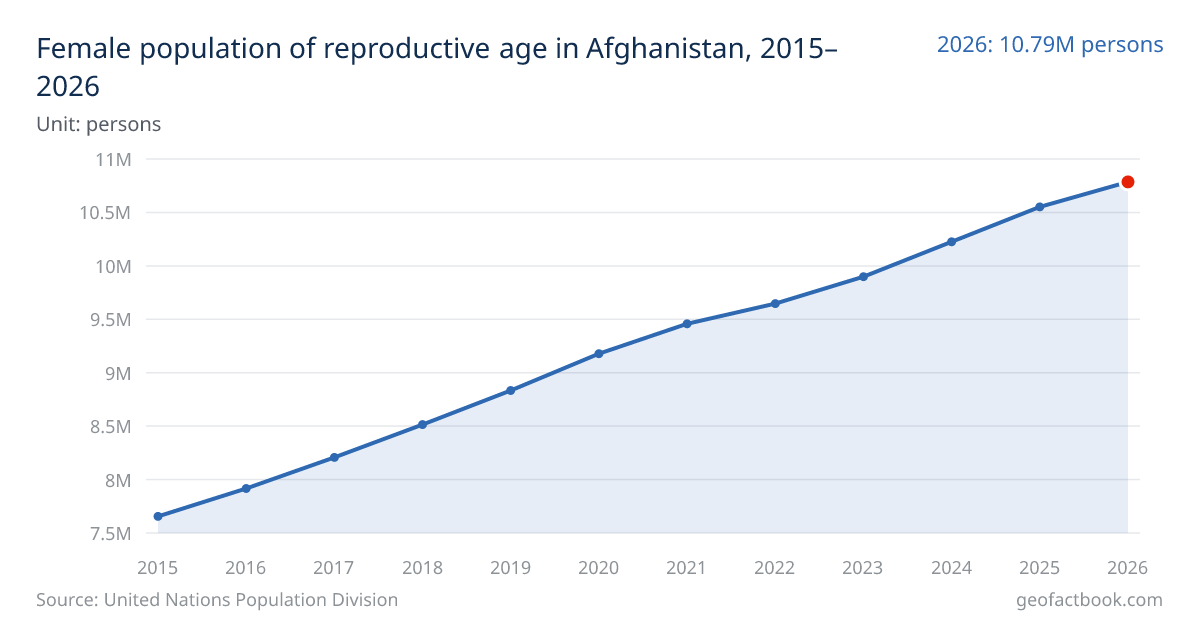
Afghanistan's female population of reproductive age in 2026 is 10.79 Million (estimate), up 2.2% from 2025. It ranks #35 of 236 countries.
The female population of reproductive age is a crucial demographic statistic that influences healthcare, economic growth, and social policies in countries. Understanding this population helps address reproductive health needs and support family planning initiatives.
Estimated value for 2026 (interpolated, no direct source).
Where Afghanistan ranks (2026)
#35 of 236- #33
 Italy11.31M persons
- #34
 South Korea10.86M persons
- #35
 Afghanistan10.79M persons
- #36
 Yemen10.54M persons
- #37
 Spain9.98M persons
Female population of reproductive age over timeSome values are estimated based on historical trends
| Year | Value | Change | % Change | Actions |
|---|---|---|---|---|
| 2026 | 10.79M persons | +234.05K persons | +2.22% | |
| 2025 | 10.55M persons | +326.99K persons | +3.20% | |
| 2024 | 10.22M persons | +326.16K persons | +3.30% | |
| 2023 | 9.90M persons | +251.88K persons | +2.61% | |
| 2022 | 9.65M persons | +189.14K persons | +2.00% | |
| 2021 | 9.46M persons | +279.93K persons | +3.05% | |
| 2020 | 9.18M persons | +343.67K persons | +3.89% | |
| 2019 | 8.83M persons | +319.66K persons | +3.75% | |
| 2018 | 8.51M persons | +307.16K persons | +3.74% | |
| 2017 | 8.21M persons | +290.73K persons | +3.67% | |
| 2016 | 7.92M persons | +261.20K persons | +3.41% | |
| 2015 | 7.66M persons | — | — |
Female population of reproductive age in Afghanistan, 2015–2026: chart
Cite this page
Geo Factbook. (n.d.). Afghanistan: Female population of reproductive age. Retrieved November 29, 2026, from https://geofactbook.com/countries/afghanistan/female-population-of-reproductive-age
The figures on this page come from United Nations Population Division. For academic work, cite the original source as well.
Frequently Asked Questions About Afghanistan Female population of reproductive age
What is Afghanistan's female population of reproductive age in 2026?▾
Afghanistan's female population of reproductive age is 10.79 Million in 2026 (estimate), according to United Nations Population Division.
Is Afghanistan's female population of reproductive age increasing or decreasing?▾
Afghanistan's female population of reproductive age rose by 2.2% from 2025 (10.55 Million) to 2026 (10.79 Million). Over the past decade (2016–2026) it rose by 36.2%.
How does Afghanistan rank for female population of reproductive age?▾
In 2026, Afghanistan has the 35th highest female population of reproductive age out of 236 countries with data.
What was Afghanistan's female population of reproductive age in 2015?▾
In 2015, Afghanistan's female population of reproductive age was 7.66 Million. By 2026 it rose by 40.9%.
Explore additional statistical insights
Currently married (Percent) in Afghanistan
The percentage of currently married individuals by country highlights societal trends in family structure and relationships. Understanding these statistics can provide insights into cultural norms and demographic shifts, influencing policies and social programs.
Urban Population Share 2050 in Afghanistan
Urban population share by 2050 shows urbanization trends. Discover which countries will be most urbanized.
Old-Age Dependency Ratio in Afghanistan
Old-age dependency ratio compares the number of elderly dependents to working-age people, affecting economic sustainability.
Total net-migration in Afghanistan
Total net-migration measures the difference between the number of immigrants and emigrants in a country, reflecting population shifts and economic opportunities. Understanding this statistic is crucial for analyzing demographic trends and policy impacts in nations worldwide.
Education Expenditure (% of GDP) in Afghanistan
Education expenditure measures the percentage of GDP spent on education. Compare countries and explore interactive rankings and trends.
Labor Force in Afghanistan
Labor force participation rate measures the active workforce in each country. Explore rankings, compare nations, and view historical trends.