
Afghanistan Total Armed Forces Personnel (PPP) 2020: 165,000
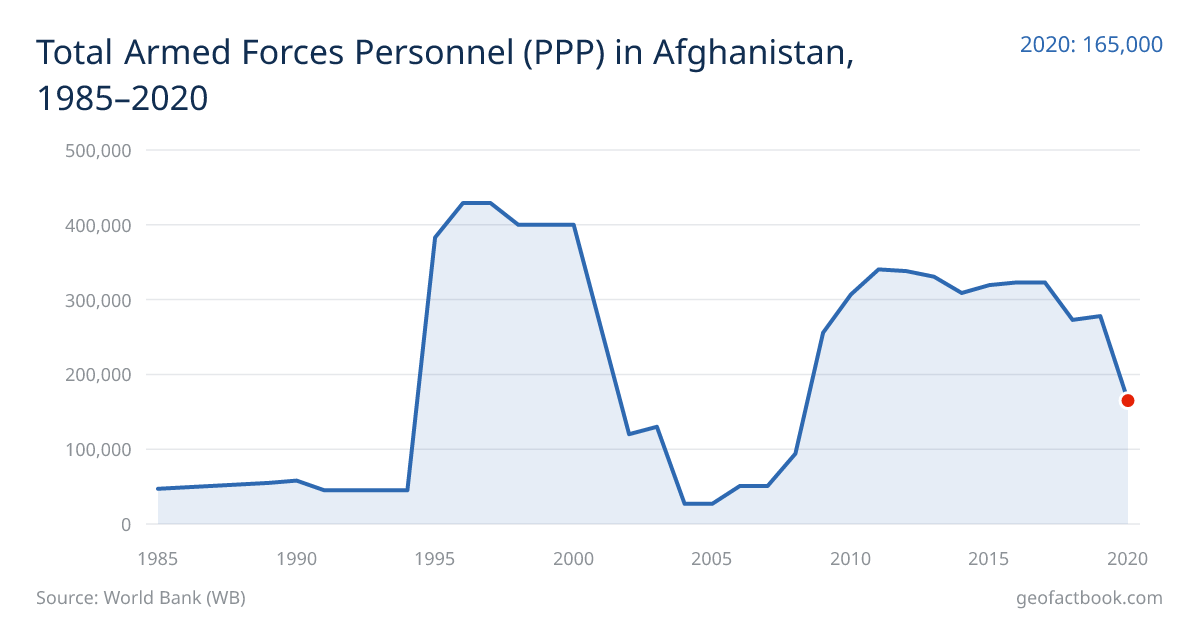
Afghanistan's total armed forces personnel (ppp) in 2020 is 165,000, down 40.6% from 2019. It ranks #37 of 170 countries.
Explore total armed forces personnel across 266+ countries. Compare military size, view rankings, and analyze historical trends on our interactive map.
Where Afghanistan ranks (2020)
#37 of 170- #35
 Germany183,000
- #36
 Israel178,000
- #37
 Afghanistan165,000
- #38
 Belarus158,000
- #38
 Peru158,000
Total Armed Forces Personnel (PPP) over time
| Year | Value | Change | % Change | Actions |
|---|---|---|---|---|
| 2020 | 165.00K | 113.00K | -40.65% | |
| 2019 | 278.00K | +5.10K | +1.87% | |
| 2018 | 272.90K | 50.10K | -15.51% | |
| 2017 | 323.00K | 0 | 0.00% | |
| 2016 | 323.00K | +3.60K | +1.13% | |
| 2015 | 319.40K | +10.60K | +3.43% | |
| 2014 | 308.80K | 21.85K | -6.61% | |
| 2013 | 330.65K | 7.50K | -2.22% | |
| 2012 | 338.15K | 2.20K | -0.65% | |
| 2011 | 340.35K | +33.55K | +10.94% | |
| 2010 | 306.80K | +51.05K | +19.96% | |
| 2009 | 255.75K | +161.75K | +172.07% | |
| 2008 | 94.00K | +43.00K | +84.31% | |
| 2007 | 51.00K | 0 | 0.00% | |
| 2006 | 51.00K | +24.00K | +88.89% | |
| 2005 | 27.00K | 0 | 0.00% | |
| 2004 | 27.00K | 103.00K | -79.23% | |
| 2003 | 130.00K | +10.00K | +8.33% | |
| 2002 | 120.00K | 280.00K | -70.00% | |
| 2000 | 400.00K | 0 | 0.00% | |
| 1999 | 400.00K | 0 | 0.00% | |
| 1998 | 400.00K | 29.00K | -6.76% | |
| 1997 | 429.00K | 0 | 0.00% | |
| 1996 | 429.00K | +46.00K | +12.01% | |
| 1995 | 383.00K | +338.00K | +751.11% | |
| 1994 | 45.00K | 0 | 0.00% | |
| 1993 | 45.00K | 0 | 0.00% | |
| 1992 | 45.00K | 0 | 0.00% | |
| 1991 | 45.00K | 13.00K | -22.41% | |
| 1990 | 58.00K | +3.00K | +5.45% | |
| 1989 | 55.00K | +8.00K | +17.02% | |
| 1985 | 47.00K | — | — |
Total Armed Forces Personnel (PPP) in Afghanistan, 1985–2020: chart
Cite this page
Geo Factbook. (n.d.). Afghanistan: Total Armed Forces Personnel (PPP). Retrieved November 29, 2026, from https://geofactbook.com/countries/afghanistan/armed-forces-personnel-total
The figures on this page come from World Bank (WB). For academic work, cite the original source as well.
Frequently Asked Questions About Afghanistan Total Armed Forces Personnel (PPP)
What is Afghanistan's total armed forces personnel (ppp) in 2020?▾
Afghanistan's total armed forces personnel (ppp) is 165,000 in 2020, according to World Bank (WB).
Is Afghanistan's total armed forces personnel (ppp) increasing or decreasing?▾
Afghanistan's total armed forces personnel (ppp) fell by 40.6% from 2019 (278,000) to 2020 (165,000). Over the past decade (2010–2020) it fell by 46.2%.
How does Afghanistan rank for total armed forces personnel (ppp)?▾
In 2020, Afghanistan has the 37th highest total armed forces personnel (ppp) out of 170 countries with data.
What was Afghanistan's total armed forces personnel (ppp) in 1985?▾
In 1985, Afghanistan's total armed forces personnel (ppp) was 47,000. By 2020 it rose by 251.1%.
Explore additional statistical insights
Military Expenditure (% of GDP) in Afghanistan
Military expenditure as a percentage of GDP reflects a country's military focus relative to its economy.
Deaths in Armed Conflicts in Afghanistan
Deaths in armed conflicts highlight the human cost of wars. Track fatalities in countries with ongoing conflicts.
Threatened Bird Species Count in Afghanistan
Threatened bird species count measures the number of bird species at risk of extinction in each country.
Egg Consumption per Capita in Afghanistan
Egg consumption per capita measures the average number of eggs consumed annually by individuals in a country.
Population living in slums in Afghanistan
This statistic measures the percentage of a country's population living in slums, highlighting urban poverty and living conditions. Understanding slum populations is crucial for addressing housing challenges and improving the quality of life.
Pharmacists Density in Afghanistan
Pharmacists density indicates healthcare accessibility; a higher number suggests better pharmaceutical services per 10,000 people.