
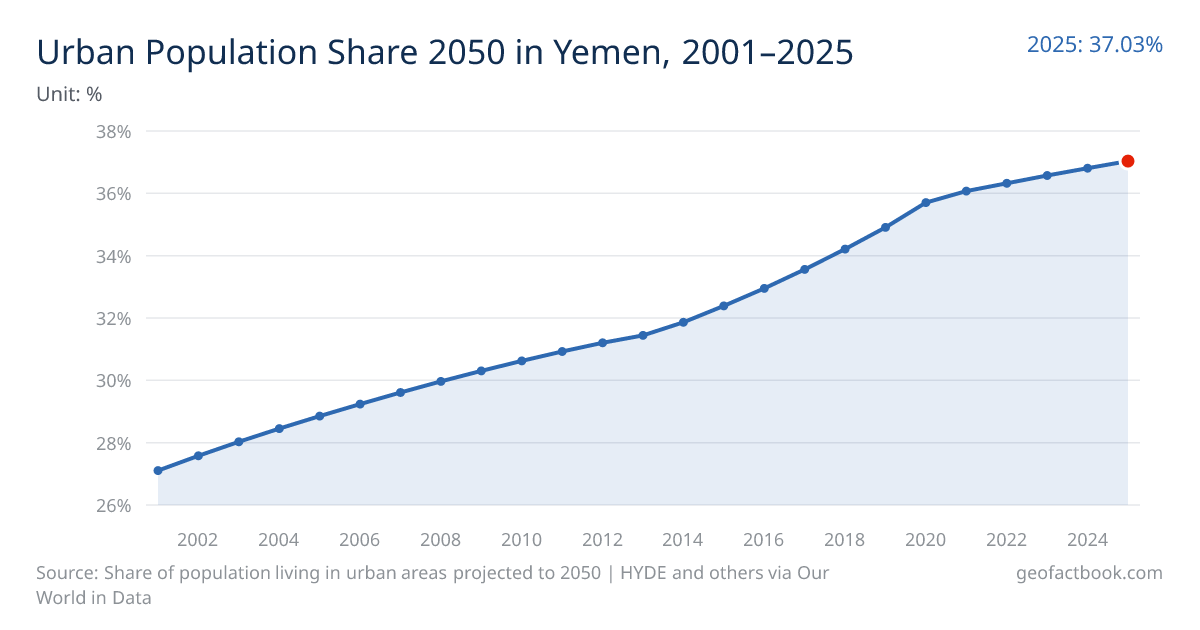
Yemen Urban Population Share 2050 2025: 37.03 %
Yemen's urban population share 2050 in 2025 is 37.03 %, up 0.6% from 2024. It ranks #194 of 236 countries.
Urban population share by 2050 shows urbanization trends. Discover which countries will be most urbanized.
Source (2025): Share of population living in urban areas projected to 2050 | Our World in Data
Where Yemen ranks (2025)
#194 of 236




Urban Population Share 2050 over time
| Year | Value | Change | % Change | Actions |
|---|---|---|---|---|
| 2025 | 37.03 % | +0.23 % | +0.61% | |
| 2024 | 36.81 % | +0.24 % | +0.65% | |
| 2023 | 36.57 % | +0.25 % | +0.68% | |
| 2022 | 36.32 % | +0.25 % | +0.70% | |
| 2021 | 36.07 % | +0.37 % | +1.03% | |
| 2020 | 35.7 % | +0.8 % | +2.28% | |
| 2019 | 34.91 % | +0.7 % | +2.03% | |
| 2018 | 34.21 % | +0.65 % | +1.94% | |
| 2017 | 33.56 % | +0.61 % | +1.84% | |
| 2016 | 32.95 % | +0.56 % | +1.74% | |
| 2015 | 32.39 % | +0.53 % | +1.65% | |
| 2014 | 31.86 % | +0.42 % | +1.34% | |
| 2013 | 31.44 % | +0.24 % | +0.77% | |
| 2012 | 31.2 % | +0.28 % | +0.90% | |
| 2011 | 30.92 % | +0.3 % | +0.98% | |
| 2010 | 30.62 % | +0.32 % | +1.06% | |
| 2009 | 30.3 % | +0.34 % | +1.13% | |
| 2008 | 29.96 % | +0.36 % | +1.20% | |
| 2007 | 29.61 % | +0.37 % | +1.27% | |
| 2006 | 29.24 % | +0.39 % | +1.34% | |
| 2005 | 28.85 % | +0.4 % | +1.41% | |
| 2004 | 28.45 % | +0.42 % | +1.51% | |
| 2003 | 28.03 % | +0.45 % | +1.63% | |
| 2002 | 27.58 % | +0.47 % | +1.75% | |
| 2001 | 27.1 % | — | — |
Urban Population Share 2050 in Yemen, 2001–2025: chart
Cite this page
Geo Factbook. (n.d.). Yemen: Urban Population Share 2050. Retrieved November 29, 2026, from https://geofactbook.com/countries/yemen/urban-population-share-2050
The figures on this page come from Share of population living in urban areas projected to 2050 | HYDE and others via Our World in Data. For academic work, cite the original source as well.
Frequently Asked Questions About Yemen Urban Population Share 2050
What is Yemen's urban population share 2050 in 2025?▾
Yemen's urban population share 2050 is 37.03 % in 2025, according to Share of population living in urban areas projected to 2050 | HYDE and others via Our World in Data.
Is Yemen's urban population share 2050 increasing or decreasing?▾
Yemen's urban population share 2050 rose by 0.6% from 2024 (36.81 %) to 2025 (37.03 %). Over the past decade (2015–2025) it rose by 14.3%.
How does Yemen rank for urban population share 2050?▾
In 2025, Yemen has the 194th highest urban population share 2050 out of 236 countries with data.
What was Yemen's urban population share 2050 in 2001?▾
In 2001, Yemen's urban population share 2050 was 27.10 %. By 2025 it rose by 36.6%.
Explore additional statistical insights
Female population of reproductive age in Yemen
The female population of reproductive age is a crucial demographic statistic that influences healthcare, economic growth, and social policies in countries. Understanding this population helps address reproductive health needs and support family planning initiatives.
Academic Freedom Index in Yemen
Explore the Academic Freedom Index measuring educational liberties globally. Compare countries' scores, view rankings, and analyze historical trends.
Crude Birth Rate in Yemen
Crude birth rate measures births per 1,000 people. Identify regions with high or low birth rates globally.
Percentage of population by degree of urbanization in Yemen
Explore the percentage of population by degree of urbanization across countries, highlighting the shift towards urban living and its impact on economic growth and development. Understanding these trends is crucial for addressing urban planning and resource allocation.
Major Urban Areas Population in Yemen
Explore population figures for major urban areas worldwide. Compare cities, view rankings, and interact with detailed maps.
Total deaths in Yemen
Total deaths in countries measure the number of individuals who have passed away within a specific timeframe. This statistic is crucial for understanding health trends, mortality rates, and the impact of various factors on population dynamics.