
Tanzania Urban Population Share 2050 2025: 36.88 %
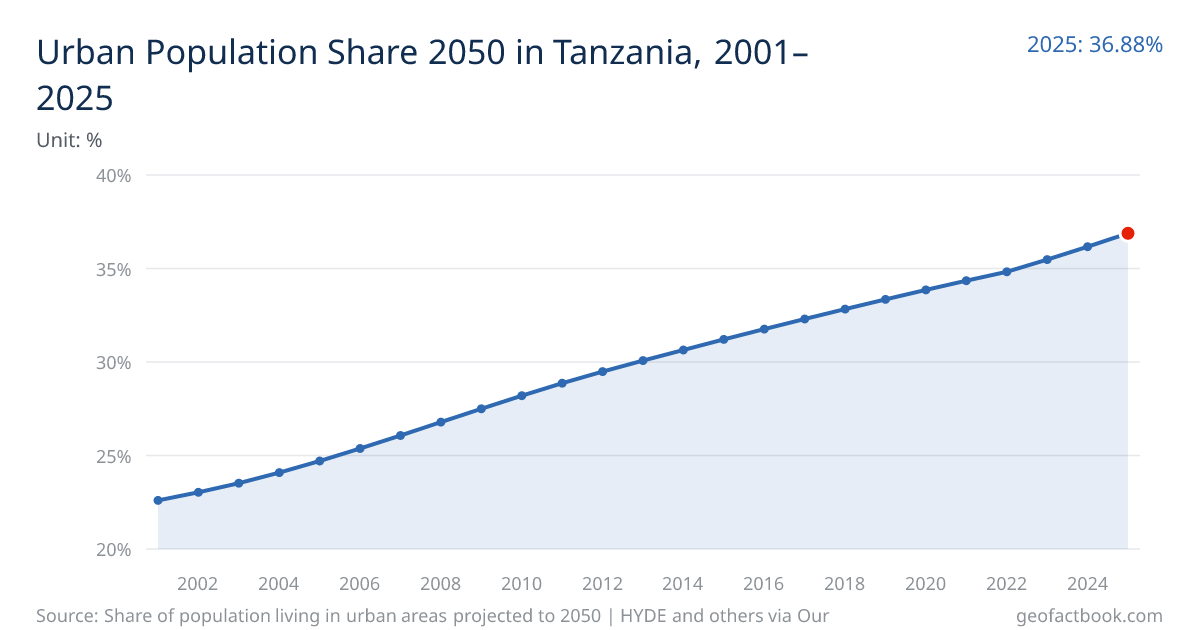
Tanzania's urban population share 2050 in 2025 is 36.88 %, up 2.0% from 2024. It ranks #195 of 236 countries.
Urban population share by 2050 shows urbanization trends. Discover which countries will be most urbanized.
Source (2025): Share of population living in urban areas projected to 2050 | Our World in Data
Where Tanzania ranks (2025)
#195 of 236- #193
 Niue37.19%
- #194
 Yemen37.03%
- #195
 Tanzania36.88%
- #196
 Grenada36.67%
- #197
 India35.69%
Urban Population Share 2050 over time
| Year | Value | Change | % Change | Actions |
|---|---|---|---|---|
| 2025 | 36.88 % | +0.71 % | +1.98% | |
| 2024 | 36.17 % | +0.69 % | +1.96% | |
| 2023 | 35.47 % | +0.65 % | +1.87% | |
| 2022 | 34.82 % | +0.47 % | +1.38% | |
| 2021 | 34.35 % | +0.5 % | +1.46% | |
| 2020 | 33.85 % | +0.51 % | +1.52% | |
| 2019 | 33.35 % | +0.52 % | +1.58% | |
| 2018 | 32.83 % | +0.53 % | +1.64% | |
| 2017 | 32.3 % | +0.54 % | +1.70% | |
| 2016 | 31.76 % | +0.55 % | +1.77% | |
| 2015 | 31.21 % | +0.56 % | +1.83% | |
| 2014 | 30.64 % | +0.57 % | +1.90% | |
| 2013 | 30.07 % | +0.58 % | +1.98% | |
| 2012 | 29.49 % | +0.62 % | +2.16% | |
| 2011 | 28.87 % | +0.67 % | +2.37% | |
| 2010 | 28.2 % | +0.7 % | +2.54% | |
| 2009 | 27.5 % | +0.71 % | +2.66% | |
| 2008 | 26.79 % | +0.71 % | +2.74% | |
| 2007 | 26.07 % | +0.7 % | +2.75% | |
| 2006 | 25.37 % | +0.67 % | +2.70% | |
| 2005 | 24.71 % | +0.62 % | +2.59% | |
| 2004 | 24.08 % | +0.56 % | +2.39% | |
| 2003 | 23.52 % | +0.49 % | +2.13% | |
| 2002 | 23.03 % | +0.43 % | +1.92% | |
| 2001 | 22.6 % | — | — |
Urban Population Share 2050 in Tanzania, 2001–2025: chart
Cite this page
Geo Factbook. (n.d.). Tanzania: Urban Population Share 2050. Retrieved November 29, 2026, from https://geofactbook.com/countries/tanzania/urban-population-share-2050
The figures on this page come from Share of population living in urban areas projected to 2050 | HYDE and others via Our World in Data. For academic work, cite the original source as well.
Frequently Asked Questions About Tanzania Urban Population Share 2050
What is Tanzania's urban population share 2050 in 2025?▾
Tanzania's urban population share 2050 is 36.88 % in 2025, according to Share of population living in urban areas projected to 2050 | HYDE and others via Our World in Data.
Is Tanzania's urban population share 2050 increasing or decreasing?▾
Tanzania's urban population share 2050 rose by 2.0% from 2024 (36.17 %) to 2025 (36.88 %). Over the past decade (2015–2025) it rose by 18.2%.
How does Tanzania rank for urban population share 2050?▾
In 2025, Tanzania has the 195th highest urban population share 2050 out of 236 countries with data.
What was Tanzania's urban population share 2050 in 2001?▾
In 2001, Tanzania's urban population share 2050 was 22.60 %. By 2025 it rose by 63.2%.
Explore additional statistical insights
Percentage of One-Person Households in Tanzania
Discover which countries have the highest percentage of one-person households, highlighting trends in living arrangements.
Beer Consumption per Capita in Tanzania
Beer consumption per capita measures the average liters of beer consumed by each person in a country annually.
Total population in Tanzania
Discover the latest total population statistics for every country and region worldwide. Explore accurate, up-to-date data on global population growth, density, and demographic trends — sourced from trusted international databases like the UN and World Bank. Perfect for researchers, students, and data enthusiasts looking to understand how the world’s population is changing.
Under-five mortality rate in Tanzania
The under-five mortality rate measures the number of deaths per 1,000 live births for children under five. This critical statistic highlights child health and development, reflecting a country's healthcare quality and socioeconomic conditions. Understanding these rates is vital for improving global health initiatives.
Mean Years of Schooling in Tanzania
Mean Years of Schooling indicates the average number of years of education received by people aged 25 and older.
Population Change in Tanzania
This statistic measures population change across countries, highlighting shifts in demographics. Understanding these changes is crucial for planning resources, economic growth, and social services.