
Vietnam Urban Population Share 2050 2025: 38.83 %
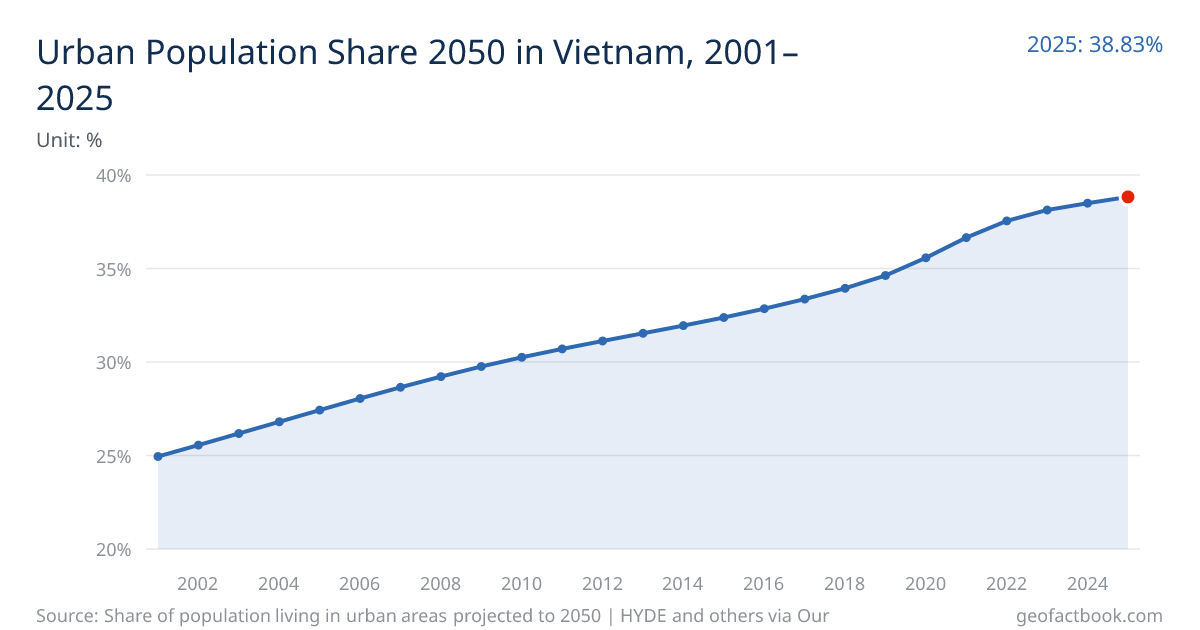
Vietnam's urban population share 2050 in 2025 is 38.83 %, up 0.9% from 2024. It ranks #189 of 236 countries.
Urban population share by 2050 shows urbanization trends. Discover which countries will be most urbanized.
Source (2025): Share of population living in urban areas projected to 2050 | Our World in Data
Where Vietnam ranks (2025)
#189 of 236




Urban Population Share 2050 over time
| Year | Value | Change | % Change | Actions |
|---|---|---|---|---|
| 2025 | 38.83 % | +0.34 % | +0.88% | |
| 2024 | 38.49 % | +0.36 % | +0.94% | |
| 2023 | 38.13 % | +0.58 % | +1.55% | |
| 2022 | 37.55 % | +0.89 % | +2.44% | |
| 2021 | 36.65 % | +1.08 % | +3.05% | |
| 2020 | 35.57 % | +0.95 % | +2.73% | |
| 2019 | 34.62 % | +0.68 % | +2.01% | |
| 2018 | 33.94 % | +0.58 % | +1.73% | |
| 2017 | 33.36 % | +0.51 % | +1.57% | |
| 2016 | 32.85 % | +0.47 % | +1.44% | |
| 2015 | 32.38 % | +0.43 % | +1.36% | |
| 2014 | 31.95 % | +0.41 % | +1.31% | |
| 2013 | 31.53 % | +0.41 % | +1.32% | |
| 2012 | 31.12 % | +0.42 % | +1.38% | |
| 2011 | 30.7 % | +0.45 % | +1.48% | |
| 2010 | 30.25 % | +0.49 % | +1.65% | |
| 2009 | 29.76 % | +0.54 % | +1.84% | |
| 2008 | 29.22 % | +0.57 % | +2.00% | |
| 2007 | 28.65 % | +0.6 % | +2.14% | |
| 2006 | 28.05 % | +0.62 % | +2.25% | |
| 2005 | 27.43 % | +0.63 % | +2.34% | |
| 2004 | 26.8 % | +0.63 % | +2.40% | |
| 2003 | 26.17 % | +0.62 % | +2.43% | |
| 2002 | 25.55 % | +0.61 % | +2.43% | |
| 2001 | 24.95 % | — | — |
Urban Population Share 2050 in Vietnam, 2001–2025: chart
Cite this page
Geo Factbook. (n.d.). Vietnam: Urban Population Share 2050. Retrieved November 29, 2026, from https://geofactbook.com/countries/vietnam/urban-population-share-2050
The figures on this page come from Share of population living in urban areas projected to 2050 | HYDE and others via Our World in Data. For academic work, cite the original source as well.
Frequently Asked Questions About Vietnam Urban Population Share 2050
What is Vietnam's urban population share 2050 in 2025?▾
Vietnam's urban population share 2050 is 38.83 % in 2025, according to Share of population living in urban areas projected to 2050 | HYDE and others via Our World in Data.
Is Vietnam's urban population share 2050 increasing or decreasing?▾
Vietnam's urban population share 2050 rose by 0.9% from 2024 (38.49 %) to 2025 (38.83 %). Over the past decade (2015–2025) it rose by 19.9%.
How does Vietnam rank for urban population share 2050?▾
In 2025, Vietnam has the 189th highest urban population share 2050 out of 236 countries with data.
What was Vietnam's urban population share 2050 in 2001?▾
In 2001, Vietnam's urban population share 2050 was 24.95 %. By 2025 it rose by 55.6%.
Explore additional statistical insights
Human Development Index in Vietnam
The Human Development Index combines indicators of health, education, and income to assess development levels.
Female Tertiary Enrollment Rate (%) in Vietnam
This measures the percentage of female students enrolling in tertiary education, reflecting gender parity in higher education globally.
Total demand for family planning (Percent) in Vietnam
Total demand for family planning measures the percentage of individuals seeking access to reproductive health services. Understanding this statistic is crucial for addressing global population growth and improving health outcomes.
Total population in Vietnam
Discover the latest total population statistics for every country and region worldwide. Explore accurate, up-to-date data on global population growth, density, and demographic trends — sourced from trusted international databases like the UN and World Bank. Perfect for researchers, students, and data enthusiasts looking to understand how the world’s population is changing.
Education Expenditure (% of GDP) in Vietnam
Education expenditure measures the percentage of GDP spent on education. Compare countries and explore interactive rankings and trends.
Total net-migration in Vietnam
Total net-migration measures the difference between the number of immigrants and emigrants in a country, reflecting population shifts and economic opportunities. Understanding this statistic is crucial for analyzing demographic trends and policy impacts in nations worldwide.