
Vietnam Beer Consumption per Capita 2022: 3.46 liters
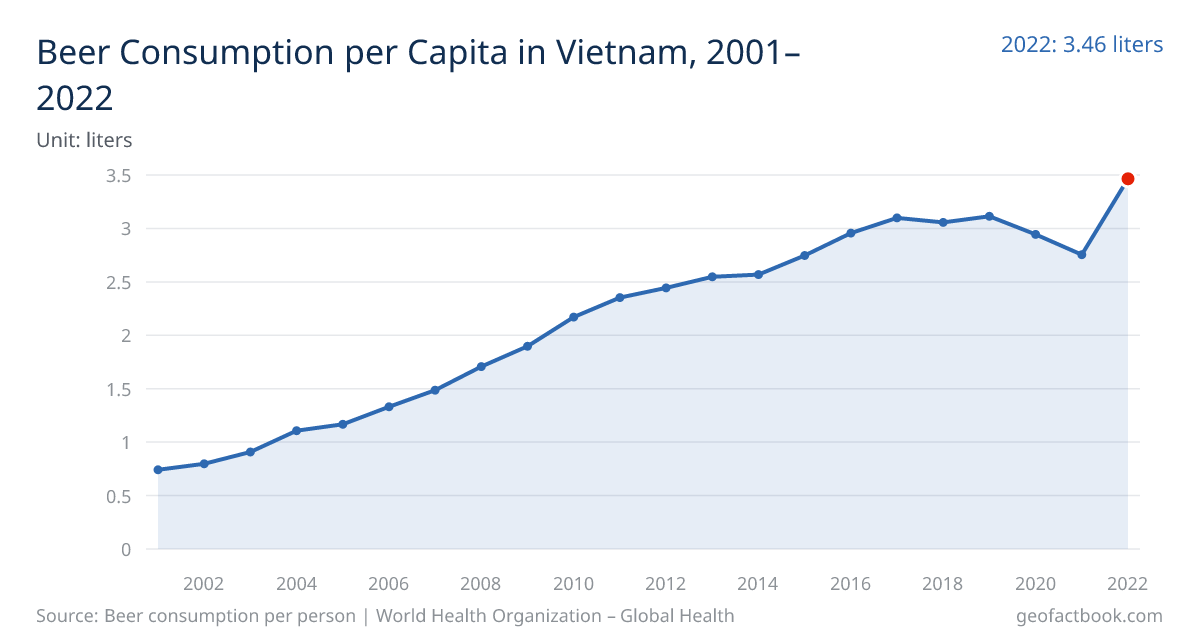
Vietnam's beer consumption per capita in 2022 is 3.46 liters, up 25.8% from 2021. It ranks #39 of 186 countries.
Beer consumption per capita measures the average liters of beer consumed by each person in a country annually.
Source (2022): Beer consumption per person | Our World in Data
Where Vietnam ranks (2022)
#39 of 186- #37
 Finland3.49 liters
- #38
 Chile3.48 liters
- #39
 Vietnam3.46 liters
- #40
 Paraguay3.44 liters
- #41
 Saint Kitts and Nevis3.41 liters
Beer Consumption per Capita over time
| Year | Value | Change | % Change | Actions |
|---|---|---|---|---|
| 2022 | 3.46 liters | +0.71 liters | +25.78% | |
| 2021 | 2.75 liters | 0.19 liters | -6.45% | |
| 2020 | 2.94 liters | 0.17 liters | -5.42% | |
| 2019 | 3.11 liters | +0.06 liters | +1.87% | |
| 2018 | 3.06 liters | 0.04 liters | -1.38% | |
| 2017 | 3.1 liters | +0.14 liters | +4.82% | |
| 2016 | 2.96 liters | +0.21 liters | +7.66% | |
| 2015 | 2.75 liters | +0.18 liters | +6.93% | |
| 2014 | 2.57 liters | +0.02 liters | +0.83% | |
| 2013 | 2.55 liters | +0.1 liters | +4.25% | |
| 2012 | 2.44 liters | +0.09 liters | +3.87% | |
| 2011 | 2.35 liters | +0.18 liters | +8.39% | |
| 2010 | 2.17 liters | +0.27 liters | +14.40% | |
| 2009 | 1.9 liters | +0.19 liters | +11.12% | |
| 2008 | 1.71 liters | +0.22 liters | +14.87% | |
| 2007 | 1.49 liters | +0.16 liters | +11.70% | |
| 2006 | 1.33 liters | +0.16 liters | +14.03% | |
| 2005 | 1.17 liters | +0.06 liters | +5.42% | |
| 2004 | 1.11 liters | +0.2 liters | +21.99% | |
| 2003 | 0.91 liters | +0.11 liters | +13.81% | |
| 2002 | 0.8 liters | +0.06 liters | +7.61% | |
| 2001 | 0.74 liters | — | — |
Beer Consumption per Capita in Vietnam, 2001–2022: chart
Cite this page
Geo Factbook. (n.d.). Vietnam: Beer Consumption per Capita. Retrieved November 28, 2026, from https://geofactbook.com/countries/vietnam/beer-consumption-per-capita
The figures on this page come from Beer consumption per person | World Health Organization – Global Health Observatory via Our World in Data. For academic work, cite the original source as well.
Frequently Asked Questions About Vietnam Beer Consumption per Capita
What is Vietnam's beer consumption per capita in 2022?▾
Vietnam's beer consumption per capita is 3.46 liters in 2022, according to Beer consumption per person | World Health Organization – Global Health Observatory via Our World in Data.
Is Vietnam's beer consumption per capita increasing or decreasing?▾
Vietnam's beer consumption per capita rose by 25.8% from 2021 (2.75 liters) to 2022 (3.46 liters). Over the past decade (2012–2022) it rose by 41.8%.
How does Vietnam rank for beer consumption per capita?▾
In 2022, Vietnam has the 39th highest beer consumption per capita out of 186 countries with data.
What was Vietnam's beer consumption per capita in 2001?▾
In 2001, Vietnam's beer consumption per capita was 0.74 liters. By 2022 it rose by 367.6%.
Explore additional statistical insights
Share of Students Studying Abroad in Vietnam
Share of students studying abroad tracks the percentage of tertiary-level students enrolled outside their home country.
Total demand for family planning (Percent) in Vietnam
Total demand for family planning measures the percentage of individuals seeking access to reproductive health services. Understanding this statistic is crucial for addressing global population growth and improving health outcomes.
Wine Consumption Per Capita in Vietnam
Wine consumption per capita measures the average liters of wine consumed by individuals in a country annually.
Physician Density in Vietnam
Physician density measures healthcare access, showing the number of doctors per square kilometer. Compare countries and explore interactive maps.
Female population of reproductive age in Vietnam
The female population of reproductive age is a crucial demographic statistic that influences healthcare, economic growth, and social policies in countries. Understanding this population helps address reproductive health needs and support family planning initiatives.
Life expectancy at birth in Vietnam
Life expectancy at birth measures the average years a newborn is expected to live, reflecting a country's health standards and quality of life. This vital statistic highlights disparities in healthcare and living conditions across nations, making it essential for global health assessments.