
United States Virgin Islands Agricultural land 2026: 33 sq. km
United States Virgin Islands's agricultural land in 2026 is 33 sq. km (estimate), unchanged from 2025. It ranks #197 of 209 countries.
Agricultural land measures the area dedicated to farming and cultivation in countries, impacting food production and sustainability. Understanding this statistic is crucial for assessing agricultural capacity and economic development.
Estimated value for 2026 (interpolated, no direct source).
Where United States Virgin Islands ranks (2026)
#197 of 209- #195
 Micronesia (Fed. States of)50 sq. km
- #196
 Palau43 sq. km
- #197
 United States Virgin Islands33 sq. km
- #198
 American Samoa30.08 sq. km
- #199
 Cayman Islands27 sq. km
Agricultural land over timeSome values are estimated based on historical trends
| Year | Value | Change | % Change | Actions |
|---|---|---|---|---|
| 2026 | 33 sq. km | 0 sq. km | 0.00% | |
| 2025 | 33 sq. km | 0 sq. km | 0.00% | |
| 2024 | 33 sq. km | 0 sq. km | 0.00% | |
| 2023 | 33 sq. km | 0 sq. km | 0.00% | |
| 2022 | 33 sq. km | 0 sq. km | 0.00% | |
| 2021 | 33 sq. km | 0 sq. km | 0.00% | |
| 2020 | 33 sq. km | 0 sq. km | 0.00% | |
| 2019 | 33 sq. km | 0 sq. km | 0.00% | |
| 2018 | 33 sq. km | 7 sq. km | -17.50% | |
| 2017 | 40 sq. km | 0 sq. km | 0.00% | |
| 2016 | 40 sq. km | 0 sq. km | 0.00% | |
| 2015 | 40 sq. km | 0 sq. km | 0.00% | |
| 2014 | 40 sq. km | 0 sq. km | 0.00% | |
| 2013 | 40 sq. km | 0 sq. km | 0.00% | |
| 2012 | 40 sq. km | 0 sq. km | 0.00% | |
| 2011 | 40 sq. km | 0 sq. km | 0.00% | |
| 2010 | 40 sq. km | 0 sq. km | 0.00% | |
| 2009 | 40 sq. km | 0 sq. km | 0.00% | |
| 2008 | 40 sq. km | 0 sq. km | 0.00% | |
| 2007 | 40 sq. km | 0 sq. km | 0.00% | |
| 2006 | 40 sq. km | 20 sq. km | -33.33% | |
| 2005 | 60 sq. km | 0 sq. km | 0.00% | |
| 2004 | 60 sq. km | 0 sq. km | 0.00% | |
| 2003 | 60 sq. km | 0 sq. km | 0.00% | |
| 2002 | 60 sq. km | 10 sq. km | -14.29% | |
| 2001 | 70 sq. km | 0 sq. km | 0.00% | |
| 2000 | 70 sq. km | 0 sq. km | 0.00% | |
| 1999 | 70 sq. km | 10 sq. km | -12.50% | |
| 1998 | 80 sq. km | 0 sq. km | 0.00% | |
| 1997 | 80 sq. km | 0 sq. km | 0.00% | |
| 1996 | 80 sq. km | 0 sq. km | 0.00% | |
| 1995 | 80 sq. km | 10 sq. km | -11.11% | |
| 1994 | 90 sq. km | 10 sq. km | -10.00% | |
| 1993 | 100 sq. km | 0 sq. km | 0.00% | |
| 1992 | 100 sq. km | 0 sq. km | 0.00% | |
| 1991 | 100 sq. km | 0 sq. km | 0.00% | |
| 1990 | 100 sq. km | 10 sq. km | -9.09% | |
| 1989 | 110 sq. km | 0 sq. km | 0.00% | |
| 1988 | 110 sq. km | 10 sq. km | -8.33% | |
| 1987 | 120 sq. km | 0 sq. km | 0.00% | |
| 1986 | 120 sq. km | 0 sq. km | 0.00% | |
| 1985 | 120 sq. km | 20 sq. km | -14.29% | |
| 1984 | 140 sq. km | 0 sq. km | 0.00% | |
| 1983 | 140 sq. km | 10 sq. km | -6.67% | |
| 1982 | 150 sq. km | 10 sq. km | -6.25% | |
| 1981 | 160 sq. km | 0 sq. km | 0.00% | |
| 1980 | 160 sq. km | +10 sq. km | +6.67% | |
| 1979 | 150 sq. km | 0 sq. km | 0.00% | |
| 1978 | 150 sq. km | 0 sq. km | 0.00% | |
| 1977 | 150 sq. km | 0 sq. km | 0.00% | |
| 1976 | 150 sq. km | 0 sq. km | 0.00% | |
| 1975 | 150 sq. km | 0 sq. km | 0.00% | |
| 1974 | 150 sq. km | 0 sq. km | 0.00% | |
| 1973 | 150 sq. km | 0 sq. km | 0.00% | |
| 1972 | 150 sq. km | 0 sq. km | 0.00% | |
| 1971 | 150 sq. km | 0 sq. km | 0.00% | |
| 1970 | 150 sq. km | 0 sq. km | 0.00% | |
| 1969 | 150 sq. km | 0 sq. km | 0.00% | |
| 1968 | 150 sq. km | 0 sq. km | 0.00% | |
| 1967 | 150 sq. km | 10 sq. km | -6.25% | |
| 1966 | 160 sq. km | 0 sq. km | 0.00% | |
| 1965 | 160 sq. km | 0 sq. km | 0.00% | |
| 1964 | 160 sq. km | +20 sq. km | +14.29% | |
| 1963 | 140 sq. km | +20 sq. km | +16.67% | |
| 1962 | 120 sq. km | 0 sq. km | 0.00% | |
| 1961 | 120 sq. km | — | — |
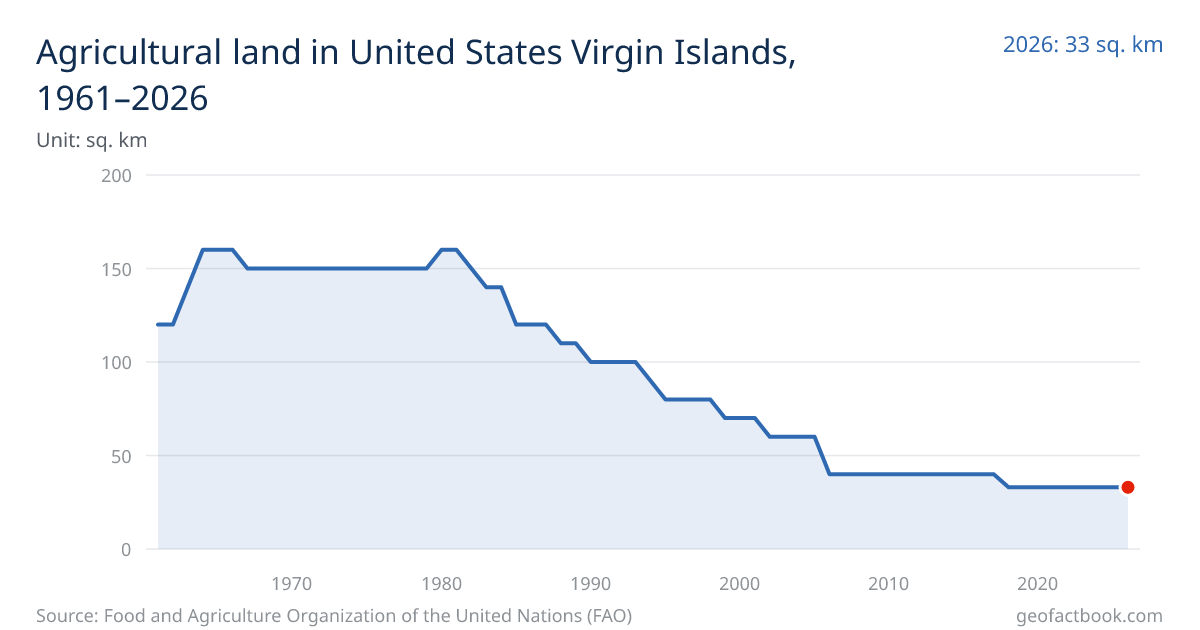
Agricultural land in United States Virgin Islands, 1961–2026: chart
Cite this page
Geo Factbook. (n.d.). United States Virgin Islands: Agricultural land. Retrieved November 28, 2026, from https://geofactbook.com/countries/united-states-virgin-islands/agricultural-land
The figures on this page come from Food and Agriculture Organization of the United Nations (FAO). For academic work, cite the original source as well.
Frequently Asked Questions About United States Virgin Islands Agricultural land
What is United States Virgin Islands's agricultural land in 2026?▾
United States Virgin Islands's agricultural land is 33 sq. km in 2026 (estimate), according to Food and Agriculture Organization of the United Nations (FAO).
Is United States Virgin Islands's agricultural land increasing or decreasing?▾
United States Virgin Islands's agricultural land was essentially unchanged from 2025 (33 sq. km) to 2026 (33 sq. km). Over the past decade (2016–2026) it fell by 17.5%.
How does United States Virgin Islands rank for agricultural land?▾
In 2026, United States Virgin Islands has the 197th highest agricultural land out of 209 countries with data.
What was United States Virgin Islands's agricultural land in 1961?▾
In 1961, United States Virgin Islands's agricultural land was 120 sq. km. By 2026 it fell by 72.5%.
Explore additional statistical insights
Arable Land Per Person in United States Virgin Islands
Arable land per person measures the amount of farmable land available to each individual in a country.
Electricity Installed Capacity in United States Virgin Islands
Electricity Installed Capacity measures the total power generation capability. Compare countries, explore rankings, and view interactive maps.
Electricity from Hydroelectric Plants in United States Virgin Islands
Electricity from hydroelectric plants shows renewable energy production. Explore country rankings, compare data, and view interactive maps.
Population living in slums in United States Virgin Islands
This statistic measures the percentage of a country's population living in slums, highlighting urban poverty and living conditions. Understanding slum populations is crucial for addressing housing challenges and improving the quality of life.
Revenue from Forest Resources in United States Virgin Islands
Revenue from forest resources reveals economic contributions by country. Explore rankings, compare nations, and view interactive maps.
Refined Petroleum Products Production in United States Virgin Islands
Refined Petroleum Products Production data reveals insights into global energy trends. Compare countries and explore interactive maps and rankings.