
United Kingdom Total Armed Forces Personnel (PPP) 2020: 153,000
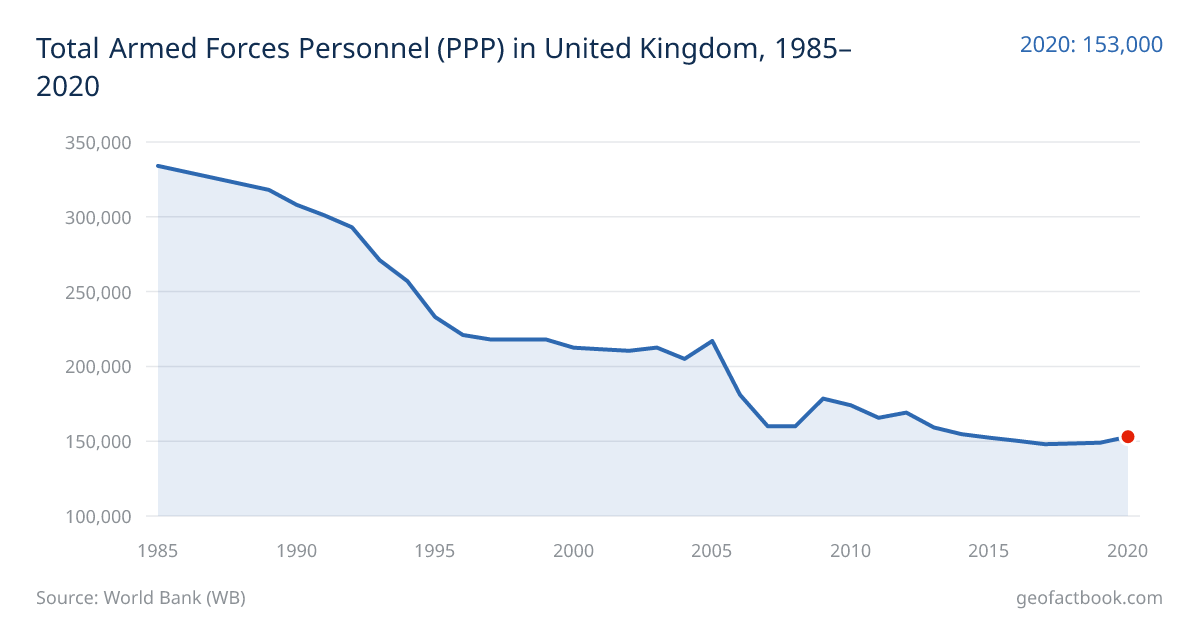
United Kingdom's total armed forces personnel (ppp) in 2020 is 153,000, up 2.7% from 2019. It ranks #41 of 170 countries.
Explore total armed forces personnel across 266+ countries. Compare military size, view rankings, and analyze historical trends on our interactive map.
Where United Kingdom ranks (2020)
#41 of 170- #38
 Peru158,000
- #40
 Philippines157,000
- #41
 United Kingdom153,000
- #42
 Greece147,000
- #43
 Sudan144,000
Total Armed Forces Personnel (PPP) over time
| Year | Value | Change | % Change | Actions |
|---|---|---|---|---|
| 2020 | 153.00K | +4.00K | +2.68% | |
| 2019 | 149.00K | +550 | +0.37% | |
| 2018 | 148.45K | +450 | +0.30% | |
| 2017 | 148.00K | 2.25K | -1.50% | |
| 2016 | 150.25K | 2.10K | -1.38% | |
| 2015 | 152.35K | 2.35K | -1.52% | |
| 2014 | 154.70K | 4.45K | -2.80% | |
| 2013 | 159.15K | 10.00K | -5.91% | |
| 2012 | 169.15K | +3.50K | +2.11% | |
| 2011 | 165.65K | 8.37K | -4.81% | |
| 2010 | 174.02K | 4.45K | -2.49% | |
| 2009 | 178.47K | +18.47K | +11.54% | |
| 2008 | 160.00K | 0 | 0.00% | |
| 2007 | 160.00K | 21.00K | -11.60% | |
| 2006 | 181.00K | 36.00K | -16.59% | |
| 2005 | 217.00K | +12.00K | +5.85% | |
| 2004 | 205.00K | 7.60K | -3.57% | |
| 2003 | 212.60K | +2.20K | +1.05% | |
| 2002 | 210.40K | 1.00K | -0.47% | |
| 2001 | 211.40K | 1.10K | -0.52% | |
| 2000 | 212.50K | 5.50K | -2.52% | |
| 1999 | 218.00K | 0 | 0.00% | |
| 1998 | 218.00K | 0 | 0.00% | |
| 1997 | 218.00K | 3.00K | -1.36% | |
| 1996 | 221.00K | 12.00K | -5.15% | |
| 1995 | 233.00K | 24.00K | -9.34% | |
| 1994 | 257.00K | 14.00K | -5.17% | |
| 1993 | 271.00K | 22.00K | -7.51% | |
| 1992 | 293.00K | 8.00K | -2.66% | |
| 1991 | 301.00K | 7.00K | -2.27% | |
| 1990 | 308.00K | 10.00K | -3.14% | |
| 1989 | 318.00K | 16.00K | -4.79% | |
| 1985 | 334.00K | — | — |
Total Armed Forces Personnel (PPP) in United Kingdom, 1985–2020: chart
Cite this page
Geo Factbook. (n.d.). United Kingdom: Total Armed Forces Personnel (PPP). Retrieved November 27, 2026, from https://geofactbook.com/countries/united-kingdom/armed-forces-personnel-total
The figures on this page come from World Bank (WB). For academic work, cite the original source as well.
Frequently Asked Questions About United Kingdom Total Armed Forces Personnel (PPP)
What is United Kingdom's total armed forces personnel (ppp) in 2020?▾
United Kingdom's total armed forces personnel (ppp) is 153,000 in 2020, according to World Bank (WB).
Is United Kingdom's total armed forces personnel (ppp) increasing or decreasing?▾
United Kingdom's total armed forces personnel (ppp) rose by 2.7% from 2019 (149,000) to 2020 (153,000). Over the past decade (2010–2020) it fell by 12.1%.
How does United Kingdom rank for total armed forces personnel (ppp)?▾
In 2020, United Kingdom has the 41st highest total armed forces personnel (ppp) out of 170 countries with data.
What was United Kingdom's total armed forces personnel (ppp) in 1985?▾
In 1985, United Kingdom's total armed forces personnel (ppp) was 334,000. By 2020 it fell by 54.2%.
Explore additional statistical insights
Military Expenditures (% of GDP) in United Kingdom
Military Expenditures as a percentage of GDP highlights national defense spending. Compare countries, explore rankings, and view trends.
Unemployment Rate in United Kingdom
Unemployment Rate measures jobless individuals as a percentage of the labor force. Explore country comparisons and historical trends with interactive maps.
Inflation Rate (CPI) in United Kingdom
Inflation rate measures the annual percentage increase in consumer prices, reflecting the cost of living.
Education Expenditure (% of GDP) in United Kingdom
Education expenditure measures the percentage of GDP spent on education. Compare countries and explore interactive rankings and trends.
Breast Cancer Mortality Rate in United Kingdom
Breast cancer mortality rate measures deaths per 100,000 women; indicates healthcare effectiveness.
Population living in slums in United Kingdom
This statistic measures the percentage of a country's population living in slums, highlighting urban poverty and living conditions. Understanding slum populations is crucial for addressing housing challenges and improving the quality of life.