
Trinidad and Tobago Rule of Law Index by Country 2026: 39.39 %
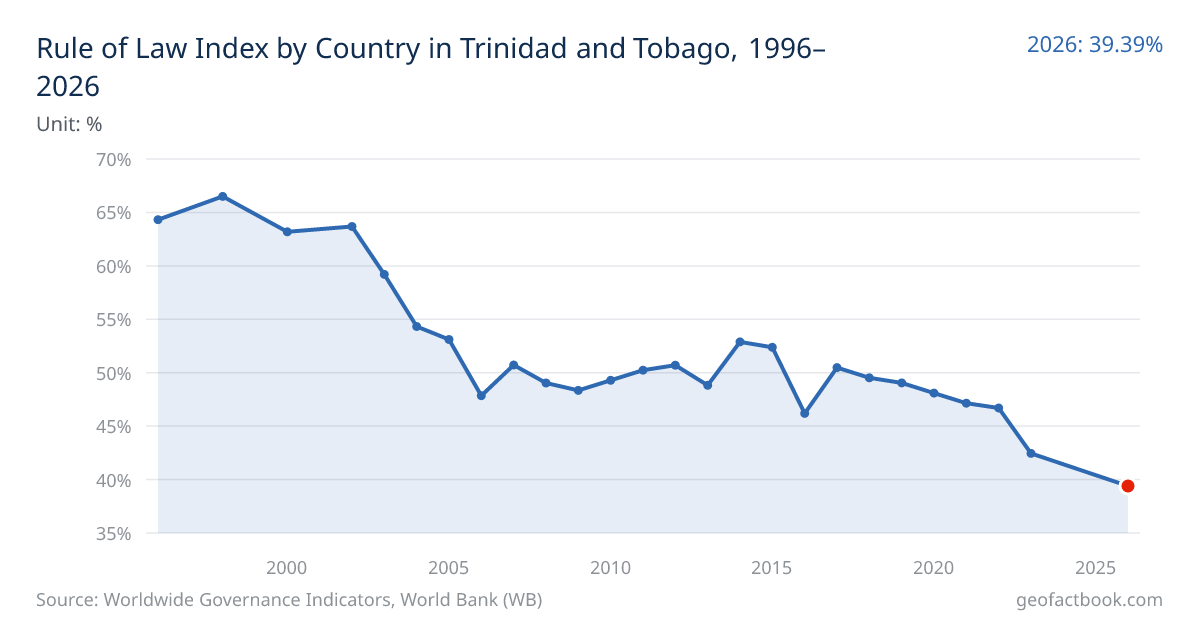
Trinidad and Tobago's rule of law index by country in 2026 is 39.39 % (estimate), down 7.2% from 2023. It ranks #128 of 209 countries.
Compare countries by Rule of Law percentile rank, reflecting confidence in laws, courts, police, property rights, and protection from crime and violence.
Estimated value for 2026 (interpolated, no direct source).
Where Trinidad and Tobago ranks (2026)
#128 of 209- #126
 Philippines41.02%
- #127
 Nepal40.77%
- #128
 Trinidad and Tobago39.39%
- #129
 Senegal38.89%
- #130
 Kazakhstan38.11%
Rule of Law Index by Country over timeSome values are estimated based on historical trends
| Year | Value | Change | % Change | Actions |
|---|---|---|---|---|
| 2026 | 39.39 % | — | — | |
| 2025 | — | — | — | |
| 2024 | — | — | — | |
| 2023 | 42.45 % | 4.25 % | -9.09% | |
| 2022 | 46.7 % | 0.44 % | -0.94% | |
| 2021 | 47.14 % | 0.95 % | -1.98% | |
| 2020 | 48.1 % | 0.95 % | -1.94% | |
| 2019 | 49.05 % | 0.48 % | -0.96% | |
| 2018 | 49.52 % | 0.95 % | -1.89% | |
| 2017 | 50.48 % | +4.29 % | +9.28% | |
| 2016 | 46.19 % | 6.19 % | -11.82% | |
| 2015 | 52.38 % | 0.5 % | -0.95% | |
| 2014 | 52.88 % | +4.06 % | +8.31% | |
| 2013 | 48.83 % | 1.88 % | -3.70% | |
| 2012 | 50.7 % | +0.47 % | +0.93% | |
| 2011 | 50.23 % | +0.95 % | +1.92% | |
| 2010 | 49.29 % | +0.95 % | +1.96% | |
| 2009 | 48.34 % | 0.7 % | -1.42% | |
| 2008 | 49.04 % | 1.68 % | -3.31% | |
| 2007 | 50.72 % | +2.87 % | +6.00% | |
| 2006 | 47.85 % | 5.26 % | -9.91% | |
| 2005 | 53.11 % | 1.22 % | -2.24% | |
| 2004 | 54.33 % | 4.88 % | -8.24% | |
| 2003 | 59.2 % | 4.48 % | -7.03% | |
| 2002 | 63.68 % | — | — | |
| 2001 | — | — | — | |
| 2000 | 63.18 % | — | — | |
| 1999 | — | — | — | |
| 1998 | 66.5 % | — | — | |
| 1997 | — | — | — | |
| 1996 | 64.32 % | — | — |
Rule of Law Index by Country in Trinidad and Tobago, 1996–2026: chart
Cite this page
Geo Factbook. (n.d.). Trinidad and Tobago: Rule of Law Index by Country. Retrieved November 29, 2026, from https://geofactbook.com/countries/trinidad-and-tobago/rule-of-law-index-by-country
The figures on this page come from Worldwide Governance Indicators, World Bank (WB). For academic work, cite the original source as well.
Frequently Asked Questions About Trinidad and Tobago Rule of Law Index by Country
What is Trinidad and Tobago's rule of law index by country in 2026?▾
Trinidad and Tobago's rule of law index by country is 39.39 % in 2026 (estimate), according to Worldwide Governance Indicators, World Bank (WB).
Is Trinidad and Tobago's rule of law index by country increasing or decreasing?▾
Trinidad and Tobago's rule of law index by country fell by 7.2% from 2023 (42.45 %) to 2026 (39.39 %). Over the past decade (2016–2026) it fell by 14.7%.
How does Trinidad and Tobago rank for rule of law index by country?▾
In 2026, Trinidad and Tobago has the 128th highest rule of law index by country out of 209 countries with data.
What was Trinidad and Tobago's rule of law index by country in 1996?▾
In 1996, Trinidad and Tobago's rule of law index by country was 64.32 %. By 2026 it fell by 38.8%.
Explore additional statistical insights
Women in National Parliaments in Trinidad and Tobago
Women in National Parliaments indicates female representation in government, reflecting political gender balance.
Government Health Spending % of Total Government Expenditure in Trinidad and Tobago
This metric shows the proportion of a country's total government budget allocated to health services.
Education Share of Government Spending in Trinidad and Tobago
Education share of government spending reveals priorities; measures the percentage of national budgets allocated to education.
Independence in Trinidad and Tobago
Independence measures a country's self-governance. Compare global rankings, explore interactive maps, and analyze historical trends.
Corruption Perception Index in Trinidad and Tobago
Corruption Perception Index ranks countries by perceived corruption levels. It influences investment decisions.
LGBT Rights Index Score in Trinidad and Tobago
LGBT Rights Index Score assesses legal protections and societal attitudes towards LGBT individuals in a country.