
Syrian Arab Republic Female population of reproductive age 2026: 7.6 Million
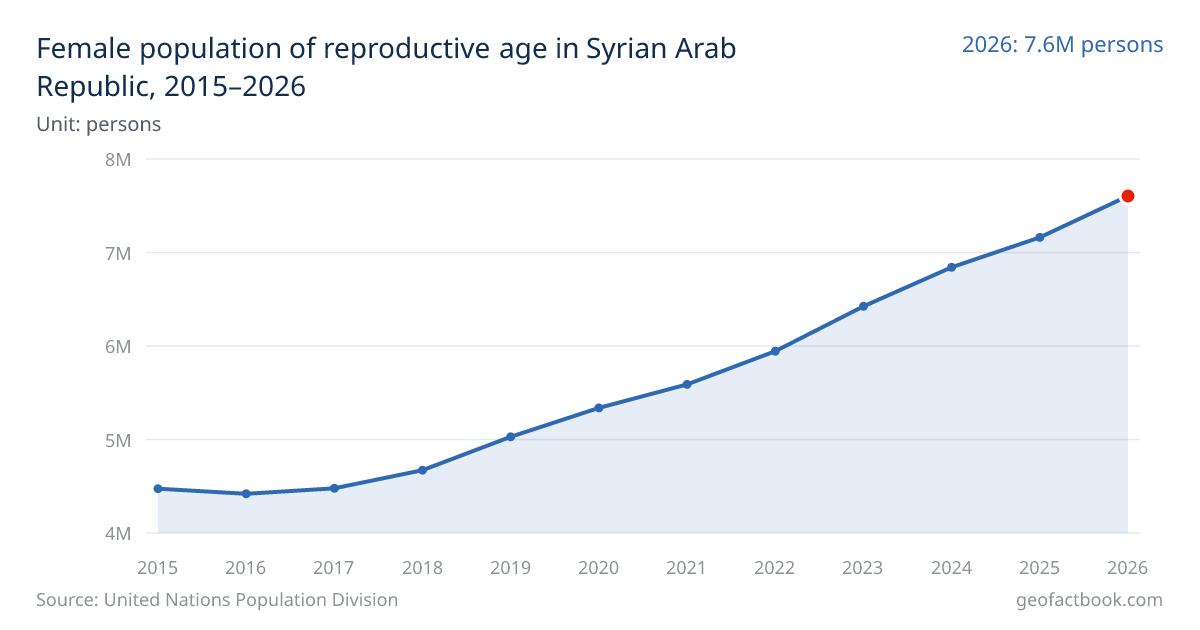
Syrian Arab Republic's female population of reproductive age in 2026 is 7.6 Million (estimate), up 6.2% from 2025. It ranks #52 of 236 countries.
The female population of reproductive age is a crucial demographic statistic that influences healthcare, economic growth, and social policies in countries. Understanding this population helps address reproductive health needs and support family planning initiatives.
Estimated value for 2026 (interpolated, no direct source).
Where Syrian Arab Republic ranks (2026)
#52 of 236- #50
 Saudi Arabia8.25M persons
- #51
 Côte d'Ivoire8.23M persons
- #52
 Syrian Arab Republic7.6M persons
- #53
 Cameroon7.57M persons
- #54
 Venezuela7.03M persons
Female population of reproductive age over timeSome values are estimated based on historical trends
| Year | Value | Change | % Change | Actions |
|---|---|---|---|---|
| 2026 | 7.60M persons | +443.42K persons | +6.19% | |
| 2025 | 7.16M persons | +319.54K persons | +4.67% | |
| 2024 | 6.84M persons | +417.02K persons | +6.49% | |
| 2023 | 6.42M persons | +480.21K persons | +8.08% | |
| 2022 | 5.94M persons | +355.30K persons | +6.36% | |
| 2021 | 5.59M persons | +251.13K persons | +4.70% | |
| 2020 | 5.34M persons | +309.36K persons | +6.15% | |
| 2019 | 5.03M persons | +357.66K persons | +7.66% | |
| 2018 | 4.67M persons | +192.84K persons | +4.31% | |
| 2017 | 4.48M persons | +59.55K persons | +1.35% | |
| 2016 | 4.42M persons | 55.19K persons | -1.23% | |
| 2015 | 4.47M persons | — | — |
Female population of reproductive age in Syrian Arab Republic, 2015–2026: chart
Cite this page
Geo Factbook. (n.d.). Syrian Arab Republic: Female population of reproductive age. Retrieved November 29, 2026, from https://geofactbook.com/countries/syrian-arab-republic/female-population-of-reproductive-age
The figures on this page come from United Nations Population Division. For academic work, cite the original source as well.
Frequently Asked Questions About Syrian Arab Republic Female population of reproductive age
What is Syrian Arab Republic's female population of reproductive age in 2026?▾
Syrian Arab Republic's female population of reproductive age is 7.6 Million in 2026 (estimate), according to United Nations Population Division.
Is Syrian Arab Republic's female population of reproductive age increasing or decreasing?▾
Syrian Arab Republic's female population of reproductive age rose by 6.2% from 2025 (7.16 Million) to 2026 (7.6 Million). Over the past decade (2016–2026) it rose by 72.1%.
How does Syrian Arab Republic rank for female population of reproductive age?▾
In 2026, Syrian Arab Republic has the 52nd highest female population of reproductive age out of 236 countries with data.
What was Syrian Arab Republic's female population of reproductive age in 2015?▾
In 2015, Syrian Arab Republic's female population of reproductive age was 4.47 Million. By 2026 it rose by 70.0%.
Explore additional statistical insights
Beer Consumption per Capita in Syrian Arab Republic
Beer consumption per capita measures the average liters of beer consumed by each person in a country annually.
Total deaths in Syrian Arab Republic
Total deaths in countries measure the number of individuals who have passed away within a specific timeframe. This statistic is crucial for understanding health trends, mortality rates, and the impact of various factors on population dynamics.
Share of Students Studying Abroad in Syrian Arab Republic
Share of students studying abroad tracks the percentage of tertiary-level students enrolled outside their home country.
Population Growth Rate in Syrian Arab Republic
Explore the Population Growth Rate across 266+ countries. Compare trends, view rankings, and interact with detailed maps.
Urban Population Annual Growth Rate in Syrian Arab Republic
Urban population annual growth rate measures the year-over-year percentage increase in a country's urban population.
Total demand for family planning (Percent) in Syrian Arab Republic
Total demand for family planning measures the percentage of individuals seeking access to reproductive health services. Understanding this statistic is crucial for addressing global population growth and improving health outcomes.