
Switzerland Total Armed Forces Personnel (PPP) 2020: 20,000
Switzerland's total armed forces personnel (ppp) in 2020 is 20,000, unchanged from 2019. It ranks #106 of 170 countries.
Explore total armed forces personnel across 266+ countries. Compare military size, view rankings, and analyze historical trends on our interactive map.
Where Switzerland ranks (2020)
#106 of 170- #104
 Mauritania21,000
- #106
 Croatia20,000
- #106
 Switzerland20,000
- #108
 Bahrain19,000
- #108
 Senegal19,000
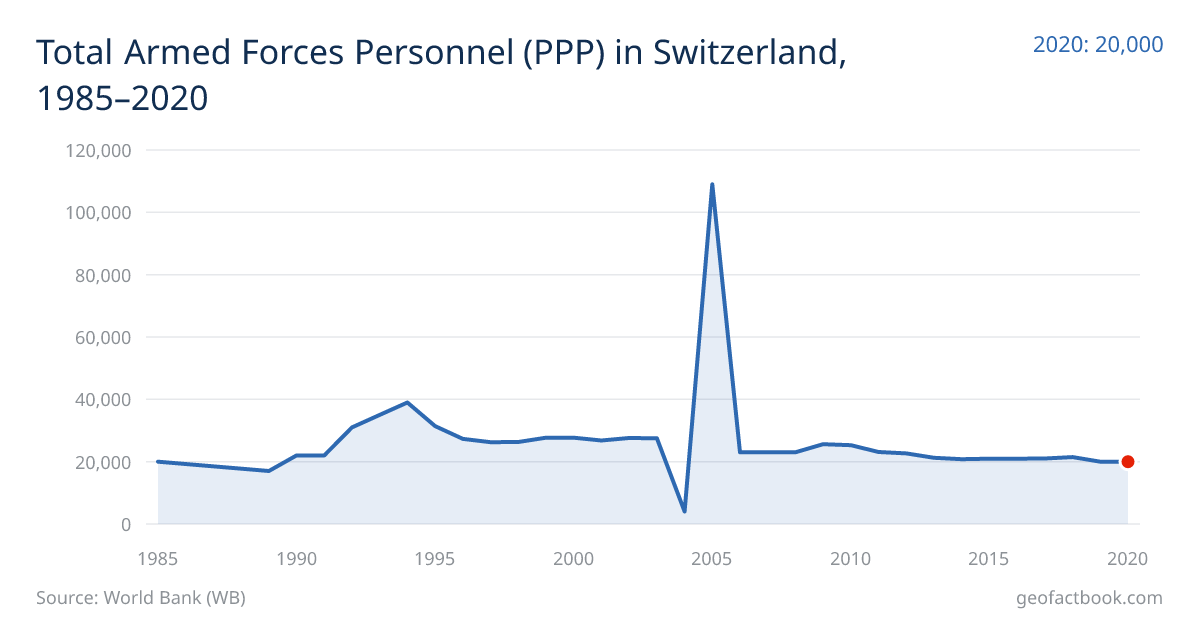
Total Armed Forces Personnel (PPP) over time
| Year | Value | Change | % Change | Actions |
|---|---|---|---|---|
| 2020 | 20.00K | 0 | 0.00% | |
| 2019 | 20.00K | 1.45K | -6.76% | |
| 2018 | 21.45K | +450 | +2.14% | |
| 2017 | 21.00K | +50 | +0.24% | |
| 2016 | 20.95K | 0 | 0.00% | |
| 2015 | 20.95K | +150 | +0.72% | |
| 2014 | 20.80K | 450 | -2.12% | |
| 2013 | 21.25K | 1.40K | -6.18% | |
| 2012 | 22.65K | 450 | -1.95% | |
| 2011 | 23.10K | 2.19K | -8.65% | |
| 2010 | 25.29K | 333 | -1.30% | |
| 2009 | 25.62K | +2.62K | +11.39% | |
| 2008 | 23.00K | 0 | 0.00% | |
| 2007 | 23.00K | 0 | 0.00% | |
| 2006 | 23.00K | 86.00K | -78.90% | |
| 2005 | 109.00K | +105.00K | +2625.00% | |
| 2004 | 4.00K | 23.50K | -85.45% | |
| 2003 | 27.50K | 100 | -0.36% | |
| 2002 | 27.60K | +800 | +2.99% | |
| 2001 | 26.80K | 900 | -3.25% | |
| 2000 | 27.70K | 0 | 0.00% | |
| 1999 | 27.70K | +1.40K | +5.32% | |
| 1998 | 26.30K | +40 | +0.15% | |
| 1997 | 26.26K | 1.04K | -3.81% | |
| 1996 | 27.30K | 4.10K | -13.06% | |
| 1995 | 31.40K | 7.60K | -19.49% | |
| 1994 | 39.00K | +4.00K | +11.43% | |
| 1993 | 35.00K | +4.00K | +12.90% | |
| 1992 | 31.00K | +9.00K | +40.91% | |
| 1991 | 22.00K | 0 | 0.00% | |
| 1990 | 22.00K | +5.00K | +29.41% | |
| 1989 | 17.00K | 3.00K | -15.00% | |
| 1985 | 20.00K | — | — |
Total Armed Forces Personnel (PPP) in Switzerland, 1985–2020: chart
Cite this page
Geo Factbook. (n.d.). Switzerland: Total Armed Forces Personnel (PPP). Retrieved November 28, 2026, from https://geofactbook.com/countries/switzerland/armed-forces-personnel-total
The figures on this page come from World Bank (WB). For academic work, cite the original source as well.
Frequently Asked Questions About Switzerland Total Armed Forces Personnel (PPP)
What is Switzerland's total armed forces personnel (ppp) in 2020?▾
Switzerland's total armed forces personnel (ppp) is 20,000 in 2020, according to World Bank (WB).
Is Switzerland's total armed forces personnel (ppp) increasing or decreasing?▾
Switzerland's total armed forces personnel (ppp) was essentially unchanged from 2019 (20,000) to 2020 (20,000). Over the past decade (2010–2020) it fell by 20.9%.
How does Switzerland rank for total armed forces personnel (ppp)?▾
In 2020, Switzerland has the 106th highest total armed forces personnel (ppp) out of 170 countries with data.
What was Switzerland's total armed forces personnel (ppp) in 1985?▾
In 1985, Switzerland's total armed forces personnel (ppp) was 20,000. By 2020 it was essentially unchanged.
Explore additional statistical insights
Military Expenditures (% of GDP) in Switzerland
Military Expenditures as a percentage of GDP highlights national defense spending. Compare countries, explore rankings, and view trends.
Total Coal Reserves in Switzerland
Total coal reserves by country measure the quantity of coal available for extraction and use globally.
Average BMI (Adult Men) in Switzerland
The average BMI for adults provides insight into a country's health trends, highlighting potential obesity issues.
Global Cattle Population in Switzerland
Explore the global cattle population; discover the countries with the highest number of cattle and their impact on agriculture.
Mean Years of Schooling in Switzerland
Mean Years of Schooling indicates the average number of years of education received by people aged 25 and older.
Currently married (Percent) in Switzerland
The percentage of currently married individuals by country highlights societal trends in family structure and relationships. Understanding these statistics can provide insights into cultural norms and demographic shifts, influencing policies and social programs.