
State of Palestine Female population of reproductive age 2026: 1.46 Million
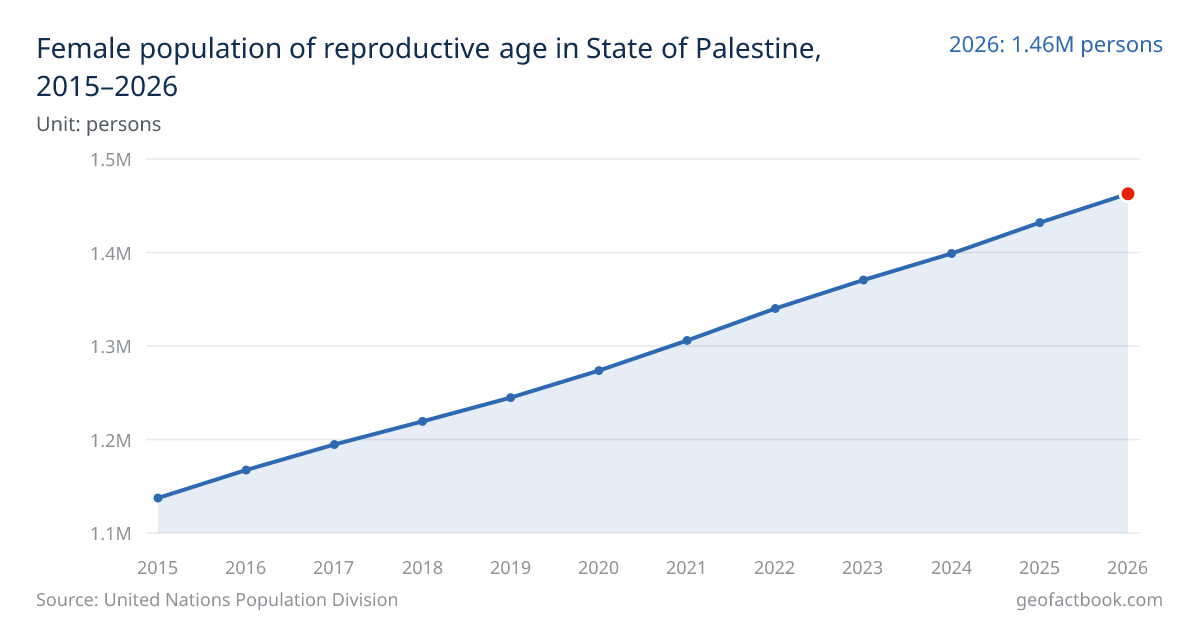
State of Palestine's female population of reproductive age in 2026 is 1.46 Million (estimate), up 2.2% from 2025. It ranks #114 of 236 countries.
The female population of reproductive age is a crucial demographic statistic that influences healthcare, economic growth, and social policies in countries. Understanding this population helps address reproductive health needs and support family planning initiatives.
Estimated value for 2026 (interpolated, no direct source).
Where State of Palestine ranks (2026)
#114 of 236- #112
 Singapore1.58M persons
- #113
 Liberia1.46M persons
- #114
 State of Palestine1.46M persons
- #115
 Lebanon1.45M persons
- #116
 Serbia1.42M persons
Female population of reproductive age over timeSome values are estimated based on historical trends
| Year | Value | Change | % Change | Actions |
|---|---|---|---|---|
| 2026 | 1.46M persons | +30.84K persons | +2.15% | |
| 2025 | 1.43M persons | +33.01K persons | +2.36% | |
| 2024 | 1.40M persons | +28.39K persons | +2.07% | |
| 2023 | 1.37M persons | +30.49K persons | +2.28% | |
| 2022 | 1.34M persons | +34.20K persons | +2.62% | |
| 2021 | 1.31M persons | +32.16K persons | +2.52% | |
| 2020 | 1.27M persons | +28.95K persons | +2.33% | |
| 2019 | 1.24M persons | +25.41K persons | +2.08% | |
| 2018 | 1.22M persons | +24.67K persons | +2.06% | |
| 2017 | 1.19M persons | +27.28K persons | +2.34% | |
| 2016 | 1.17M persons | +29.99K persons | +2.64% | |
| 2015 | 1.14M persons | — | — |
Female population of reproductive age in State of Palestine, 2015–2026: chart
Cite this page
Geo Factbook. (n.d.). State of Palestine: Female population of reproductive age. Retrieved November 29, 2026, from https://geofactbook.com/countries/state-of-palestine/female-population-of-reproductive-age
The figures on this page come from United Nations Population Division. For academic work, cite the original source as well.
Frequently Asked Questions About State of Palestine Female population of reproductive age
What is State of Palestine's female population of reproductive age in 2026?▾
State of Palestine's female population of reproductive age is 1.46 Million in 2026 (estimate), according to United Nations Population Division.
Is State of Palestine's female population of reproductive age increasing or decreasing?▾
State of Palestine's female population of reproductive age rose by 2.2% from 2025 (1.43 Million) to 2026 (1.46 Million). Over the past decade (2016–2026) it rose by 25.3%.
How does State of Palestine rank for female population of reproductive age?▾
In 2026, State of Palestine has the 114th highest female population of reproductive age out of 236 countries with data.
What was State of Palestine's female population of reproductive age in 2015?▾
In 2015, State of Palestine's female population of reproductive age was 1.14 Million. By 2026 it rose by 28.6%.
Explore additional statistical insights
Labor Force in State of Palestine
Labor force participation rate measures the active workforce in each country. Explore rankings, compare nations, and view historical trends.
Mean Years of Schooling in State of Palestine
Mean Years of Schooling indicates the average number of years of education received by people aged 25 and older.
Percentage of One-Person Households in State of Palestine
Discover which countries have the highest percentage of one-person households, highlighting trends in living arrangements.
Median age of population in State of Palestine
The median age of a population is a key demographic indicator, reflecting the age distribution within a country. Understanding median age helps assess economic development, healthcare needs, and social dynamics. Countries with a higher median age may face challenges related to aging populations, while younger populations often indicate growth potential.
Global Average Sex Ratio at Birth in State of Palestine
Explore the global average sex ratio at birth, highlighting the natural baseline in different countries.
Total deaths in State of Palestine
Total deaths in countries measure the number of individuals who have passed away within a specific timeframe. This statistic is crucial for understanding health trends, mortality rates, and the impact of various factors on population dynamics.