
State of Palestine Control of Corruption Score 2025: 36.26 index
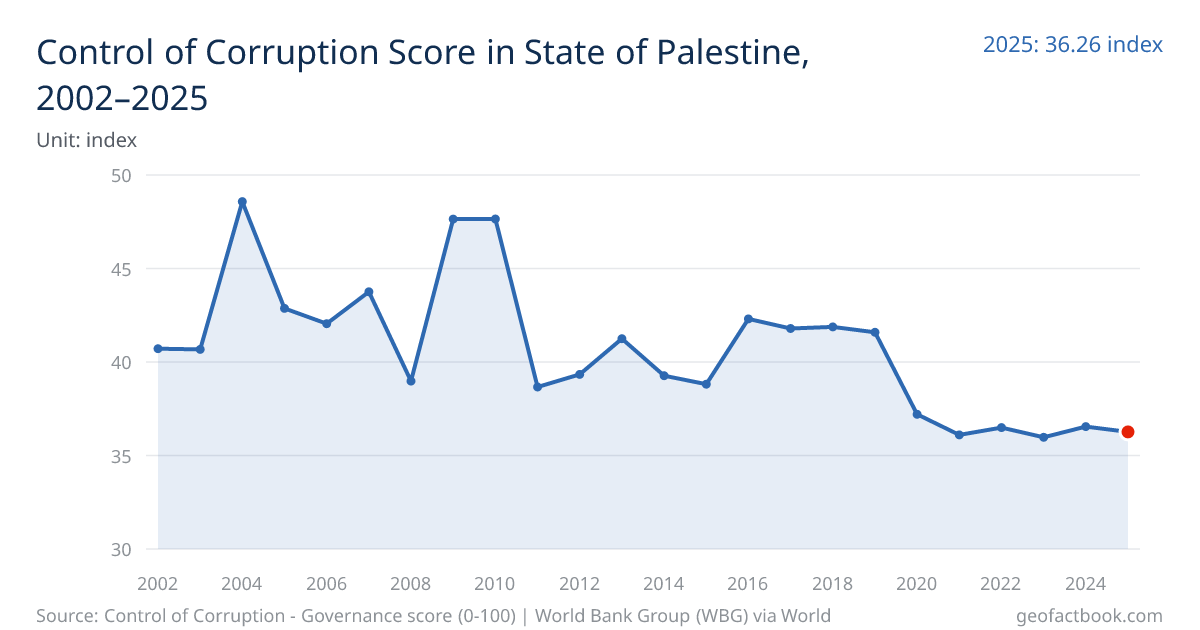
State of Palestine's control of corruption score in 2025 is 36.26 index, down 0.8% from 2024. It ranks #141 of 207 countries.
Control of Corruption score measures governance quality and public sector transparency across countries.
Source (2025): Control of Corruption score
Where State of Palestine ranks (2025)
#141 of 207- #139
 Belarus36.5 index
- #140
 Philippines36.47 index
- #141
 State of Palestine36.26 index
- #142
 Serbia35.9 index
- #143
 Malawi34.69 index
Control of Corruption Score over time
| Year | Value | Change | % Change | Actions |
|---|---|---|---|---|
| 2025 | 36.26 index | 0.28 index | -0.78% | |
| 2024 | 36.55 index | +0.58 index | +1.60% | |
| 2023 | 35.97 index | 0.52 index | -1.43% | |
| 2022 | 36.49 index | +0.39 index | +1.08% | |
| 2021 | 36.1 index | 1.1 index | -2.95% | |
| 2020 | 37.2 index | 4.39 index | -10.55% | |
| 2019 | 41.59 index | 0.29 index | -0.69% | |
| 2018 | 41.88 index | +0.08 index | +0.20% | |
| 2017 | 41.79 index | 0.51 index | -1.21% | |
| 2016 | 42.31 index | +3.49 index | +8.99% | |
| 2015 | 38.82 index | 0.45 index | -1.15% | |
| 2014 | 39.27 index | 1.98 index | -4.80% | |
| 2013 | 41.25 index | +1.91 index | +4.86% | |
| 2012 | 39.34 index | +0.68 index | +1.75% | |
| 2011 | 38.66 index | 8.99 index | -18.86% | |
| 2010 | 47.65 index | +0.01 index | +0.01% | |
| 2009 | 47.64 index | +8.66 index | +22.23% | |
| 2008 | 38.98 index | 4.77 index | -10.91% | |
| 2007 | 43.75 index | +1.7 index | +4.05% | |
| 2006 | 42.05 index | 0.82 index | -1.91% | |
| 2005 | 42.87 index | 5.71 index | -11.76% | |
| 2004 | 48.58 index | +7.9 index | +19.43% | |
| 2003 | 40.67 index | 0.04 index | -0.09% | |
| 2002 | 40.71 index | — | — |
Control of Corruption Score in State of Palestine, 2002–2025: chart
Cite this page
Geo Factbook. (n.d.). State of Palestine: Control of Corruption Score. Retrieved November 26, 2026, from https://geofactbook.com/countries/state-of-palestine/control-of-corruption-score
The figures on this page come from Control of Corruption - Governance score (0-100) | World Bank Group (WBG) via World Bank. For academic work, cite the original source as well.
Frequently Asked Questions About State of Palestine Control of Corruption Score
What is State of Palestine's control of corruption score in 2025?▾
State of Palestine's control of corruption score is 36.26 index in 2025, according to Control of Corruption - Governance score (0-100) | World Bank Group (WBG) via World Bank.
Is State of Palestine's control of corruption score increasing or decreasing?▾
State of Palestine's control of corruption score fell by 0.8% from 2024 (36.55 index) to 2025 (36.26 index). Over the past decade (2015–2025) it fell by 6.6%.
How does State of Palestine rank for control of corruption score?▾
In 2025, State of Palestine has the 141st highest control of corruption score out of 207 countries with data.
What was State of Palestine's control of corruption score in 2002?▾
In 2002, State of Palestine's control of corruption score was 40.71 index. By 2025 it fell by 10.9%.
Explore additional statistical insights
Government Effectiveness Index in State of Palestine
Government effectiveness index evaluates the quality of public services and policy implementation efficiency, influencing public trust.
Government Health Spending % of Total Government Expenditure in State of Palestine
This metric shows the proportion of a country's total government budget allocated to health services.
Public Sector Employment Share in State of Palestine
Public sector employment share measures the percentage of a country's workforce employed by the government.
Duration of Compulsory Education in State of Palestine
Duration of compulsory education varies across countries, impacting educational outcomes and workforce readiness.
Deaths in Armed Conflicts in State of Palestine
Deaths in armed conflicts highlight the human cost of wars. Track fatalities in countries with ongoing conflicts.
Total fertility rate in State of Palestine
The total fertility rate measures the average number of children a woman is expected to have during her lifetime, reflecting population growth and demographic trends. Understanding this statistic is crucial for analyzing economic development, healthcare needs, and societal changes across countries.