
South Korea Diabetes Deaths Per 100,000 (Age-Std) 2022: 11.56
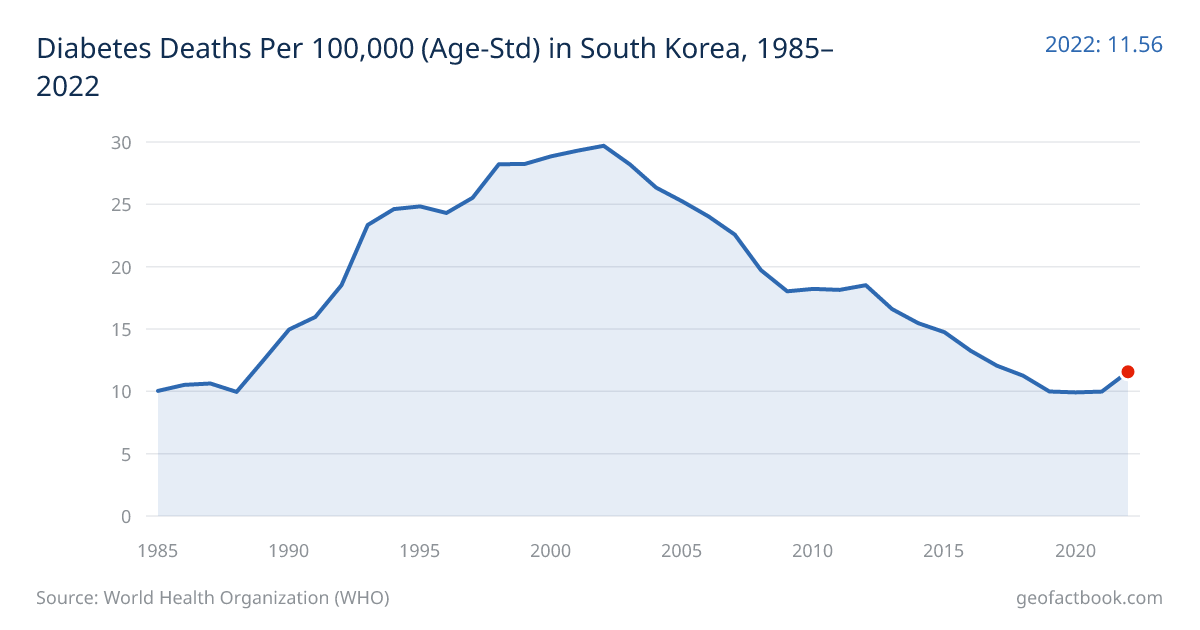
South Korea's diabetes deaths per 100,000 (age-std) in 2022 is 11.56, up 15.9% from 2021. It ranks #43 of 62 countries.
Diabetes deaths per 100,000 people reveal health trends. Compare countries and explore interactive maps for deeper insights.
Where South Korea ranks (2022)
#43 of 62- #41
 Canada13.47
- #42
 Greece11.6
- #43
 South Korea11.56
- #44
 Sweden11.45
- #45
 Lithuania11.1
Diabetes Deaths Per 100,000 (Age-Std) over time
| Year | Value | Change | % Change | Actions |
|---|---|---|---|---|
| 2022 | 11.56 | +1.59 | +15.92% | |
| 2021 | 9.98 | +0.06 | +0.62% | |
| 2020 | 9.92 | 0.07 | -0.71% | |
| 2019 | 9.99 | 1.26 | -11.23% | |
| 2018 | 11.25 | 0.81 | -6.69% | |
| 2017 | 12.06 | 1.2 | -9.03% | |
| 2016 | 13.25 | 1.49 | -10.11% | |
| 2015 | 14.75 | 0.72 | -4.64% | |
| 2014 | 15.46 | 1.13 | -6.83% | |
| 2013 | 16.6 | 1.91 | -10.34% | |
| 2012 | 18.51 | +0.38 | +2.07% | |
| 2011 | 18.13 | 0.08 | -0.46% | |
| 2010 | 18.22 | +0.19 | +1.08% | |
| 2009 | 18.02 | 1.69 | -8.57% | |
| 2008 | 19.71 | 2.86 | -12.65% | |
| 2007 | 22.57 | 1.47 | -6.10% | |
| 2006 | 24.03 | 1.2 | -4.76% | |
| 2005 | 25.23 | 1.11 | -4.20% | |
| 2004 | 26.34 | 1.86 | -6.61% | |
| 2003 | 28.2 | 1.49 | -5.01% | |
| 2002 | 29.69 | +0.39 | +1.33% | |
| 2001 | 29.3 | +0.45 | +1.57% | |
| 2000 | 28.85 | +0.61 | +2.16% | |
| 1999 | 28.24 | +0.03 | +0.11% | |
| 1998 | 28.21 | +2.69 | +10.54% | |
| 1997 | 25.52 | +1.22 | +5.00% | |
| 1996 | 24.31 | 0.53 | -2.13% | |
| 1995 | 24.83 | +0.22 | +0.88% | |
| 1994 | 24.62 | +1.28 | +5.47% | |
| 1993 | 23.34 | +4.83 | +26.08% | |
| 1992 | 18.51 | +2.55 | +16.00% | |
| 1991 | 15.96 | +1 | +6.70% | |
| 1990 | 14.96 | +2.52 | +20.26% | |
| 1989 | 12.44 | +2.48 | +24.91% | |
| 1988 | 9.96 | 0.67 | -6.34% | |
| 1987 | 10.63 | +0.11 | +1.06% | |
| 1986 | 10.52 | +0.49 | +4.87% | |
| 1985 | 10.03 | — | — |
Diabetes Deaths Per 100,000 (Age-Std) in South Korea, 1985–2022: chart
Cite this page
Geo Factbook. (n.d.). South Korea: Diabetes Deaths Per 100,000 (Age-Std). Retrieved November 28, 2026, from https://geofactbook.com/countries/south-korea/deaths-from-diabetes
The figures on this page come from World Health Organization (WHO). For academic work, cite the original source as well.
Frequently Asked Questions About South Korea Diabetes Deaths Per 100,000 (Age-Std)
What is South Korea's diabetes deaths per 100,000 (age-std) in 2022?▾
South Korea's diabetes deaths per 100,000 (age-std) is 11.56 in 2022, according to World Health Organization (WHO).
Is South Korea's diabetes deaths per 100,000 (age-std) increasing or decreasing?▾
South Korea's diabetes deaths per 100,000 (age-std) rose by 15.9% from 2021 (9.98) to 2022 (11.56). Over the past decade (2012–2022) it fell by 37.5%.
How does South Korea rank for diabetes deaths per 100,000 (age-std)?▾
In 2022, South Korea has the 43rd highest diabetes deaths per 100,000 (age-std) out of 62 countries with data.
What was South Korea's diabetes deaths per 100,000 (age-std) in 1985?▾
In 1985, South Korea's diabetes deaths per 100,000 (age-std) was 10.03. By 2022 it rose by 15.3%.
Explore additional statistical insights
Carbon Dioxide Emissions in South Korea
Carbon dioxide emissions reveal environmental impact. Explore rankings, compare countries, and analyze historical trends with interactive maps.
Low Birth Weight Prevalence in South Korea
Low birth weight prevalence shows the percentage of newborns weighing less than 2,500 grams at birth.
Fruit Consumption Per Capita in South Korea
Fruit consumption per capita measures the average fruit intake per person annually, reflecting dietary habits.
Physician Density in South Korea
Physician density measures healthcare access, showing the number of doctors per square kilometer. Compare countries and explore interactive maps.
Women Tobacco Use by Age Group in South Korea
Women tobacco use by age group; compare age-specific smoking and tobacco habits among females globally.
Number of Clinical Trials in South Korea
Explore the number of clinical trials conducted in various countries; critical for medical research and innovation.