
Lithuania Diabetes Deaths Per 100,000 (Age-Std) 2023: 11.16
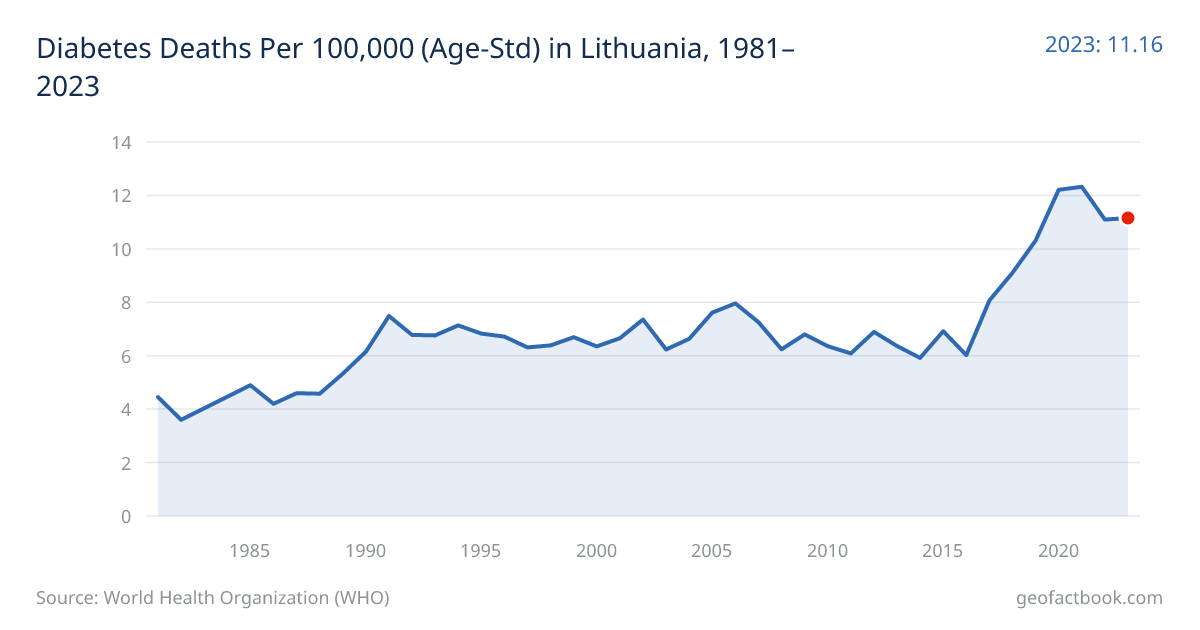
Lithuania's diabetes deaths per 100,000 (age-std) in 2023 is 11.16, up 0.5% from 2022. It ranks #21 of 32 countries.
Diabetes deaths per 100,000 people reveal health trends. Compare countries and explore interactive maps for deeper insights.
Where Lithuania ranks (2023)
#21 of 32- #19
 Latvia13.38
- #20
 Mongolia11.93
- #21
 Lithuania11.16
- #22
 Sweden11.09
- #23
 Spain10.57
Diabetes Deaths Per 100,000 (Age-Std) over time
| Year | Value | Change | % Change | Actions |
|---|---|---|---|---|
| 2023 | 11.16 | +0.06 | +0.53% | |
| 2022 | 11.1 | 1.23 | -9.95% | |
| 2021 | 12.32 | +0.11 | +0.92% | |
| 2020 | 12.21 | +1.9 | +18.43% | |
| 2019 | 10.31 | +1.2 | +13.23% | |
| 2018 | 9.1 | +1.04 | +12.84% | |
| 2017 | 8.07 | +2.05 | +34.00% | |
| 2016 | 6.02 | 0.9 | -12.98% | |
| 2015 | 6.92 | +1 | +16.93% | |
| 2014 | 5.92 | 0.45 | -7.03% | |
| 2013 | 6.37 | 0.53 | -7.63% | |
| 2012 | 6.89 | +0.8 | +13.19% | |
| 2011 | 6.09 | 0.27 | -4.21% | |
| 2010 | 6.36 | 0.44 | -6.49% | |
| 2009 | 6.8 | +0.55 | +8.88% | |
| 2008 | 6.24 | 1.01 | -13.97% | |
| 2007 | 7.26 | 0.7 | -8.85% | |
| 2006 | 7.96 | +0.34 | +4.52% | |
| 2005 | 7.62 | +0.98 | +14.84% | |
| 2004 | 6.63 | +0.4 | +6.37% | |
| 2003 | 6.23 | 1.12 | -15.23% | |
| 2002 | 7.35 | +0.7 | +10.50% | |
| 2001 | 6.66 | +0.31 | +4.86% | |
| 2000 | 6.35 | 0.34 | -5.15% | |
| 1999 | 6.69 | +0.31 | +4.78% | |
| 1998 | 6.39 | +0.07 | +1.18% | |
| 1997 | 6.31 | 0.4 | -6.00% | |
| 1996 | 6.71 | 0.11 | -1.67% | |
| 1995 | 6.83 | 0.31 | -4.31% | |
| 1994 | 7.14 | +0.38 | +5.58% | |
| 1993 | 6.76 | 0.02 | -0.31% | |
| 1992 | 6.78 | 0.71 | -9.46% | |
| 1991 | 7.49 | +1.34 | +21.76% | |
| 1990 | 6.15 | +0.82 | +15.46% | |
| 1989 | 5.33 | +0.75 | +16.40% | |
| 1988 | 4.58 | 0.02 | -0.46% | |
| 1987 | 4.6 | +0.4 | +9.51% | |
| 1986 | 4.2 | 0.7 | -14.23% | |
| 1985 | 4.9 | +1.3 | +35.99% | |
| 1982 | 3.6 | 0.85 | -19.09% | |
| 1981 | 4.45 | — | — |
Diabetes Deaths Per 100,000 (Age-Std) in Lithuania, 1981–2023: chart
Cite this page
Geo Factbook. (n.d.). Lithuania: Diabetes Deaths Per 100,000 (Age-Std). Retrieved November 27, 2026, from https://geofactbook.com/countries/lithuania/deaths-from-diabetes
The figures on this page come from World Health Organization (WHO). For academic work, cite the original source as well.
Frequently Asked Questions About Lithuania Diabetes Deaths Per 100,000 (Age-Std)
What is Lithuania's diabetes deaths per 100,000 (age-std) in 2023?▾
Lithuania's diabetes deaths per 100,000 (age-std) is 11.16 in 2023, according to World Health Organization (WHO).
Is Lithuania's diabetes deaths per 100,000 (age-std) increasing or decreasing?▾
Lithuania's diabetes deaths per 100,000 (age-std) rose by 0.5% from 2022 (11.10) to 2023 (11.16). Over the past decade (2013–2023) it rose by 75.3%.
How does Lithuania rank for diabetes deaths per 100,000 (age-std)?▾
In 2023, Lithuania has the 21st highest diabetes deaths per 100,000 (age-std) out of 32 countries with data.
What was Lithuania's diabetes deaths per 100,000 (age-std) in 1981?▾
In 1981, Lithuania's diabetes deaths per 100,000 (age-std) was 4.45. By 2023 it rose by 150.7%.
Explore additional statistical insights
Nurses and Midwives Density in Lithuania
Nurses and midwives density measures healthcare accessibility. Learn about countries with the highest and lowest density per 1,000 people.
Hospital Bed Density in Lithuania
Hospital Bed Density measures healthcare access per area. Compare countries, explore interactive maps, and view historical trends.
Change in Measles Immunization Rate in Lithuania
Tracks the change in measles immunization rates over time. Positive trends highlight successful vaccination programs.
Maternal Mortality Ratio in Lithuania
Maternal Mortality Ratio (%) measures deaths during childbirth. Compare countries, explore rankings, and view trends with our interactive maps.
Low Birth Weight Prevalence in Lithuania
Low birth weight prevalence shows the percentage of newborns weighing less than 2,500 grams at birth.
Average BMI (Adult Men) in Lithuania
The average BMI for adults provides insight into a country's health trends, highlighting potential obesity issues.