
Solomon Islands Rule of Law Index by Country 2026: 34.40 %
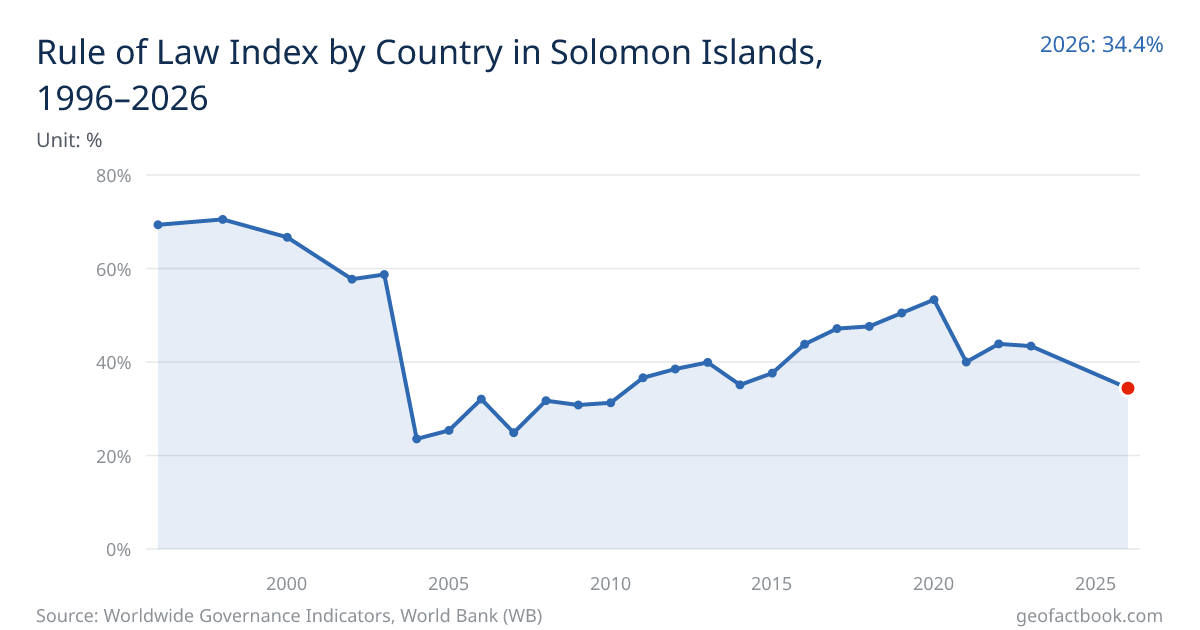
Solomon Islands's rule of law index by country in 2026 is 34.40 % (estimate), down 20.7% from 2023. It ranks #140 of 209 countries.
Compare countries by Rule of Law percentile rank, reflecting confidence in laws, courts, police, property rights, and protection from crime and violence.
Estimated value for 2026 (interpolated, no direct source).
Where Solomon Islands ranks (2026)
#140 of 209- #138
 Bosnia and Herzegovina35.22%
- #139
 Cook Islands35.1%
- #140
 Solomon Islands34.4%
- #141
 Papua New Guinea34.23%
- #142
 Panama33.75%
Rule of Law Index by Country over timeSome values are estimated based on historical trends
| Year | Value | Change | % Change | Actions |
|---|---|---|---|---|
| 2026 | 34.4 % | — | — | |
| 2025 | — | — | — | |
| 2024 | — | — | — | |
| 2023 | 43.4 % | 0.47 % | -1.08% | |
| 2022 | 43.87 % | +3.87 % | +9.67% | |
| 2021 | 40 % | 13.33 % | -25.00% | |
| 2020 | 53.33 % | +2.86 % | +5.66% | |
| 2019 | 50.48 % | +2.86 % | +6.00% | |
| 2018 | 47.62 % | +0.48 % | +1.01% | |
| 2017 | 47.14 % | +3.33 % | +7.61% | |
| 2016 | 43.81 % | +6.19 % | +16.46% | |
| 2015 | 37.62 % | +2.52 % | +7.19% | |
| 2014 | 35.1 % | 4.81 % | -12.05% | |
| 2013 | 39.91 % | +1.41 % | +3.66% | |
| 2012 | 38.5 % | +1.88 % | +5.13% | |
| 2011 | 36.62 % | +5.34 % | +17.07% | |
| 2010 | 31.28 % | +0.47 % | +1.54% | |
| 2009 | 30.81 % | 0.93 % | -2.92% | |
| 2008 | 31.73 % | +6.85 % | +27.53% | |
| 2007 | 24.88 % | 7.18 % | -22.39% | |
| 2006 | 32.06 % | +6.7 % | +26.42% | |
| 2005 | 25.36 % | +1.8 % | +7.65% | |
| 2004 | 23.56 % | 35.15 % | -59.87% | |
| 2003 | 58.71 % | +1 % | +1.72% | |
| 2002 | 57.71 % | — | — | |
| 2001 | — | — | — | |
| 2000 | 66.67 % | — | — | |
| 1999 | — | — | — | |
| 1998 | 70.5 % | — | — | |
| 1997 | — | — | — | |
| 1996 | 69.35 % | — | — |
Rule of Law Index by Country in Solomon Islands, 1996–2026: chart
Cite this page
Geo Factbook. (n.d.). Solomon Islands: Rule of Law Index by Country. Retrieved November 29, 2026, from https://geofactbook.com/countries/solomon-islands/rule-of-law-index-by-country
The figures on this page come from Worldwide Governance Indicators, World Bank (WB). For academic work, cite the original source as well.
Frequently Asked Questions About Solomon Islands Rule of Law Index by Country
What is Solomon Islands's rule of law index by country in 2026?▾
Solomon Islands's rule of law index by country is 34.40 % in 2026 (estimate), according to Worldwide Governance Indicators, World Bank (WB).
Is Solomon Islands's rule of law index by country increasing or decreasing?▾
Solomon Islands's rule of law index by country fell by 20.7% from 2023 (43.40 %) to 2026 (34.40 %). Over the past decade (2016–2026) it fell by 21.5%.
How does Solomon Islands rank for rule of law index by country?▾
In 2026, Solomon Islands has the 140th highest rule of law index by country out of 209 countries with data.
What was Solomon Islands's rule of law index by country in 1996?▾
In 1996, Solomon Islands's rule of law index by country was 69.35 %. By 2026 it fell by 50.4%.
Explore additional statistical insights
Share of Women in Ministerial Positions in Solomon Islands
Share of women in ministerial roles shows gender equality in government leadership worldwide.
Control of Corruption Score in Solomon Islands
Control of Corruption score measures governance quality and public sector transparency across countries.
Suffrage Participation Rate in Solomon Islands
Suffrage Participation Rate reflects voter engagement across countries. Compare rates, explore rankings, and visualize trends with interactive maps.
Corruption Perceptions Index in Solomon Islands
Corruption Perceptions Index scores countries based on perceived levels of public sector corruption according to experts and businesspeople.
Education Share of Government Spending in Solomon Islands
Education share of government spending reveals priorities; measures the percentage of national budgets allocated to education.
Government Effectiveness Index in Solomon Islands
Government effectiveness index evaluates the quality of public services and policy implementation efficiency, influencing public trust.