
Saudi Arabia Total Armed Forces Personnel (PPP) 2020: 282,000
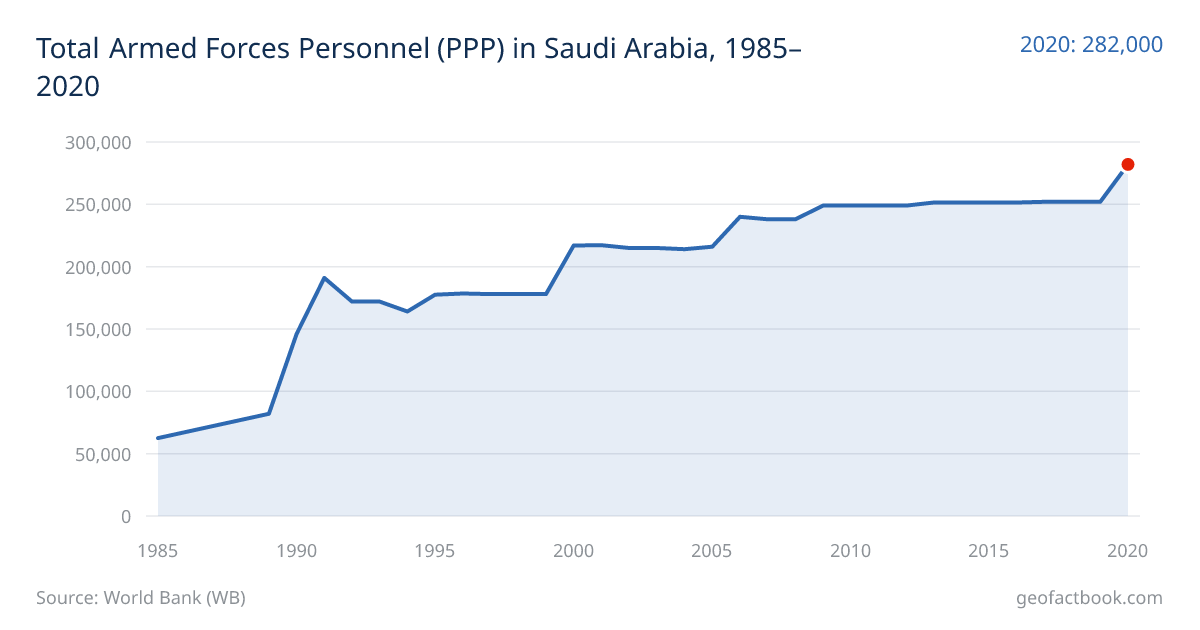
Saudi Arabia's total armed forces personnel (ppp) in 2020 is 282,000, up 11.9% from 2019. It ranks #25 of 170 countries.
Explore total armed forces personnel across 266+ countries. Compare military size, view rankings, and analyze historical trends on our interactive map.
Where Saudi Arabia ranks (2020)
#25 of 170- #23
 France304,000
- #24
 Ukraine298,000
- #25
 Saudi Arabia282,000
- #26
 Syrian Arab Republic269,000
- #27
 Japan261,000
Total Armed Forces Personnel (PPP) over time
| Year | Value | Change | % Change | Actions |
|---|---|---|---|---|
| 2020 | 282.00K | +30.00K | +11.90% | |
| 2019 | 252.00K | 0 | 0.00% | |
| 2018 | 252.00K | 0 | 0.00% | |
| 2017 | 252.00K | +500 | +0.20% | |
| 2016 | 251.50K | 0 | 0.00% | |
| 2015 | 251.50K | 0 | 0.00% | |
| 2014 | 251.50K | 0 | 0.00% | |
| 2013 | 251.50K | +2.50K | +1.00% | |
| 2012 | 249.00K | 0 | 0.00% | |
| 2011 | 249.00K | 0 | 0.00% | |
| 2010 | 249.00K | 0 | 0.00% | |
| 2009 | 249.00K | +11.00K | +4.62% | |
| 2008 | 238.00K | 0 | 0.00% | |
| 2007 | 238.00K | 2.00K | -0.83% | |
| 2006 | 240.00K | +24.00K | +11.11% | |
| 2005 | 216.00K | +2.00K | +0.93% | |
| 2004 | 214.00K | 1.00K | -0.47% | |
| 2003 | 215.00K | 0 | 0.00% | |
| 2002 | 215.00K | 2.20K | -1.01% | |
| 2001 | 217.20K | +200 | +0.09% | |
| 2000 | 217.00K | +39.00K | +21.91% | |
| 1999 | 178.00K | 0 | 0.00% | |
| 1998 | 178.00K | 0 | 0.00% | |
| 1997 | 178.00K | 500 | -0.28% | |
| 1996 | 178.50K | +1.00K | +0.56% | |
| 1995 | 177.50K | +13.50K | +8.23% | |
| 1994 | 164.00K | 8.00K | -4.65% | |
| 1993 | 172.00K | 0 | 0.00% | |
| 1992 | 172.00K | 19.00K | -9.95% | |
| 1991 | 191.00K | +45.00K | +30.82% | |
| 1990 | 146.00K | +64.00K | +78.05% | |
| 1989 | 82.00K | +19.50K | +31.20% | |
| 1985 | 62.50K | — | — |
Total Armed Forces Personnel (PPP) in Saudi Arabia, 1985–2020: chart
Cite this page
Geo Factbook. (n.d.). Saudi Arabia: Total Armed Forces Personnel (PPP). Retrieved November 29, 2026, from https://geofactbook.com/countries/saudi-arabia/armed-forces-personnel-total
The figures on this page come from World Bank (WB). For academic work, cite the original source as well.
Frequently Asked Questions About Saudi Arabia Total Armed Forces Personnel (PPP)
What is Saudi Arabia's total armed forces personnel (ppp) in 2020?▾
Saudi Arabia's total armed forces personnel (ppp) is 282,000 in 2020, according to World Bank (WB).
Is Saudi Arabia's total armed forces personnel (ppp) increasing or decreasing?▾
Saudi Arabia's total armed forces personnel (ppp) rose by 11.9% from 2019 (252,000) to 2020 (282,000). Over the past decade (2010–2020) it rose by 13.3%.
How does Saudi Arabia rank for total armed forces personnel (ppp)?▾
In 2020, Saudi Arabia has the 25th highest total armed forces personnel (ppp) out of 170 countries with data.
What was Saudi Arabia's total armed forces personnel (ppp) in 1985?▾
In 1985, Saudi Arabia's total armed forces personnel (ppp) was 62,500. By 2020 it rose by 351.2%.
Explore additional statistical insights
Military Expenditures (% of GDP) in Saudi Arabia
Military Expenditures as a percentage of GDP highlights national defense spending. Compare countries, explore rankings, and view trends.
Military Service Age and Obligation in Saudi Arabia
Military service age and obligation details for 266+ countries. Compare requirements, explore rankings, and view interactive maps.
Protected Land Area Percentage in Saudi Arabia
Protected land area percentage shows the share of a country's land dedicated to conservation and biodiversity.
Bank Account Ownership Rate in Saudi Arabia
Bank account ownership rate indicates financial inclusion levels among adults globally, highlighting economic access.
Refined Petroleum Products Exports in Saudi Arabia
Refined petroleum products exports reflect a country's economic strength. Compare nations, explore rankings, and view interactive maps.
AI Preparedness Index in Saudi Arabia
The IMF's AI Preparedness Index scores how ready a country is to adopt artificial intelligence, on a scale from 0 to 1 (higher is better prepared). It combines four areas: digital infrastructure, human capital and labour market policies, innovation and economic integration, and regulation and ethics. It measures readiness, not how many jobs AI has replaced or could affect.