
Russia Population 2026: 143.17 Million
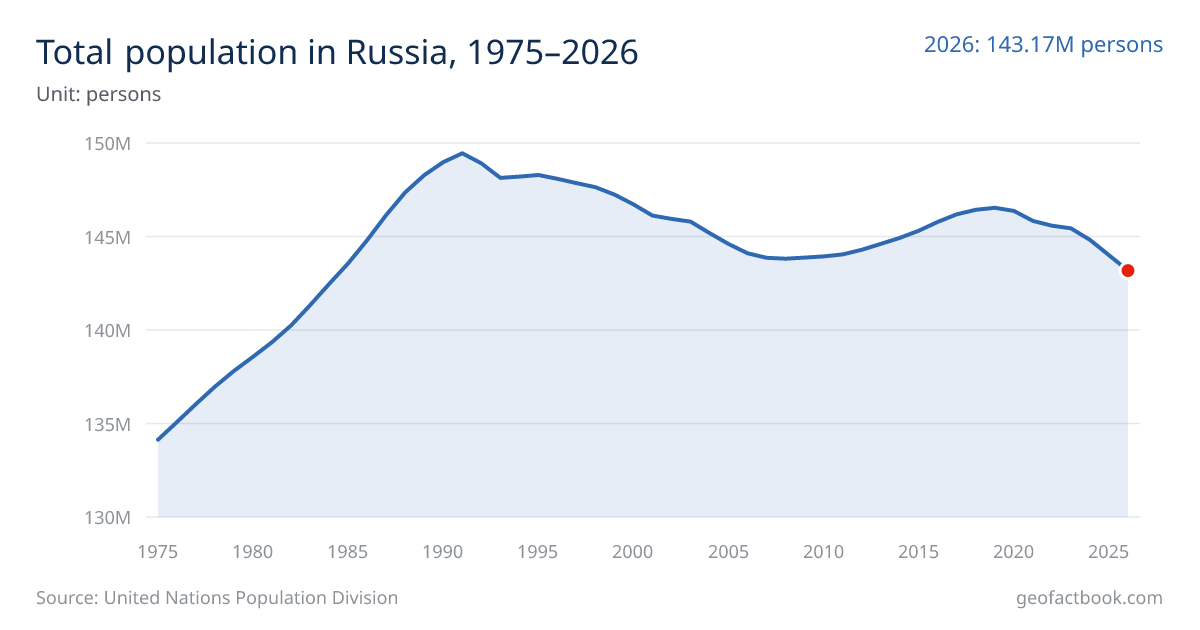
The population of Russia in 2026 is 143,174,363 people (estimate), down 0.6% from 2025. It is the 9th most populous of 236 countries.
Discover the latest total population statistics for every country and region worldwide. Explore accurate, up-to-date data on global population growth, density, and demographic trends — sourced from trusted international databases like the UN and World Bank. Perfect for researchers, students, and data enthusiasts looking to understand how the world’s population is changing.
Estimated value for 2026 (interpolated, no direct source).
Where Russia ranks (2026)
#9 of 236- #7
 Brazil213.63M persons
- #8
 Bangladesh177.81M persons
- #9
 Russia143.17M persons
- #10
 Ethiopia138.88M persons
- #11
 Mexico133.03M persons
Total population over timeSome values are estimated based on historical trends
| Year | Value | Change | % Change | Actions |
|---|---|---|---|---|
| 2026 | 143.17M persons | 823.03K persons | -0.57% | |
| 2025 | 144.00M persons | 823.03K persons | -0.57% | |
| 2024 | 144.82M persons | 620.08K persons | -0.43% | |
| 2023 | 145.44M persons | 139.40K persons | -0.10% | |
| 2022 | 145.58M persons | 256.28K persons | -0.18% | |
| 2021 | 145.84M persons | 535.12K persons | -0.37% | |
| 2020 | 146.37M persons | 161.77K persons | -0.11% | |
| 2019 | 146.53M persons | +102.92K persons | +0.07% | |
| 2018 | 146.43M persons | +243.35K persons | +0.17% | |
| 2017 | 146.19M persons | +408.12K persons | +0.28% | |
| 2016 | 145.78M persons | +471.06K persons | +0.32% | |
| 2015 | 145.31M persons | +381.98K persons | +0.26% | |
| 2014 | 144.93M persons | +321.54K persons | +0.22% | |
| 2013 | 144.60M persons | +313.07K persons | +0.22% | |
| 2012 | 144.29M persons | +247.28K persons | +0.17% | |
| 2011 | 144.04M persons | +109.28K persons | +0.08% | |
| 2010 | 143.93M persons | +65.33K persons | +0.05% | |
| 2009 | 143.87M persons | +57.29K persons | +0.04% | |
| 2008 | 143.81M persons | 47.92K persons | -0.03% | |
| 2007 | 143.86M persons | 243.18K persons | -0.17% | |
| 2006 | 144.10M persons | 494.94K persons | -0.34% | |
| 2005 | 144.60M persons | 582.21K persons | -0.40% | |
| 2004 | 145.18M persons | 614.13K persons | -0.42% | |
| 2003 | 145.79M persons | 145.27K persons | -0.10% | |
| 2002 | 145.94M persons | 177.78K persons | -0.12% | |
| 2001 | 146.12M persons | 600.50K persons | -0.41% | |
| 2000 | 146.72M persons | 524.19K persons | -0.36% | |
| 1999 | 147.24M persons | 393.56K persons | -0.27% | |
| 1998 | 147.64M persons | 218.24K persons | -0.15% | |
| 1997 | 147.85M persons | 230.81K persons | -0.16% | |
| 1996 | 148.08M persons | 206.82K persons | -0.14% | |
| 1995 | 148.29M persons | +90.67K persons | +0.06% | |
| 1994 | 148.20M persons | +65.31K persons | +0.04% | |
| 1993 | 148.14M persons | 780.57K persons | -0.52% | |
| 1992 | 148.92M persons | 532.44K persons | -0.36% | |
| 1991 | 149.45M persons | +468.89K persons | +0.31% | |
| 1990 | 148.98M persons | +697.67K persons | +0.47% | |
| 1989 | 148.28M persons | +917.38K persons | +0.62% | |
| 1988 | 147.36M persons | +1.22M persons | +0.83% | |
| 1987 | 146.15M persons | +1.34M persons | +0.93% | |
| 1986 | 144.81M persons | +1.24M persons | +0.86% | |
| 1985 | 143.57M persons | +1.11M persons | +0.78% | |
| 1984 | 142.46M persons | +1.13M persons | +0.80% | |
| 1983 | 141.33M persons | +1.08M persons | +0.77% | |
| 1982 | 140.25M persons | +896.25K persons | +0.64% | |
| 1981 | 139.35M persons | +778.88K persons | +0.56% | |
| 1980 | 138.57M persons | +756.08K persons | +0.55% | |
| 1979 | 137.82M persons | +837.45K persons | +0.61% | |
| 1978 | 136.98M persons | +938.11K persons | +0.69% | |
| 1977 | 136.04M persons | +960.28K persons | +0.71% | |
| 1976 | 135.08M persons | +944.59K persons | +0.70% | |
| 1975 | 134.14M persons | — | — |
Total population in Russia, 1975–2026: chart
Cite this page
Geo Factbook. (n.d.). Russia: Total population. Retrieved November 27, 2026, from https://geofactbook.com/countries/russia/total-population
The figures on this page come from UNdata. For academic work, cite the original source as well.
Frequently Asked Questions About Russia Population
What is the population of Russia in 2026?▾
Russia has a population of 143,174,363 people in 2026 (estimate), according to United Nations Population Division.
Is the population of Russia growing?▾
Russia's population fell by 0.6% from 2025 (144 Million) to 2026 (143.17 Million). Over the past decade (2016–2026) it fell by 1.8%.
How does Russia rank by population?▾
In 2026, Russia is the 9th most populous country out of 236 countries with data.
What was the population of Russia in 1975?▾
In 1975, Russia's population was 134,136,098 people. By 2026 it rose by 6.7%.
Explore additional statistical insights
Total demand for family planning (Percent) in Russia
Total demand for family planning measures the percentage of individuals seeking access to reproductive health services. Understanding this statistic is crucial for addressing global population growth and improving health outcomes.
Physician Density in Russia
Physician density measures healthcare access, showing the number of doctors per square kilometer. Compare countries and explore interactive maps.
Primary School Pupil-Teacher Ratio in Russia
Pupil-teacher ratio in primary schools reflects educational quality; lower ratios indicate more personalized attention.
Currently married (Percent) in Russia
The percentage of currently married individuals by country highlights societal trends in family structure and relationships. Understanding these statistics can provide insights into cultural norms and demographic shifts, influencing policies and social programs.
Egg Consumption per Capita in Russia
Egg consumption per capita measures the average number of eggs consumed annually by individuals in a country.
Under-five mortality rate in Russia
The under-five mortality rate measures the number of deaths per 1,000 live births for children under five. This critical statistic highlights child health and development, reflecting a country's healthcare quality and socioeconomic conditions. Understanding these rates is vital for improving global health initiatives.